

01 · Deal Intelligence
| Date | 4 Aug 2026 |
|---|---|
| Buyer | Bending Spoons (BSP) |
| Target | Airtable |
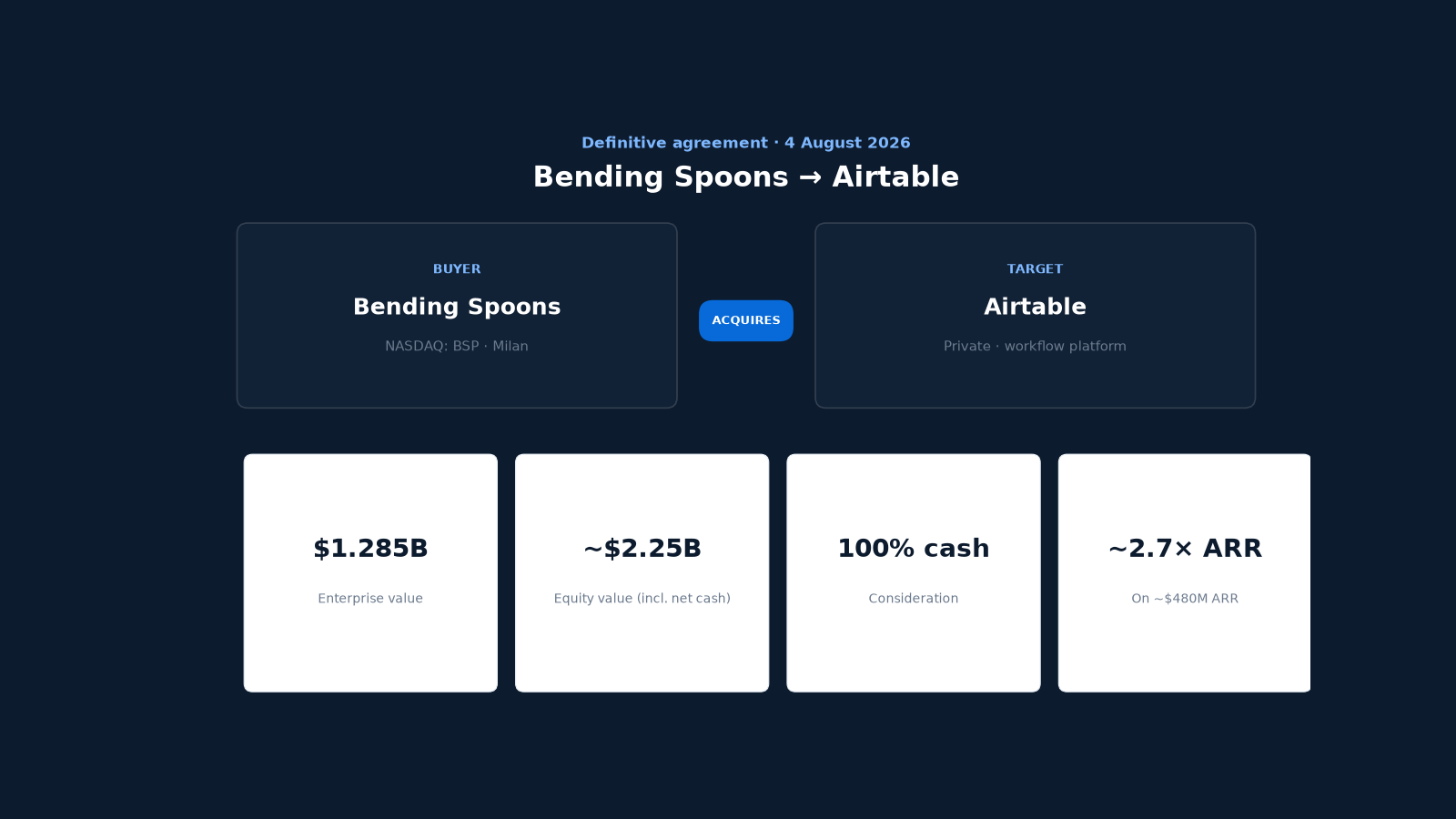
| Deal value | $1.285B EV |
| Equity | ~$2.25B |
| Structure | 100% cash |
| BSP | $41.49 +7.07% |
| EV / ARR | ~2.7× |
Acquiry Deal Intelligence · 4 August 2026
The transaction brings one of no-code's most iconic brands under a serial acquirer that has spent a decade buying, transforming, and compounding digital businesses, and signals how platform roll-ups are pricing AI-native workflow software in 2026.
Thirty-three days after Bending Spoons listed on Nasdaq, Luca Ferrari signed a $1.285 billion all-cash agreement for Airtable, no earn-out, unanimous boards on both sides, and the roll-up's clearest signal yet that enterprise workflow is the next act after consumer apps.
What follows: the announcement in full, how the price compares to Airtable's 2021 peak, why a consumer-app roll-up wanted a Fortune 100 workflow platform, and what it means if you are building or selling in SaaS.
01
02 · Deal Intelligence
What happened
On 4 August 2026, Bending Spoons S.p.A. (NASDAQ: BSP) signed a definitive agreement to acquire 100% of Airtable, the connected-work platform used by more than half a million organisations worldwide. Enterprise value is $1.285 billion. Including Airtable's net cash, equity value is approximately $2.25 billion. Consideration is all cash; no stock component or earn-out was disclosed.
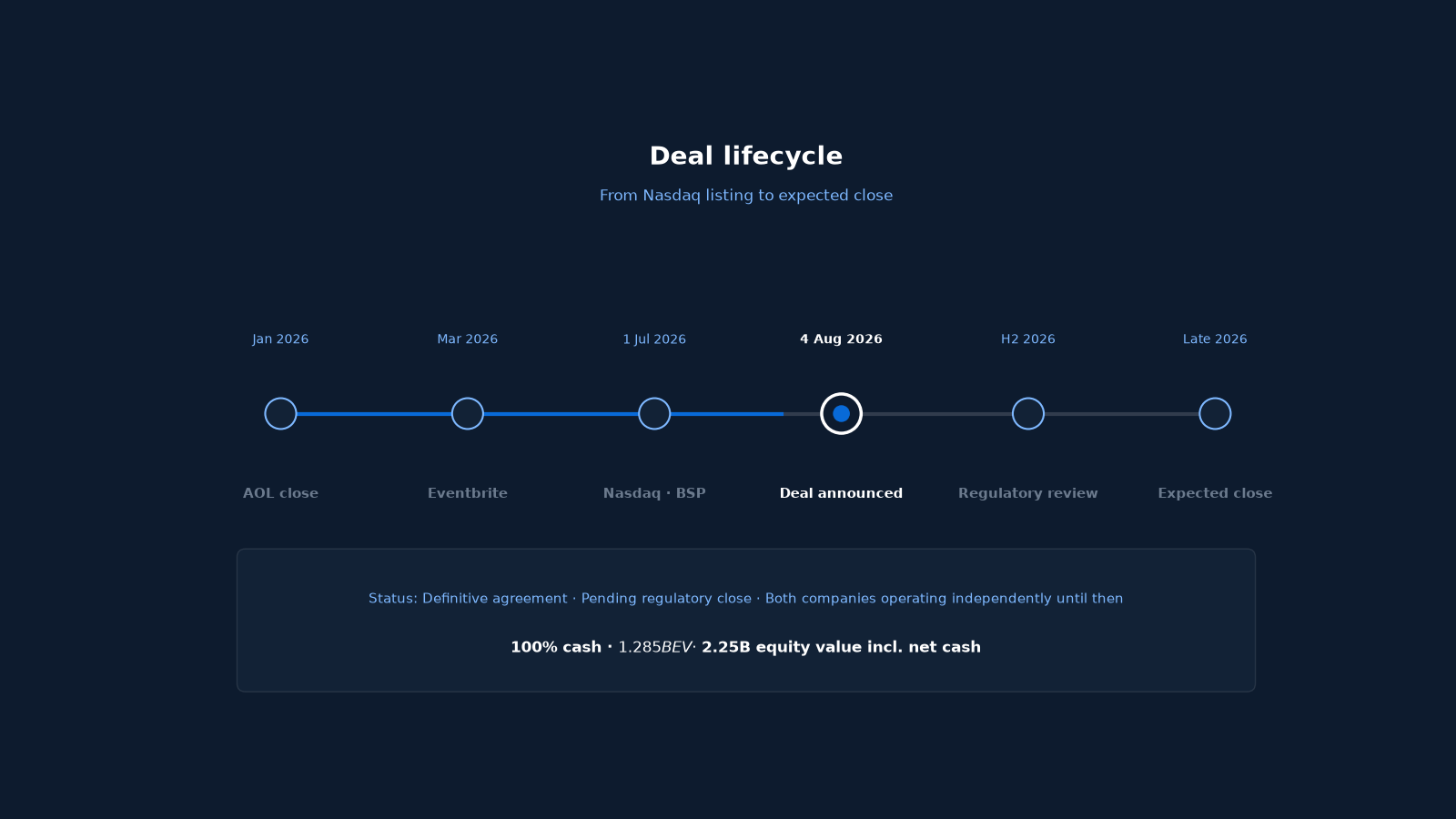
Closing is expected later in 2026, subject to regulatory approvals and customary conditions. Until then, both companies continue to operate independently.
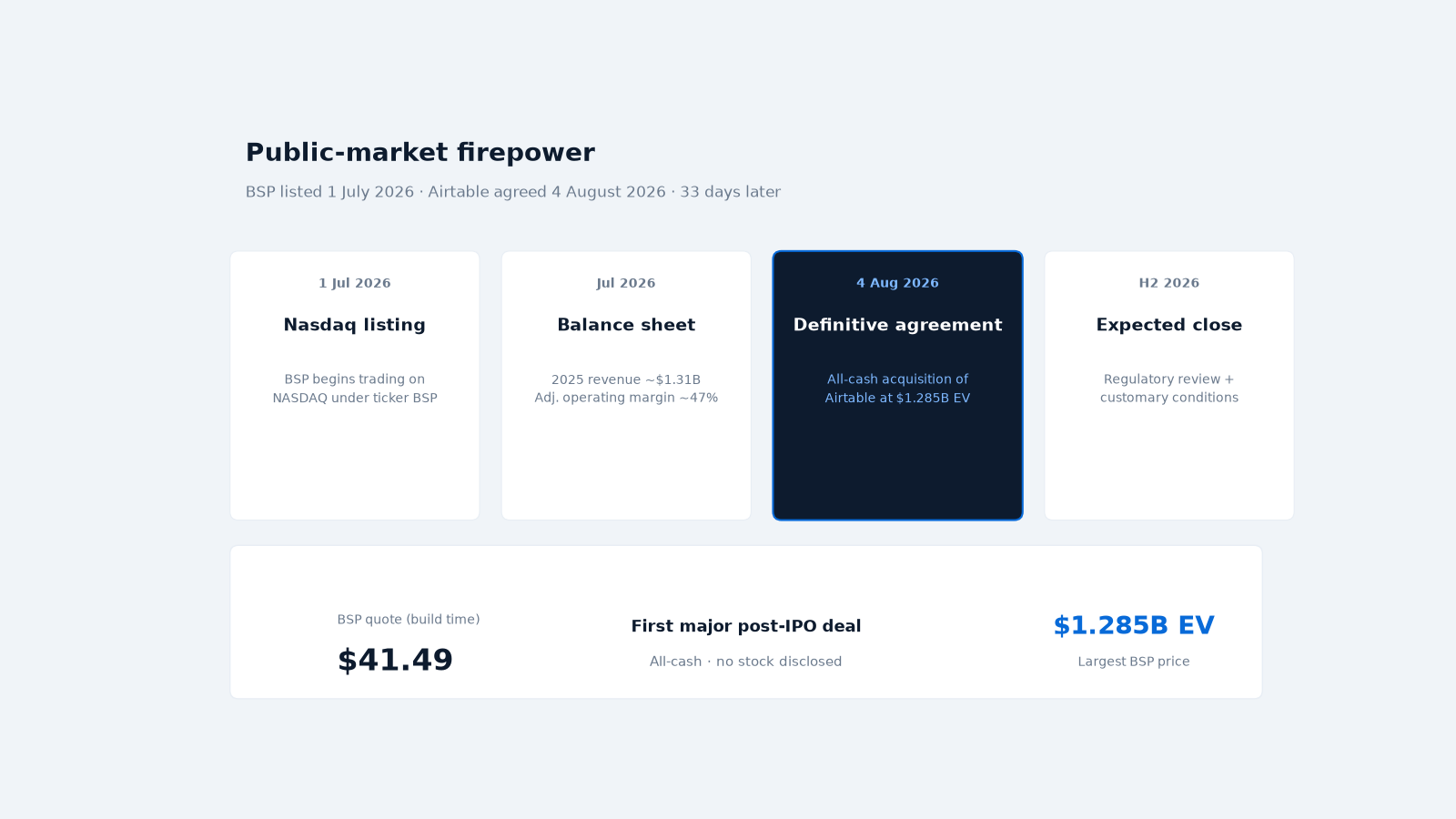
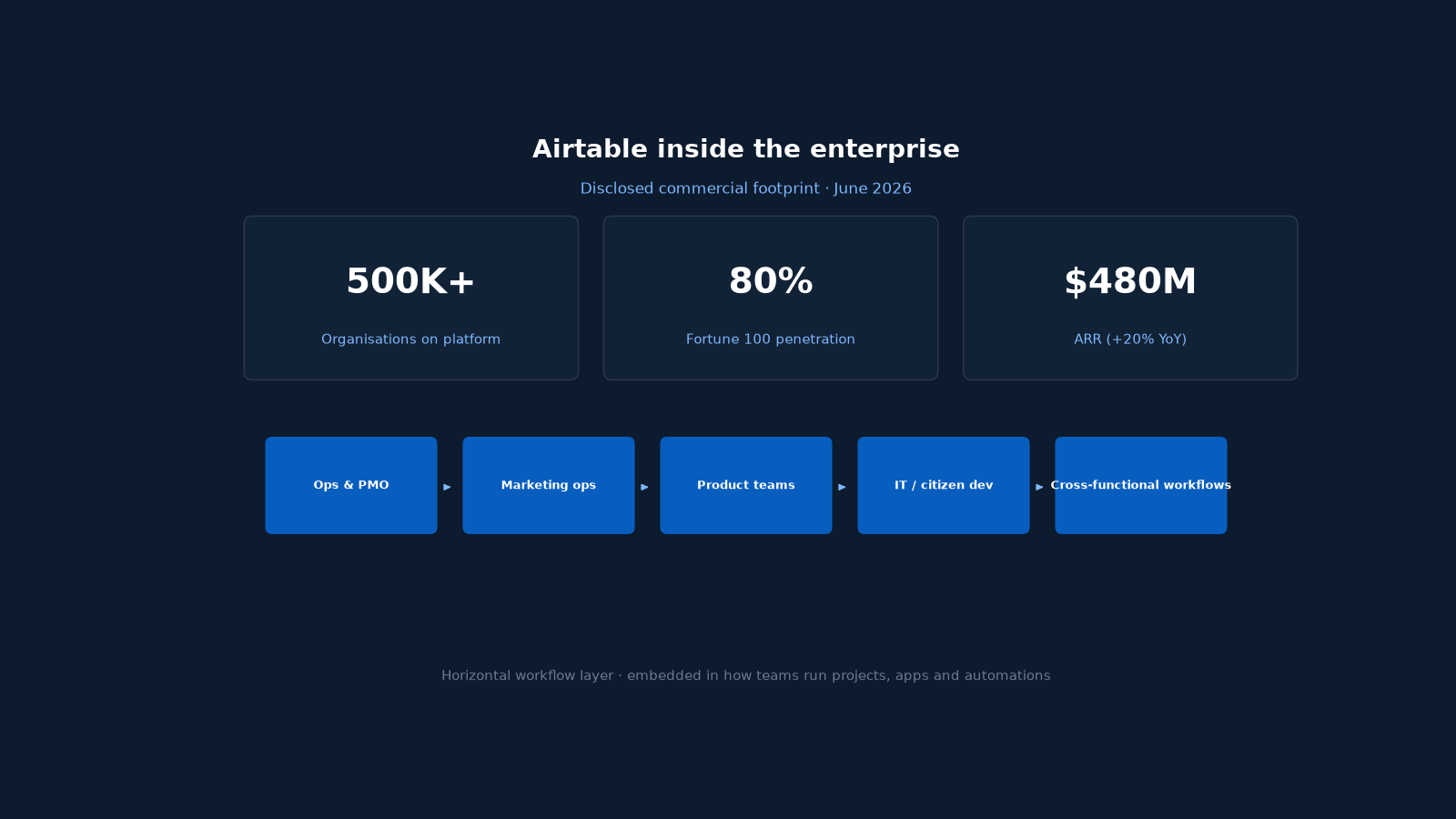
Bending Spoons listed on Nasdaq on 1 July 2026 and had already closed AOL (January 2026) and Eventbrite (March 2026). Airtable is the roll-up's first major enterprise-workflow asset and its largest disclosed price tag to date: roughly 2.7× ARR on ~$480M of recurring revenue growing more than 20% year on year as of June 2026, with penetration across roughly 80% of the Fortune 100.
Howie Liu, Airtable's co-founder and CEO, will join Bending Spoons' board after close. Liu said the combination gives Airtable "the resources and the long-term commitment" to pursue an AI-native platform vision; Bending Spoons CEO Luca Ferrari committed to "investing in Airtable for the long run." Retention pools, management rollover, and working-capital adjustments were not published in the release. Expect fuller detail in proxy and regulatory filings as closing approaches.
02
03 · Deal Intelligence
The terms
Enterprise value and equity value are not interchangeable in this announcement, and the distinction matters for how readers interpret the headline multiple. Enterprise value of $1.285 billion is the transaction benchmark cited in the release; equity value of roughly $2.25 billion reflects Airtable's net cash position on the balance sheet. For public-market comparables, EV/ARR is the cleaner lens; for shareholders dividing proceeds, equity value is the relevant figure once debt, cash, and transaction mechanics are applied.
The joint announcement discloses enterprise value and structure but does not break out earnouts, retention pools, or working-capital adjustments, common for private-company exits where the buyer controls the narrative ahead of public-company reporting. What we know from primary sources:
- Consideration100% cash for all issued and outstanding shares
- Enterprise value$1.285 billion
- Implied equity value~$2.25 billion including net cash
- GovernanceUnanimous board approval on both sides
- TimingExpected close later in 2026, regulatory approvals pending
| Transaction terms · Disclosed 4 Aug 2026 | $1.285B all-cash at ~2.7× ARR |
|---|---|
| Definitive agreement | Pending close |
Enterprise value $1.285B
Equity value ~$2.25B incl. net cash
Airtable ARR ~$480M +20% YoY · Jun 2026
EV / ARR ~2.7×
Consideration 100% cash
Consideration structure
- All-cash for 100% of equity
- Unanimous board approval (both sides)
- No stock component disclosed
- No earn-out disclosed
First major acquisition since Nasdaq listing (1 Jul 2026).
Valuation bridge
| Enterprise value | $1.285B |
|---|---|
| Net cash at target | ~$965M |
| Equity value | ~$2.25B |
$1.285B ÷ ~$480M ARR = ~2.7×
Sector · Enterprise SaaS / connected workAdvisors · J.P. Morgan (buyer) · Latham & Watkins (target)Primary release ↗ (opens in a new tab)
04 · Deal Intelligence
Valuation waterfall
From 2021 private peak to the 2026 definitive agreement
Legal and financial advisors named in the release include Willkie Farr & Gallagher and EY Advisory for Bending Spoons (with Goldman Sachs Bank Europe SE, Succursale Italia, and J.P. Morgan as co-financial advisors), and Latham & Watkins plus AXOM Partners for Airtable. For sellers benchmarking process quality, the advisor roster signals a full auction-class preparation on the target side despite the strategic nature of the buyer.
Valuation math will interest founders and investors alike. At ~$480M ARR, the disclosed EV implies roughly 2.7× ARR on headline recurring revenue, a multiple that reflects both Airtable's brand strength and the discount from peak private-markets pricing in 2021, when the company commanded an $11B+ private valuation. For Acquiry's SaaS M&A clients, the lesson is not to anchor on vintage rounds but on current growth, retention, and strategic fit. Buyers in 2026 are underwriting operational improvement and AI-native product depth, not peak-cycle growth narratives alone.
03
05 · Deal Intelligence
Why Bending Spoons bought Airtable
The buyer's M&A history is instructive. Since 2013, Bending Spoons has acquired dozens of digital products, including Evernote, Vimeo, WeTransfer, and more recently AOL and Eventbrite, and applied a consistent post-acquisition playbook: simplify pricing, sharpen product focus, improve unit economics, and reinvest cash flow into further deals. Airtable is larger and more enterprise-facing than most prior targets, which makes integration complexity higher but also makes the strategic prize more durable.
Bending Spoons has a stated playbook: acquire digital businesses, implement deep operational transformation, and reinvest cash flows into further acquisitions. The company reports it has "never sold a material business" and emphasizes AI as both product vision and transformation tool. Airtable fits that thesis because it sits at the intersection of no-code, workflow orchestration, and enterprise AI adoption, categories where product velocity and go-to-market efficiency determine winners.
“Airtable is growing over 20% year-on-year to approximately $480 million of annual recurring revenue… we are investing in Airtable for the long run.”
Strategically, Airtable gives Bending Spoons a B2B anchor alongside consumer-leaning brands such as Remini, StreamYard, and Vimeo. Enterprise buyers running product operations, marketing operations, and cross-functional programs on Airtable represent high lifetime value and deep switching costs once workflows, automations, and integrations are embedded. That profile complements Eventbrite's organizer ecosystem and AOL's media footprint without duplicating them.
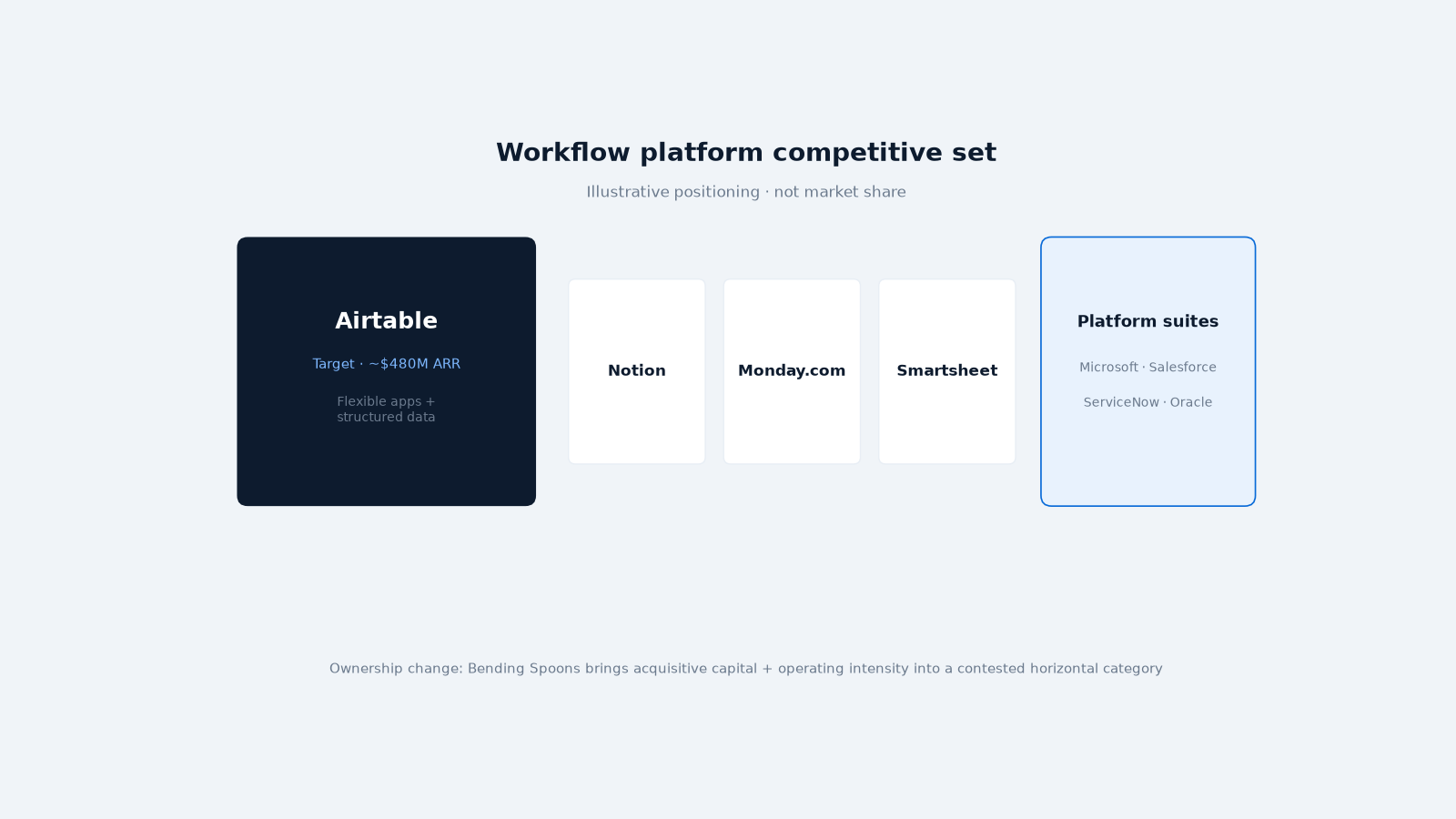
Competitively, the deal lands as platform vendors race to own "connected work." Microsoft, Salesforce, ServiceNow, and Notion-class challengers all argue that spreadsheets-plus-databases-plus-AI agents belong inside the core stack, not as sidecar tools. Airtable's answer has been flexible apps built by business users; Bending Spoons' answer is operational leverage applied to whatever product wins distribution.
For founders building in adjacent spaces, workflow automation, vertical no-code, AI agents on structured data, the transaction reinforces that category leaders with enterprise logos remain acquirable even when public multiples compress. Buyers are paying for distribution and product depth, not slide-deck AI demos. In the same August 2026 window, Dynatrace agreed to acquire Arize for approximately $915 million, another data point on how observability and AI evaluation assets are priced alongside workflow platforms.
Integration risk is real at this scale. Airtable's enterprise base expects SOC 2-grade reliability, granular permissions, and a roadmap that does not stall during ownership transition. Bending Spoons' prior acquisitions skewed toward consumer and prosumer products with faster pricing resets and smaller engineering orgs. Airtable brings a deeper services motion, solution consultants, and partner ecosystems that do not map one-to-one onto the Vimeo or Evernote playbooks. The acquirer's public commitment to long-run investment is the right signal for customers; the operational test will be whether enterprise NRR and expansion ARR accelerate or flatten in the first four quarters after close.
Financing structure matters for founders benchmarking buyer capacity. An all-cash headline at $1.285 billion enterprise value implies balance-sheet deployment rather than stock-for-stock dilution, consistent with a newly listed acquirer that wants to signal conviction without asking public shareholders to underwrite target-company risk on day one. If leverage or bridge facilities appear in subsequent SEC filings, integration spend and interest coverage will become part of the BSP equity story alongside Airtable's growth trajectory.
Strategic rationale at a glance
| 01 | Enterprise workflow | First major B2B platform asset in the BSP portfolio. |
|---|---|---|
| 02 | Monetisation | Roll-up playbook: pricing, packaging and margin expansion. |
| 03 | AI-native platform | Long-horizon capital for connected-work and automation. |
| 04 | Distribution | Cross-sell across 500k+ organisations and Fortune 100 penetration. |
| 05 | Public firepower | All-cash from balance sheet, no stock component disclosed. |
| 06 | Regulatory path | Cross-border close expected H2 2026; both cos. independent until then. |
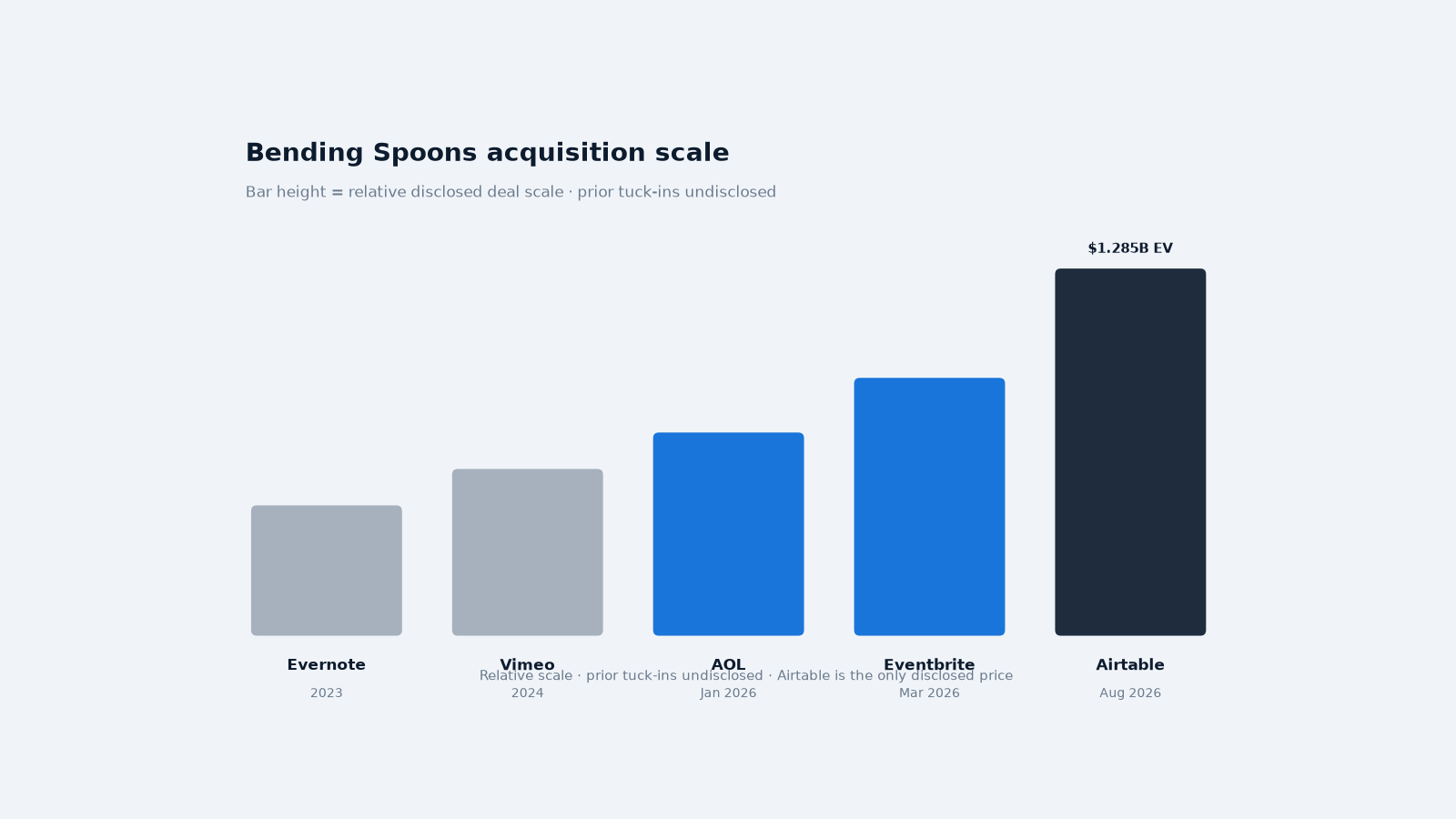
Bending Spoons acquisition cadence
Selected deals, 2023–2026. Only Airtable has a disclosed price.
- 1.2023 Evernote Undisclosed Closed
- 2.2024 Vimeo Undisclosed Closed
- 3.Jan 2026 AOL Undisclosed Closed
- 4.Mar 2026 Eventbrite Undisclosed Closed
- 5.Aug 2026 Airtable $1.285B EV Pending close
04
06 · Deal Intelligence
Market implications
The transaction re-frames competitive dynamics in connected-work software. Platform suites will market integrated AI agents; point vendors will argue flexibility and time-to-value; roll-ups will argue operational transformation plus capital depth. Airtable under Bending Spoons will be judged on whether enterprise NRR, expansion ARR, and AI-in-production velocity improve, not on whether the brand survives on a slide.
The August 2026 window for software M&A is unusually active. Alongside Bending Spoons, Airtable, buyers have announced platform-scale deals and mid-market tuck-ins in parallel, a pattern Acquiry tracks across Deal Intelligence and our SaaS M&A hub. For workflow and no-code categories specifically, the message is that enterprise penetration and recurring revenue quality matter more than vintage valuation marks from the 2021 funding cycle.
07 · Deal Intelligence
Comparable software transactions
Selected M&A comps for pricing context, live reports linked where available.
| Year | Buyer | Target | Value | EV/ARR | Sector | Row |
|---|---|---|---|---|---|---|
| 2026 | Munich Re | At-Bay | $575M EV | – | InsurSec / cyber insurance | [Report →](/insights/munich-re-acquires-at-bay/) |
| 2026 | Dynatrace | Arize | $915M | ~15× | AI observability | – |
| 2026 | Francisco Partners | Weave Communications | $650M | – | Vertical healthcare SaaS | – |
| 2021 | Salesforce | Slack | $27.7B | 26× | Enterprise collaboration | – |
For sellers: Airtable's outcome shows that strategic roll-ups will still write billion-dollar checks for workflow software with demonstrable ARR and Fortune 100 penetration, but buyers expect operational improvement stories, not just growth charts. Preparation means clean cohort data, defensible net retention, and a clear narrative on where AI expands ARPA rather than cannibalizes seats.
For competitors: Smartsheet, Monday.com, Notion, and the platform suites must assume a well-capitalized Airtable under owners who optimize aggressively on margin and product velocity. Private-equity sponsors active in vertical SaaS should note Bending Spoons' public currency and acquisition cadence as a new competitive bidder class alongside traditional strategics.
For investors: BSP shareholders are explicitly buying an integration and transformation programme. Near-term synergy disclosure may be limited; the signal is portfolio compounding across AOL, Eventbrite, and now Airtable. Watch Nasdaq filings for financing structure, leverage, and integration costs as the deal progresses toward close.
Broader Deal Intelligence context: August 2026 also saw Francisco Partners agree to acquire Weave for ~$650M, Munich Re announce a $575M acquisition of cyber InsurSec platform At-Bay, and a steady stream of AI-adjacent tuck-ins. Consolidation is bifurcated, mega-platform deals and mid-market roll-ups proceeding in parallel.
05
08 · Deal Intelligence
What happens next
Change-of-control transactions at this scale typically unfold in three visible phases: regulatory review, financing confirmation, and post-close integration disclosure. Bending Spoons' Nasdaq listing means each phase is likely to leave a documentary trail investors and customers can follow, unlike private-to-private exits where detail stays sparse until close.
Expect regulatory filings in the United States and other jurisdictions where Airtable generates material revenue. Software transactions with limited horizontal overlap sometimes clear HSR within the standard waiting period, but cross-border elements and data-platform scrutiny can extend timelines. Bending Spoons' public status will pull disclosure into SEC filings investors can track.
Operationally, customers should plan for continuity through close, both companies stated independent operation until then. Post-close, history suggests Bending Spoons will move quickly on product, pricing, and organizational design, as it has with prior acquisitions. Acquiry will update this report when primary sources publish proxy materials, financing terms, or integration roadmaps.
For Airtable's enterprise customers, the near-term question is roadmap continuity: automations, integrations, and AI features that depend on vendor investment cadence. Bending Spoons' public commitment to long-run investment is the signal management teams will cite in QBRs; procurement teams should still document contract terms and exit paths as they would for any announced change-of-control. For competitors, the window before close is an opportunity to win bake-offs where buyers fear integration distraction, but also a reminder that Airtable may emerge with stronger balance-sheet backing.
Acquiry will update this report as primary sources publish proxy materials, financing terms, HSR outcomes, and post-close integration milestones. Continuous reporting is core to Deal Intelligence: transaction pages are living documents, not static press summaries.
06
09 · Deal Intelligence
Acquiry analysis
Acquiry's read is that this transaction sits at the intersection of three durable themes in 2026 software M&A: public roll-up capital, horizontal workflow platforms with enterprise distribution, and AI-native product roadmaps that buyers will underwrite only when backed by production evidence. The deal is agreed, not closed, but the pricing, buyer identity, and target profile already reshape how founders in adjacent categories should think about exit timing and buyer outreach.
Three structural forces make this deal more than a headline-grabbing price tag. First, buyer type: Bending Spoons is not a traditional strategic acquirer defending a core suite; it is an operational investor that buys cash-flow and growth optionality, then applies a repeatable transformation playbook. That means diligence conversations for similar assets should emphasize unit economics, product surface area, and speed-to-improvement, not just strategic slide alignment.
Second, AI positioning. Both CEOs explicitly framed the combination as a path to an AI-native platform. For Airtable, that is credible: structured records, automations, and interfaces are natural homes for agentic workflows. For Bending Spoons, AI is both the product story and the operating system for how they integrate acquisitions. Sellers in workflow software should document where AI features are in production versus pilot, with customer evidence, because buyers increasingly discount roadmap-only claims.
Third, public-markets discipline. As a newly listed acquirer, Bending Spoons faces investor scrutiny on leverage, integration spend, and return on invested capital. Airtable's ~20% growth at ~$480M ARR provides a scale anchor; the transformation agenda provides the margin story. Founders negotiating with roll-ups should expect tighter synergy assumptions and longer representations on product roadmaps than they might have seen from 2021-vintage SPAC strategics.
For shareholders exploring a sale, the comparable set now spans Eventbrite (experience economy, undisclosed), Weave (vertical healthcare SaaS at ~$650M), Dynatrace / Arize (observability + AI evaluation at ~$915M), and Munich Re × At-Bay ($575M EV, InsurSec). Each reflects a buyer with a different thesis, but all reward defensible recurring revenue and clear enterprise use cases.
If you are evaluating a sale in workflow software, no-code, or AI-native productivity, this transaction is a useful comp for both valuation framing and buyer mapping: strategics, private equity, and public roll-ups are active, but each underwrites a different risk profile. Acquiry's mandate team tracks buyer mandates and sector theses in real time through our Deal Intelligence programme and sell-side advisory work.
Reference
Frequently asked questions
How much is Bending Spoons paying for Airtable?
The definitive agreement values Airtable at $1.285 billion enterprise value. Together with Airtable's net cash, the implied equity value is approximately $2.25 billion, per the joint announcement.
Is the deal all cash?
Yes. Bending Spoons will acquire 100% of issued and outstanding Airtable shares in an all-cash transaction, unanimously approved by both boards.
What is Airtable's revenue scale?
CEO Luca Ferrari stated annual recurring revenue was growing over 20% year-on-year to approximately $480 million as of June 2026.
When will the transaction close?
The companies expect closing later in 2026, subject to customary conditions including regulatory approvals. Until then, both operate independently.
Why is Bending Spoons buying Airtable?
Bending Spoons positions the deal as accelerating Airtable's AI-native platform vision with long-term capital and operational transformation capability; Airtable cites resources to pursue its mission at greater scale.
What comparable deals should sellers watch?
Recent CX/AI and observability tuck-ins (Weave, Arize) and Bending Spoons' own AOL and Eventbrite purchases illustrate how strategics and roll-ups are pricing workflow and AI-adjacent software in 2026.
What is Bending Spoons' stock ticker?
Bending Spoons trades on Nasdaq under the ticker symbol BSP. The company listed in July 2026, and the Airtable acquisition is its first announced deal since the IPO.
What revenue multiple does the deal imply?
At $1.285 billion enterprise value against approximately $480 million ARR (June 2026), the headline multiple is roughly 2.7× EV/ARR. Equity value including net cash implies a higher multiple; treat both as announcement benchmarks, not closing valuations.
How does this compare to Airtable's 2021 valuation?
Airtable was valued above $11 billion in a prior private funding round in 2021. The 2026 transaction reflects a materially lower headline valuation, consistent with broader SaaS multiple compression and Airtable's shift from hyper-growth private markets to a strategic sale.
What regulatory approvals are required?
The definitive agreement is subject to customary closing conditions, including applicable antitrust and regulatory reviews. Neither company has disclosed specific jurisdictions beyond standard merger-control expectations for a US-EU cross-border software transaction.
Where can I find SEC filings for Bending Spoons?
Bending Spoons SEC filings are available under CIK 0001990906 on EDGAR. Acquiry links the investor relations release, Nasdaq quote page and EDGAR index in the primary sources section.
Is Airtable still operating independently?
Yes. Until the transaction closes, Airtable and Bending Spoons continue as separate companies with independent management and products. Integration planning has not been publicly detailed.
Keep reading
Related analysis

Deal Intelligence · SaaS
Francisco Partners puts ~$650m on Weave and takes healthcare's AI engagement platform private
Francisco Partners signed a definitive agreement on 18 August 2026 to acquire Weave Communications (NYSE: WEAV) at approximately $650 million aggregate equity value and $7.40 per share in cash. The ~34% premium take-private folds a 40,000-location AI patient engagement and payments platform into PE ownership with a Q4 2026 close target.

Deal Intelligence · SaaS
osapiens Acquires Nasdaq Metrio: Why a Reporting Platform Fits Its Hub
osapiens has completed the acquisition of Nasdaq Metrio's platform and customers. Price is undisclosed. The logic is a North American reporting foothold on a shared compliance data layer.

Deal Intelligence · SaaS
R1 Acquires Humata Health and Moves Prior Authorisation Into the Revenue-Cycle Operating System
Acquiry Deal Intelligence analysis of R1's acquisition of Humata Health, prior-authorisation automation for Phare OS. Terms undisclosed.
Explore the sector:SaaS acquisitions
About the analyst

Joash Boyton
Founder and Managing Director, Acquiry · Melbourne, Australia · Global coverage
Joash Boyton is the Founder and Managing Director of Acquiry, a specialist M&A advisory firm focused on the acquisition and sale of businesses. He executes buy-side and sell-side mandates from USD $1M to $500M across technology, SaaS, fintech, payments, gaming, blockchain and emerging verticals, and is not limited to them. Any sector, any market.