

01 · Research

Technology M&A Research
High-velocity M&A, centralized product infrastructure and permanent ownership, turning established digital brands into a rapidly compounding global portfolio.
Acquiry Research 5 August 2026 12 min read
$1.306B 2025 revenue
95% Revenue growth
47% Adj. operating margin
50+ Acquisitions completed
Adjusted figures are non-GAAP. Airtable is announced and remains subject to closing conditions.
Bending Spoons has spent more than a decade building something unusual in software: an operating system for acquiring, transforming and permanently retaining digital businesses.
The results are hard to ignore. Revenue reached $1.306 billion in 2025, up 95% year over year, with a 47% adjusted operating margin. The portfolio now includes AOL, Brightcove, Eventbrite, Evernote, Harvest, komoot, Remini, StreamYard, Vimeo and WeTransfer, among other products. As of March 2026, the group reported more than 500 million monthly active users and over 9 million monthly paying customers.
The scale is significant. The speed is more significant. The operating results are what make the strategy particularly difficult to dismiss.
“Bending Spoons is demonstrating that acquisition-led growth and disciplined operating performance do not have to be opposing strategies.”
That context is why the proposed acquisition of Airtable matters. The all-cash transaction values Airtable at $1.285 billion on an enterprise-value basis and approximately $2.25 billion on an equity-value basis, reflecting Airtable’s substantial net cash position. It is Bending Spoons’ first announced acquisition since listing on Nasdaq in July 2026 and follows the recent additions of AOL and Eventbrite to an already substantial portfolio.
Viewed in isolation, Airtable is a major enterprise software acquisition. Viewed against the broader model, it is the clearest evidence yet that Bending Spoons is moving decisively upmarket.
Airtable
02 · Research
A transaction that signals a larger ambition
The clearest evidence yet that the acquisition model is moving decisively upmarket.
Airtable has grown into a significant horizontal enterprise platform. The company reported approximately $480 million of annual recurring revenue as of June 2026, growing at more than 20% year over year. More than 500,000 organizations use the platform, including 80% of the Fortune 100.
Based on the announced figures, the transaction implies an enterprise value of approximately 2.7 times ARR. The acquisition remains subject to regulatory approval and customary closing conditions, so it should not yet be treated as completed.
That combination closely matches the characteristics Bending Spoons says it prioritizes: a large and durable revenue base; predictable earnings supported by existing customers; strong retention and long customer histories; limited dependence on paid acquisition; meaningful scope for product, technology and monetization improvement; and a business model that can benefit from centralized data, engineering and AI capabilities.
“The proposed Airtable acquisition is less a departure from the strategy than an escalation of it.”
Financials
03 · Research
The financial results behind the acquisition narrative
Acquisition-led growth is easy to announce. The operating numbers are harder to dismiss.
Bending Spoons’ recent financial performance shows why the company is attracting attention.
Revenue progression
| Period | Revenue | Year-on-year growth |
|---|---|---|
| 2023 | $387.1 million | n/a |
| 2024 | $671.1 million | 73% |
| 2025 | $1.306 billion | 95% |
| Q1 2026 | $601.3 million | 132% |
Annual revenue ($ millions)
Annual figures only. Q1 2026 is shown separately below and is not directly comparable with full-year totals.
| Latest quarter | Q1 2026 snapshot |
|---|---|
| $601.3M Revenue | 132% Year-on-year growth |
Revenue almost doubled in 2025, increasing by approximately $635 million. Acquisitions drove most of the increase, but the company also reported 13% organic revenue growth for the year. The distinction matters: an acquisition strategy becomes more compelling when the underlying portfolio is also expanding organically rather than relying entirely on transaction volume.
Operating leverage
| Period | Adjusted operating income | Adjusted operating margin |
|---|---|---|
| 2023 | $137.4 million | 36% |
| 2024 | $299.5 million | 45% |
| 2025 | $613.2 million | 47% |
| Q1 2026 | $308.0 million | 51% |
Adjusted operating income and margin are non-GAAP measures.
Adjusted operating margin (non-GAAP)
Non-GAAP. Adjusted figures exclude items including amortization and impairment of acquired intangible assets, transaction expenses and reorganization costs.
Adjusted operating income increased by 105% in 2025, while adjusted operating margin expanded to 47%. In Q1 2026, the adjusted operating margin reached 51%.
These are unusually strong operating figures for a group simultaneously completing acquisitions, reorganizing businesses and funding product transformation. They also require proper context. Bending Spoons’ 2025 GAAP net result was approximately break-even, reflecting the interest, acquisition and restructuring burden associated with the model.
That caveat does not undermine the operating performance. It clarifies the economics. Bending Spoons is pursuing a capital-intensive acquisition strategy, and the quality of execution should be assessed through both the underlying operating gains and the full financing cost of producing them.
Growth anatomy
04 · Research
The granular growth picture
Absolute dollar growth, organic expansion, earnings leverage and extreme funnel selectivity.
Growth anatomy, 2023–2025
| Signal | Figure | Why it matters |
|---|---|---|
| Revenue CAGR (2023–2025) | ~84% | Shows the compounding slope behind the absolute dollar jump to $1.306B. |
| Absolute revenue add in 2025 | ~$635M | Nearly equal to the entire 2024 revenue base added in a single year. |
| Organic revenue growth (2025) | 13% | Confirms the portfolio expands without relying solely on deal volume. |
| Adjusted operating income growth (2025) | 105% | Earnings expanded faster than revenue, operating leverage, not only scale. |
| 2025 disclosed deal EV cohort | ~$1.92B | Capital intensity behind the six completed transactions. |
| 2025 funnel conversion | ~0.24% | Six closes from 2,500+ sourced opportunities, coverage without indiscriminate buying. |
| Revenue / FTE (2023 → 2025) | $1.12M → $2.57M | Productivity densification alongside acquisition growth. |
| Product experiments (2025) | ~3,000 | Transformation is continuous experimentation, not a one-time cutover. |
| Data processed (Q1 2026 avg) | ~3.8B points/day | Platform scale feeding underwriting and post-close optimization. |
Financial figures from company disclosures in the July 2026 prospectus and related releases. Adjusted metrics are non-GAAP.
Operating model
05 · Research
M&A is not a department. It is the operating model.
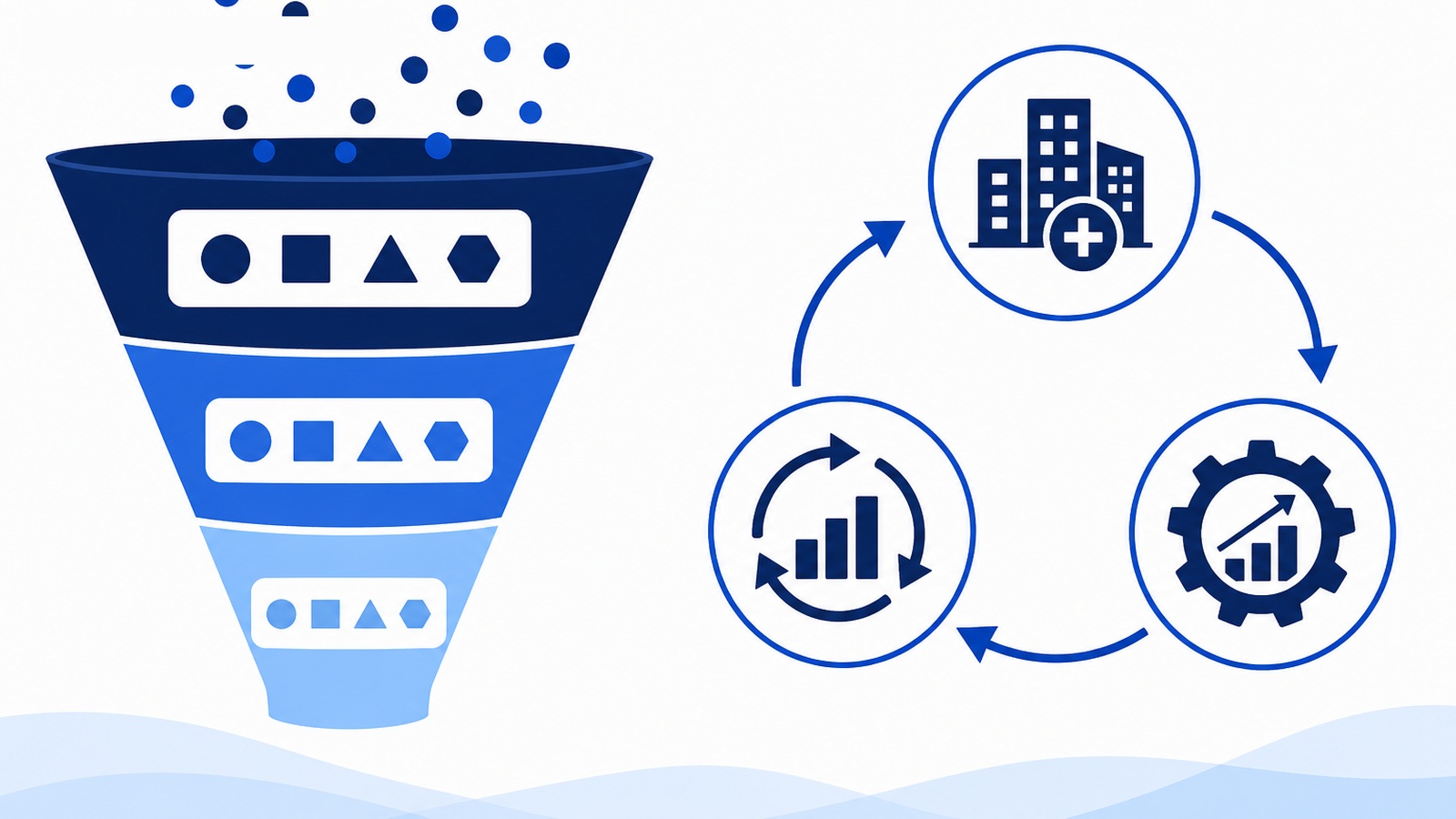
Acquire. Transform and optimize. Reinvest. The cycle is the company.
Many technology companies use acquisitions to enter adjacent markets, add features or consolidate competitors. Bending Spoons is structurally different. The company describes a three-stage cycle: acquire; transform and optimize; reinvest.
The acquisition itself is only the entry point. The central proposition is that Bending Spoons can materially improve a digital business after acquiring it, then redeploy the resulting cash flow into additional transactions. This makes the company closer to a permanent-capital operating compounder than a conventional strategic buyer.
Since its formation, Bending Spoons has completed more than 50 acquisitions. It completed one transaction in 2023, five in 2024, six in 2025 and two during Q1 2026.
The company does not present deal volume as the objective. Its 2025 sourcing funnel indicates the opposite.
2025 acquisition funnel
2,500+Opportunities sourced
~200Analysed in depth
6Completed in 2025
Conversion: six closes from 2,500+ sourced opportunities (~0.24%). Separately, Bending Spoons has identified more than 1,000 digital businesses that it believes could become attractive acquisition targets over the next several years, nearly $400 billion of estimated aggregate 2025 revenue.
This is a high-coverage but highly selective process. It also explains why the company’s acquisition strategy is difficult to replicate. The advantage is not simply access to capital or the willingness to buy. It is the integration of sourcing, underwriting, data analysis, product transformation and post-close operating execution.
Deal chronology
06 · Research
Selected acquisition timeline
Six years of compounding ownership, from a single AI photo app to a portfolio spanning consumer, creator and enterprise software.
- 1.2021 Remini AI photo editing, the early transformation proof point
- 2.2023 Evernote Established productivity brand with deep retention
- 3.2024 Issuu, Meetup, StreamYard, WeTransfer Creator and file-transfer scale-up year
- 4.2025 Brightcove, Harvest, komoot, Loomly, MileIQ, Vimeo Six closes, including Vimeo as a platform landmark
- 5.Q1 2026 AOL, Eventbrite Legacy internet brands with durable audiences
- 6.Aug 2026 Airtable Announced, enterprise workflow, pending close Pending
Transformation
07 · Research
The transformation model
Deep post-close intervention, not passive stewardship.
Bending Spoons does not position itself as a passive owner. Before an acquisition closes, it assembles a cross-functional task force that may include software engineers, data scientists, AI researchers, product designers, product managers and growth specialists. The team studies the acquired company’s product, data, infrastructure, customers and monetization model in preparation for a post-close transformation plan.
Following completion, the intervention can be extensive: organizational restructuring; technology and infrastructure replacement; product redesign; faster development cycles; pricing and monetization changes; marketing optimization; integration of shared data and experimentation systems; and deployment of AI across product and internal workflows.
The process is decisive by design. Bending Spoons acknowledges that transformations can include workforce reductions and other decisions that may appear drastic. That aspect of the model should not be minimized. The company’s approach is not appropriate for every seller, management team or product culture. It prioritizes long-term business performance and centralized execution over continuity of the acquired organization in its existing form.
What makes the strategy noteworthy is that Bending Spoons is explicit about the trade-off. It is not marketing acquisitions as passive stewardship while quietly pursuing deep restructuring. The transformation thesis is central to the company’s stated investment case.

Portfolio quality
Q1 2026 snapshot
Durability characteristics that make post-close pricing, product and cost work economically meaningful.
84% Group revenue from subscriptions
94% Net revenue retention
8 yrs Revenue-weighted avg. subscriber tenure
<1% Largest single customer share of revenue
Platform
09 · Research
Remini provides an important proof point
More than nine times the pre-acquisition revenue by 2025.
Remini is one of the clearest examples of the transformation model in practice. Bending Spoons acquired the AI-based photo-editing application in 2021. It subsequently rebuilt the product, redesigned its infrastructure, shifted monetization toward subscriptions and developed systems capable of handling rapid increases in user activity.
By 2025, Remini reportedly served more than five times as many monthly active users and generated more than nine times as much revenue as it did before the acquisition. The company also reduced and redeployed the team after the heaviest transformation phase, illustrating how it allocates centralized talent dynamically across the portfolio.
Remini is not evidence that every transaction will produce a similar outcome. It is evidence that the Bending Spoons model can produce material post-acquisition growth when the underlying product, distribution and transformation opportunity align.
Portfolio
10 · Research
Why the portfolio is becoming more valuable
Durable subscriptions, long tenure and low concentration.
The portfolio is increasingly weighted toward established products with durable customer relationships. In Q1 2026: 84% of group revenue came from subscriptions; net revenue retention was 94%; 48% of subscription revenue came from customers with at least five years of tenure; 28% came from customers with at least ten years of tenure; the revenue-weighted average subscriber tenure was eight years; and no customer represented more than 1% of total revenue.
These characteristics provide a relatively stable base from which to execute pricing, product and cost improvements. They also explain the attraction of older internet brands. Products such as Evernote, AOL, Vimeo and WeTransfer may not fit the profile of early-stage growth assets, but they possess qualities that can be highly valuable to an operator: global brand recognition, large installed user bases, historical customer data, repeat usage, established subscription or advertising revenue, operational complexity that may create improvement opportunities, and customer relationships built over many years.
Bending Spoons appears willing to acquire businesses that public markets, venture investors or prior owners may consider mature, difficult or operationally unfashionable. Its advantage depends on seeing a different future state for those assets and possessing the systems to pursue it, a pattern familiar to practitioners of SaaS M&A and broader digital acquisitions.
Capital
11 · Research
Capital availability supports the next phase
€1.49 billion in new and expanded facilities since Q2 2026.
Acquisition platforms are ultimately constrained by capital, integration capacity or both. In July 2026, the company announced a new €500 million SACE-backed term loan facility. Alongside additional term financing and expanded revolving-credit commitments, this brought new and expanded facilities agreed since the beginning of Q2 2026 to €1.49 billion. The facilities can be used for general corporate purposes and acquisitions.
Airtable’s announcement shortly afterwards demonstrates the practical relevance of that financing capacity. The balance-sheet opportunity is substantial, but so is the discipline required. Additional debt increases interest expense and raises the consequences of integration underperformance. The company’s own acquisition framework emphasizes margin of safety, predictable earnings and pricing discipline.
The strongest version of the Bending Spoons thesis is therefore not that it will acquire indiscriminately. It is that it can review an unusually large opportunity set, reject most of it and deploy significant capital when the economics and operating fit are sufficiently compelling.
Outlook
12 · Research
What Bending Spoons may do next
Acquiry’s assessment, not company guidance.
The following points are Acquiry’s assessment based on the company’s disclosed strategy and recent transaction pattern. They are not company guidance.
- 01The average acquisition size is likely to continue increasingBending Spoons has stated that larger businesses can provide more attractive opportunities because transformation effort does not necessarily increase in direct proportion to revenue. Its recent progression from established applications to Vimeo, AOL, Eventbrite and Airtable supports that direction.
- 02Enterprise SaaS will become a larger part of the portfolioAirtable provides a major entry into enterprise workflow software. Additional targets could include mature horizontal platforms, collaboration products, data tools, sales-led SaaS and software businesses with durable installed customer bases.
- 03Public-to-private transactions and late-stage resets will remain relevantVimeo, Eventbrite and Airtable demonstrate a willingness to pursue situations where strong brands and customer relationships coexist with public-market pressure, valuation compression or a need for structural change.
- 04AI will be applied as an operating layer, not treated as a standalone categoryBending Spoons appears more interested in using AI to improve products, code, support, marketing and monetization than in acquiring businesses solely because they carry an AI label.
- 05The company will continue prioritizing businesses with existing distributionIts disclosed framework favors strong customer retention and limited dependence on paid advertising.
Significance
13 · Research
The broader M&A significance
A permanent-capital acquisition OS, not episodic deal-making.
Bending Spoons represents a notable development in technology M&A. The traditional software acquisition market has often been divided between strategic buyers seeking product synergies and financial sponsors seeking cash-flow improvement. Bending Spoons combines elements of both while adding a centralized product and engineering platform.
Its model is built around five principles:
- Permanent ownershipThe company has not sold a material business and says it does not expect frequent divestitures.
- Deep operational interventionAcquisitions are followed by deliberate product, technology, pricing and organizational change.
- Centralized capabilityAcquired companies gain access to shared systems, data, talent and experimentation infrastructure.
- Disciplined selectionA large sourcing funnel supports selectivity rather than indiscriminate deal volume.
- Capital recyclingExpanded earnings are reinvested into further acquisitions.
The result is a model in which M&A is not episodic. It is the core mechanism through which the company allocates talent and capital, a useful reference point for anyone studying modern transaction process design in digital markets.
Acquiry’s view
14 · Research
What this means for digital M&A
Impressive execution, with real financing and integration risk still attached.
Bending Spoons has built one of the most ambitious acquisition and transformation platforms in global technology. The company’s recent performance is impressive because the growth is not limited to headline transaction value. Revenue, adjusted operating income, portfolio scale and per-employee productivity have all moved materially higher as acquisition activity accelerated.
There are genuine execution risks. Debt must be serviced. Large businesses are more difficult to integrate. Workforce restructuring can affect customer trust and product continuity. Non-GAAP performance must be considered alongside transaction costs, amortization and financing expense.
None of those issues invalidate the central achievement. Bending Spoons has demonstrated that mature digital brands can become the foundation of a high-growth portfolio when paired with rigorous underwriting, centralized technology and decisive operational execution.
The proposed Airtable acquisition raises the stakes. It also confirms the direction. Bending Spoons is no longer simply acquiring a collection of recognizable applications. It is building a scaled, permanent-capital platform designed to compound through technology M&A for many years.
Reference
15 · Research
Key figures
Disclosed metrics referenced throughout this briefing.
| Metric | Disclosed figure |
|---|---|
| 2025 revenue | $1.306 billion |
| 2025 revenue growth | 95% |
| 2025 organic revenue growth | 13% |
| 2025 adjusted operating income (non-GAAP) | $613.2 million |
| 2025 adjusted operating margin (non-GAAP) | 47% |
| Q1 2026 revenue | $601.3 million |
| Q1 2026 adjusted operating margin (non-GAAP) | 51% |
| Acquisitions completed since formation | More than 50 |
| 2025 opportunities sourced | More than 2,500 |
| 2025 opportunities analysed in depth | Approximately 200 |
| 2025 acquisitions completed | Six |
| Identified potential targets | More than 1,000 |
| March 2026 monthly active users | More than 500 million |
| March 2026 monthly paying customers | More than 9 million |
| Airtable announced enterprise value | $1.285 billion |
| Airtable announced equity value | Approximately $2.25 billion |
| Airtable ARR as of June 2026 | Approximately $480 million |
| New and expanded financing facilities announced in 2026 | €1.49 billion |
16 · Research
FAQ
What is Bending Spoons’ acquisition strategy?
Bending Spoons acquires established digital businesses, implements deep operational and product transformations, optimizes them over time and reinvests the resulting earnings into further acquisitions.
How many companies has Bending Spoons acquired?
Bending Spoons stated in its July 2026 prospectus that it had completed more than 50 acquisitions since its formation.
Has Bending Spoons completed the Airtable acquisition?
No. The acquisition was announced on 4 August 2026 and remains subject to regulatory approvals and customary closing conditions.
What were Bending Spoons’ 2025 financial results?
The company reported $1.306 billion in 2025 revenue, representing 95% growth, together with adjusted operating income of $613.2 million and a 47% adjusted operating margin. Adjusted figures are non-GAAP.
Sources
- 1.Bending Spoons, “Bending Spoons has entered into a definitive agreement to acquire Airtable for $1.285 billion,” 4 August 2026. investors.bendingspoons.com (opens in a new tab)
- 2.Bending Spoons S.p.A., Final Prospectus as filed, 1 July 2026. Prospectus PDF (opens in a new tab)
- 3.Bending Spoons S.p.A., Final Prospectus, revenue and operating data for 2023, 2024, 2025 and Q1 2026. Prospectus PDF (opens in a new tab)
- 4.Bending Spoons S.p.A., Final Prospectus, non-GAAP reconciliation and consolidated financial statements. Prospectus PDF (opens in a new tab)
- 5.Bending Spoons S.p.A., Final Prospectus, Remini case study. Prospectus PDF (opens in a new tab)
- 6.Bending Spoons, “Bending Spoons enters into €500 million SACE-backed term loan facility,” 28 July 2026. investors.bendingspoons.com (opens in a new tab)
Keep reading
Related analysis

Deal Intelligence · SaaS
NetApp Acquires JetStream to Reach VMware Workloads Beyond Its Own Storage
News Analysis · Data Infrastructure

Deal Intelligence · SaaS
ServiceNow Completes $7.75 Billion Armis Deal to Own Cyber-Physical Visibility
News Analysis · Cybersecurity

Deal Intelligence · SaaS
Francisco Partners puts ~$650m on Weave and takes healthcare's AI engagement platform private
Francisco Partners signed a definitive agreement on 18 August 2026 to acquire Weave Communications (NYSE: WEAV) at approximately $650 million aggregate equity value and $7.40 per share in cash. The ~34% premium take-private folds a 40,000-location AI patient engagement and payments platform into PE ownership with a Q4 2026 close target.
Explore the sector:SaaS acquisitions
About the analyst

Joash Boyton
Founder and Managing Director, Acquiry · Melbourne, Australia · Global coverage
Joash Boyton is the Founder and Managing Director of Acquiry, a specialist M&A advisory firm focused on the acquisition and sale of businesses. He executes buy-side and sell-side mandates from USD $1M to $500M across technology, SaaS, fintech, payments, gaming, blockchain and emerging verticals, and is not limited to them. Any sector, any market.