

01 · Deal Intelligence
| Date | 18 Aug 2026 |
|---|---|
| Buyer | Francisco Partners |
| Target | Weave (WEAV) |
| Deal value | ~$650M equity |
| Per share | $7.40 cash |
| Close | Q4 2026 |
| WEAV | $7.31 +0.41% |
| Premium | ~34% |
Acquiry Deal Intelligence · 18 August 2026
Francisco Partners is buying a vertical healthcare SaaS franchise at the center of practice communications and collections: cash certainty for public stockholders, private capital for AI and revenue-cycle depth, and a take-private that tests what PE will pay for AI-attached SMB healthcare software with tens of thousands of locations.
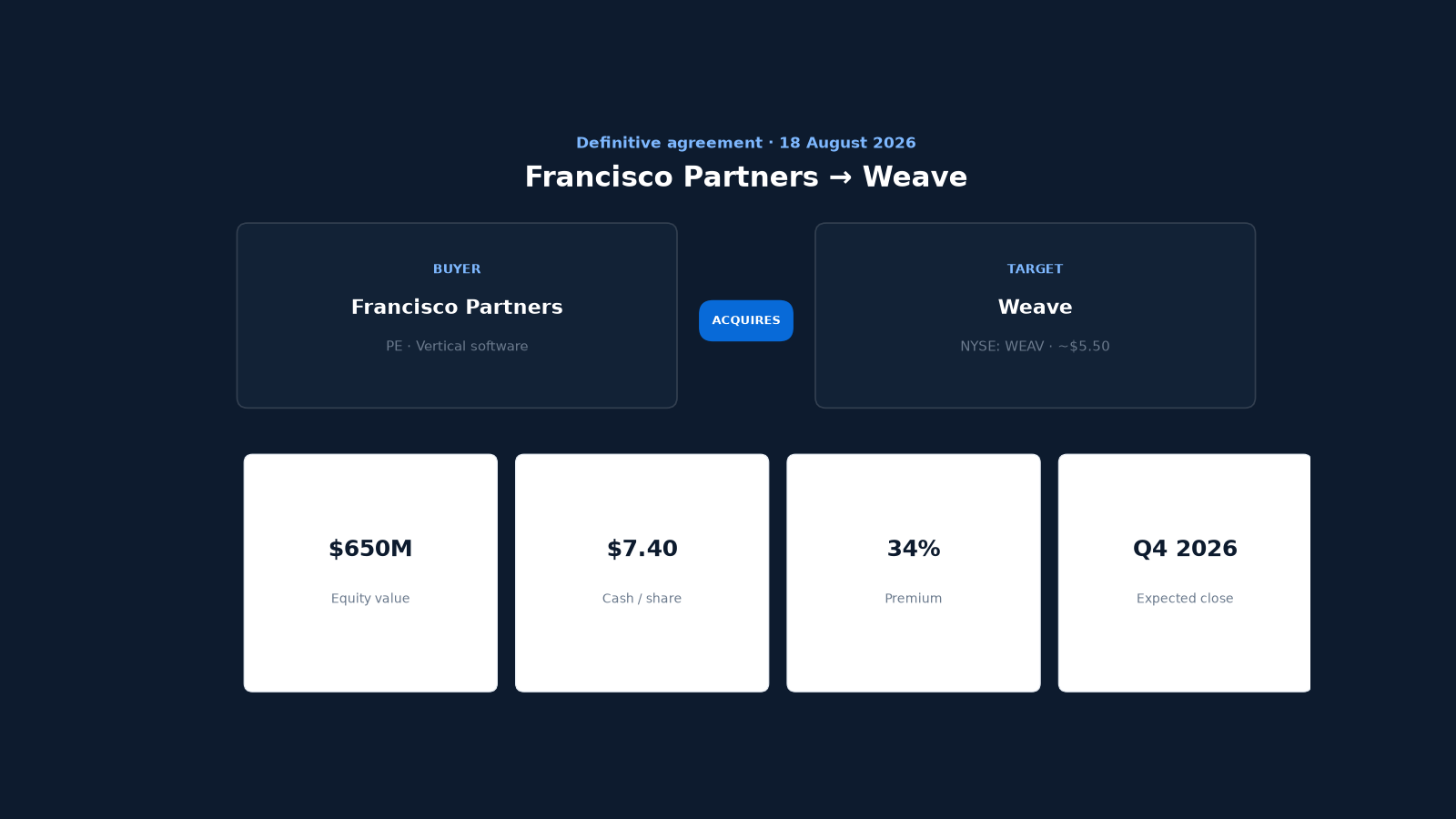
On 18 August 2026, Francisco Partners agreed to take Weave Communications private at approximately $650 million aggregate equity value, $7.40 per share cash, and a ~34% premium to the prior day's close, for an AI patient engagement and payments platform serving more than 40,000 healthcare locations.
What follows: the announcement in full, how the cash take-private is structured, why Francisco Partners wants Weave's practice footprint, and what vertical healthcare SaaS founders should take from a PE bid that pairs AI with payments and revenue-cycle ambition.
01
02 · Deal Intelligence
What happened
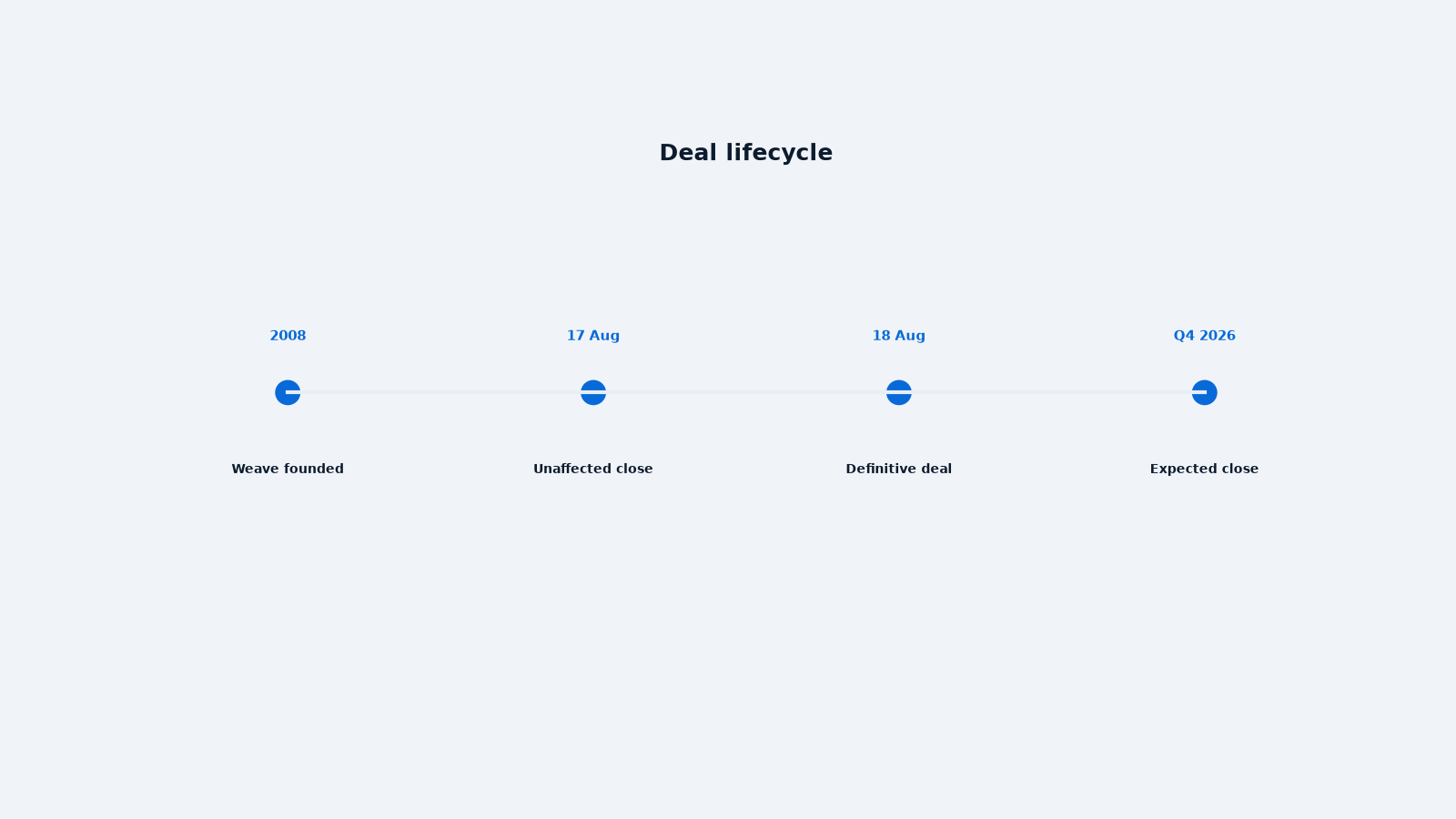
On 18 August 2026, Weave Communications, Inc. (NYSE: WEAV) and Francisco Partners announced a definitive agreement for Francisco Partners to acquire Weave at an aggregate equity valuation of approximately $650 million. Weave stockholders will receive $7.40 per share in cash, a premium of approximately 34% to Weave's unaffected closing stock price on 17 August 2026, the last full trading day before the announcement.
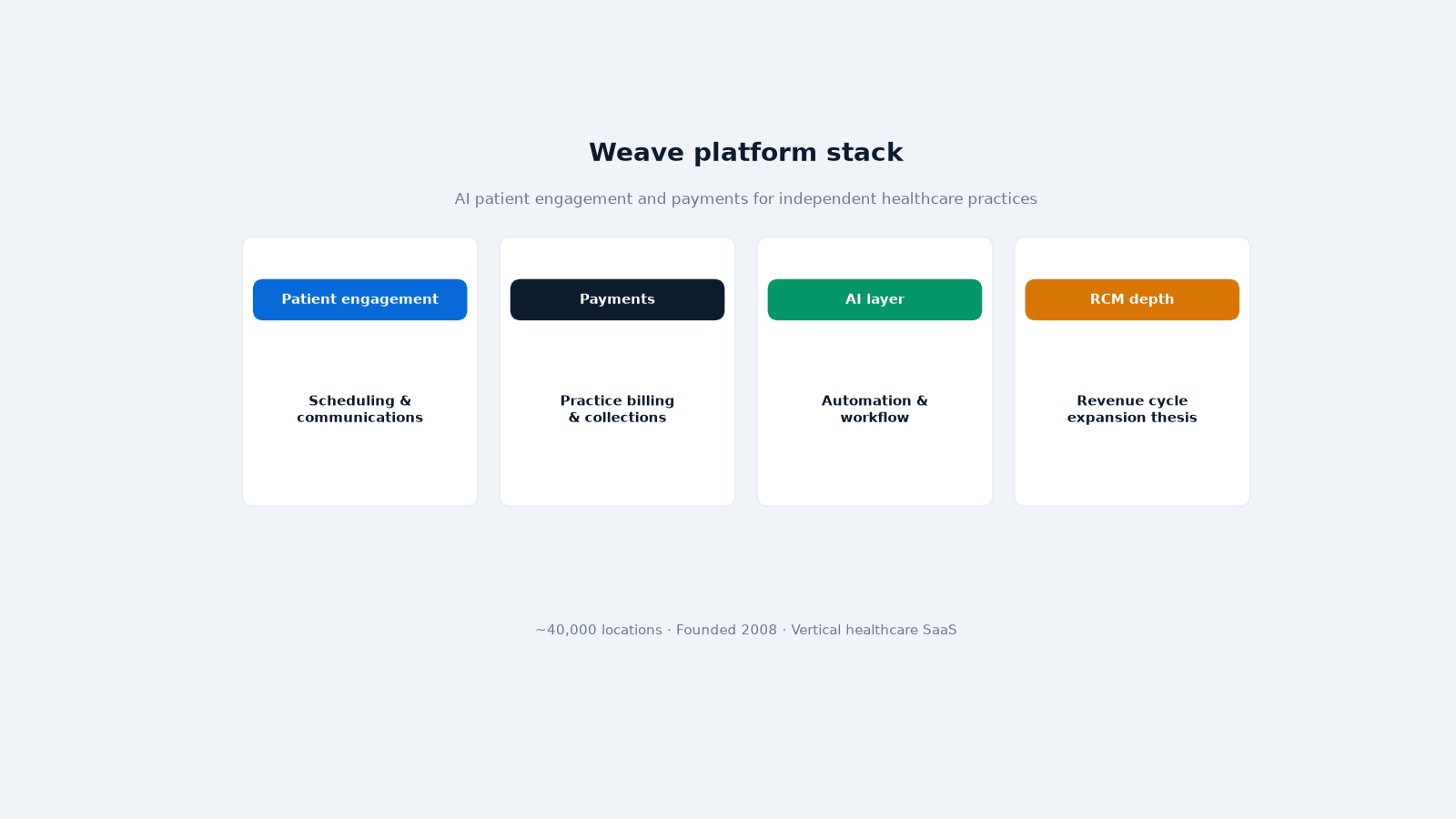
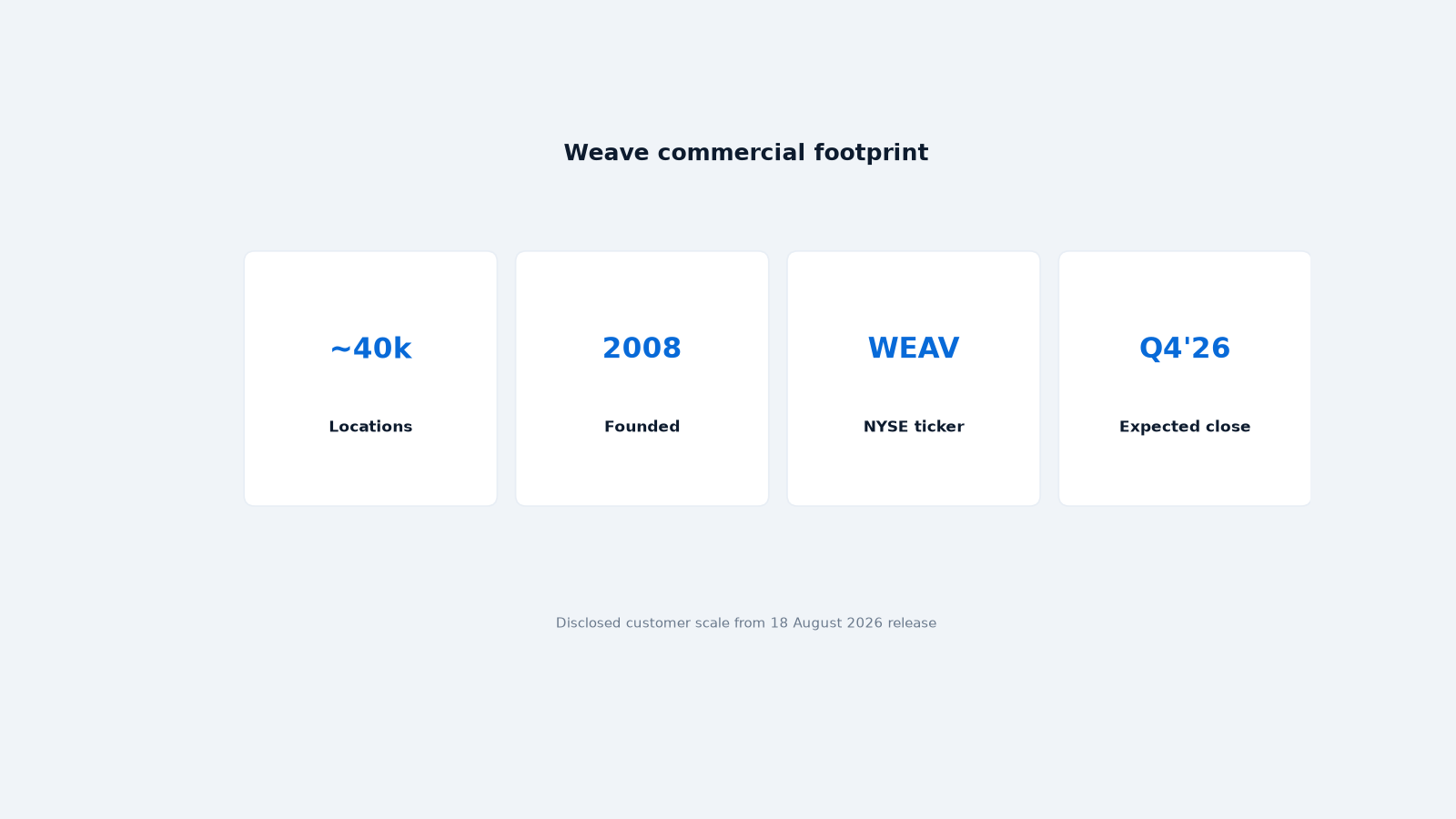
Weave is an AI-powered patient engagement and payments platform purpose-built for healthcare practices. Founded in 2008, the company describes itself as an all-in-one customer experience and payments software platform for small and medium-sized healthcare businesses, used at more than 40,000 locations. Headquarters are in Lehi, Utah. After close, Weave will cease NYSE trading, become a private company, continue to operate under the Weave name, and keep that Lehi headquarters.
The Weave Board of Directors unanimously approved the transaction and recommends that stockholders vote in favor. Stuart C. Harvey Jr., Chair of the Board, said the Board conducted a thorough evaluation of strategic alternatives, spoke with a number of strategic and financial parties, and concluded that Francisco Partners delivers a substantial premium and compelling, certain cash value. As of the agreement date, no Weave executive officer has entered any agreement with Francisco Partners to roll over equity, invest alongside the buyer, or acquire an equity interest in the surviving company.
Brett White, Weave's Chief Executive Officer, framed the sale as capital for product depth rather than an end of the independent-practice mission. More than 40,000 locations rely on Weave today, he said, and Francisco Partners' track record at the intersection of vertical software and healthcare is the partnership for the next chapter: more investment in the AI platform, deeper payments and revenue cycle management capabilities, and a better healthcare experience at every practice.
Francisco Partners' public comments sit on the same axis. Ezra Perlman, Co-President, said Weave is positioned for healthcare's demand for AI to optimize practices, and that its vertical platform sits at the center of how tens of thousands of practices communicate with patients and collect revenue, a position that is difficult to build and harder still to replicate. Nick Nelson, Principal, pointed to continued product innovation and expanding the value Weave delivers to customers.
The announcement lands in an active August 2026 M&A window that already includes Bending Spoons' $1.285 billion Airtable agreement and Munich Re's $575 million At-Bay InsurSec acquisition. Weave is the healthcare vertical SaaS take-private in that cluster: public stockholders get cash at a stated premium, and a technology specialist sponsor takes the platform private to invest without a listed ticker.
Jefferies LLC is exclusive financial advisor to Weave. Orrick, Herrington & Sutcliffe LLP is Weave's legal counsel. Kirkland & Ellis LLP is legal counsel to Francisco Partners. Closing is anticipated in the fourth quarter of 2026, subject to customary conditions including Weave stockholder approval and required regulatory approvals.
02
03 · Deal Intelligence
The terms
Primary sources disclose equity value, per-share cash, and a premium to the unaffected close. They do not disclose enterprise value, net cash or net debt, ARR, revenue, EBITDA, or a take-private multiple. This report stays inside that disclosed set and uses the 18 August 2026 Form 8-K for merger mechanics that the media pages summarize only at headline level.
What we know from primary sources:
- Aggregate equity valuationapproximately $650 million
- Consideration$7.40 per share in cash (no stock component disclosed)
- Premiumapproximately 34% to the 17 August 2026 unaffected close
- Buyer vehiclesWillow Parent, LLC and Willow Merger Sub, Inc. (Francisco Partners affiliates)
- Timingexpected close Q4 2026, subject to stockholder and regulatory approvals
- Post-closeNYSE delisting and Exchange Act deregistration; Weave remains the operating name in Lehi, Utah
- Scale (target)more than 40,000 customer locations; founded 2008
- Processunanimous Weave Board approval; no executive rollover disclosed as of the agreement date
| Transaction terms · Disclosed 18 Aug 2026 | ~$650M equity · $7.40/share cash · ~34% premium |
|---|---|
| Definitive agreement | Pending close |
Aggregate equity ~$650M
Per share $7.40 all cash
Premium ~34% vs 17 Aug close
Locations ~40,000+
Expected close Q4 2026
Post-close Private · NYSE delist
Consideration structure
- All-cash acquisition by Francisco Partners affiliates
- $7.40 per share to Weave stockholders
- Weave becomes private; continues under Weave name (Lehi, UT)
- No executive equity rollover disclosed as of agreement date
- Director support agreements (~14.5% voting power as of 13 Aug 2026)
- EV/ARR or revenue multiples not disclosed
Primary sources: Weave investor release and Form 8-K, 18 August 2026.
Valuation context
| Unaffected close (17 Aug 2026) | Basis for ~34% premium |
|---|---|
| Cash consideration per share | $7.40 |
| Aggregate equity valuation | ~$650 million |
$7.40 cash/share · ~34% premium · ~$650M aggregate equity (announcement)
Sector · Vertical healthcare SaaS / patient engagement + paymentsBuyer · Francisco Partners · Target · Weave Communications (WEAV)Primary release ↗ (opens in a new tab)
04 · Deal Intelligence
Valuation waterfall
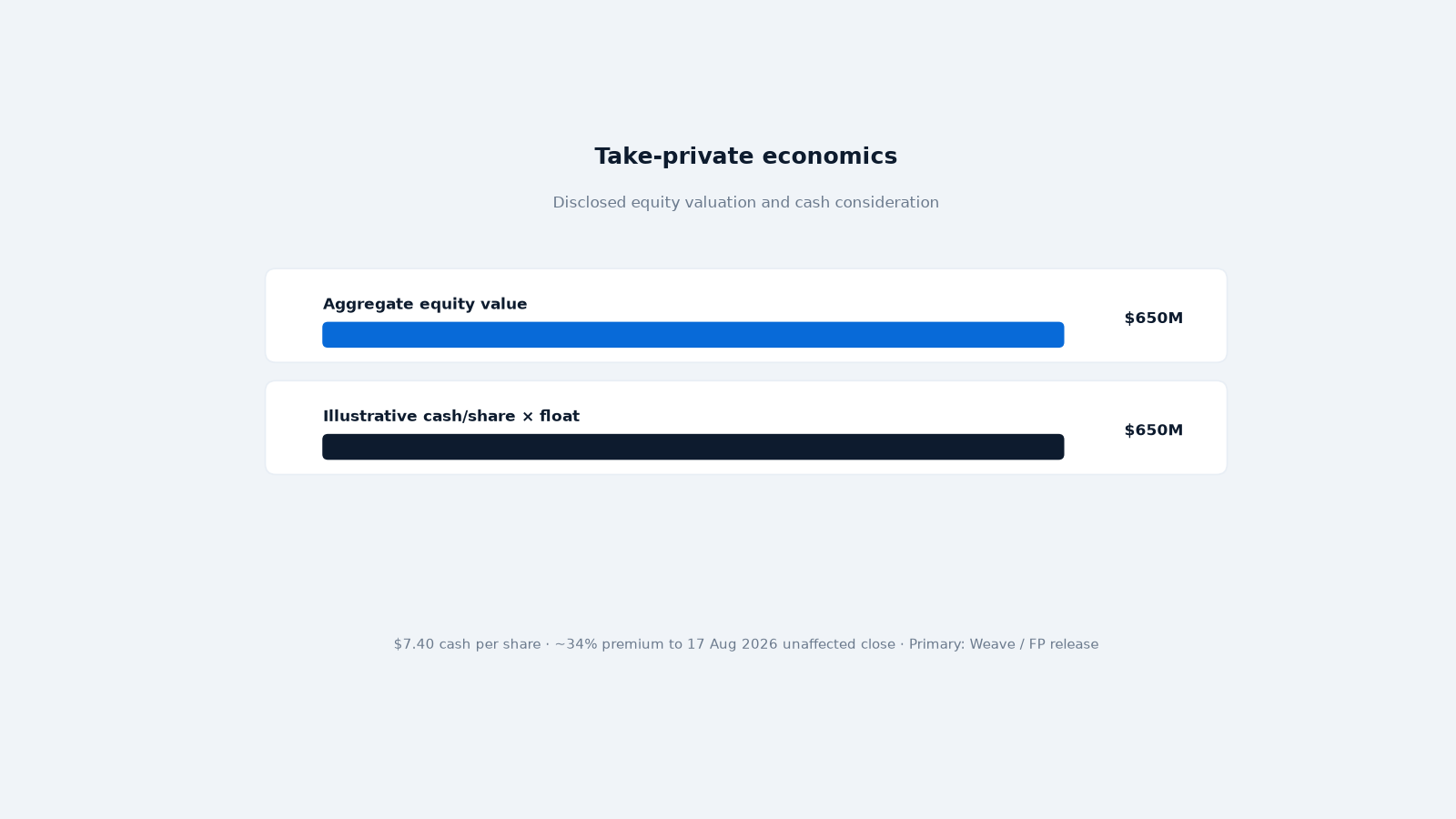
$7.40 cash per share · ~$650M aggregate equity · ~34% premium
The 8-K describes a reverse triangular merger. On 18 August 2026, Weave entered an Agreement and Plan of Merger with Willow Parent, LLC, a Delaware limited liability company, and Willow Merger Sub, Inc., a Delaware corporation and wholly owned subsidiary of Parent. Merger Sub will merge with and into Weave, and Weave will survive as a wholly owned subsidiary of Parent. Parent and Merger Sub are affiliates of Francisco Partners Management, L.P. At the Effective Time, each outstanding share of Weave common stock (other than dissenting shares, treasury shares, subsidiary-owned shares, and shares owned by Parent, Merger Sub, or their wholly owned subsidiaries) converts into the right to receive $7.40 in cash, without interest, subject to applicable tax withholding.
Equity awards are cashed out on a disclosed schedule rather than left as an undisclosed pool. Vested in-the-money options convert into cash equal to the excess of $7.40 over the exercise price, times the number of shares. Underwater vested options cancel for no consideration. Unvested in-the-money options held by continuing employees convert into a cash opportunity that keeps the same vesting (including any acceleration and continued-employment terms); cash is not automatically paid at close. Unvested options that are underwater, or held by someone who is not a continuing employee, cancel for no consideration. Vested RSUs convert into $7.40 cash per unit. Unvested RSUs held by continuing employees become a cash opportunity on the same vesting schedule; unvested RSUs held by others cancel. The 2021 Employee Stock Purchase Plan may complete the offering in effect on the agreement date, then is barred from new offerings, new participants, and contribution increases, and will terminate at the Effective Time.
Closing conditions are specified. Stockholders must adopt the Merger Agreement by the affirmative vote of a majority of outstanding shares entitled to vote. The waiting period under the Hart-Scott-Rodino Antitrust Improvements Act of 1976 must expire. No governmental Restraint or applicable law may prevent or prohibit the merger. Each side must satisfy customary bring-down, covenant, and certificate conditions. Parent's obligation also depends on the absence of a Company Material Adverse Effect since the agreement date and on a payoff letter for amounts outstanding under Weave's existing credit facility. Weave must file a preliminary proxy statement for a special meeting within 30 calendar days after the agreement date.
Walk-away economics are also in the 8-K. Weave is subject to customary no-shop restrictions, with a fiduciary-out that allows information and negotiation if an unsolicited proposal is (or would reasonably be expected to lead to) a Company Superior Proposal, and that allows a change of recommendation or termination to accept a Superior Proposal or respond to an Intervening Event, in each case after specified matching rights and counsel-and-advisor determinations. Weave must pay Parent a $22.8 million termination fee in connection with recommendation changes and certain other terminations. Parent must pay Weave a $39 million termination fee in other specified circumstances. Either party may terminate if the merger is not consummated by 18 February 2027 (the Outside Date), automatically extendable to 18 May 2027 under specified circumstances, if a final nonappealable Restraint blocks the merger, or if stockholder approval is not obtained after the special meeting (including adjournments).
Financing support is described as equity first. Concurrently with the Merger Agreement, certain Francisco Partners-affiliated investment funds delivered an equity commitment letter to fund up to the full aggregate merger consideration and related fees and expenses, subject to that letter's terms. Weave is a third-party beneficiary entitled to enforce the commitment on those terms. The sponsors also provided a limited guarantee of Parent's termination fee and certain reimbursement obligations. If Parent elects to pursue debt financing contemplated by the Merger Agreement, Weave agreed to commercially reasonable customary assistance. Parent's and Merger Sub's aggregate monetary-damages liability is capped at $39 million; Weave's is capped at $22.8 million; enforcement and collection costs may add up to $6 million in each case.
Directors, solely as stockholders, and certain affiliated funds signed support agreements covering approximately 14.5% of outstanding voting power based on shares outstanding as of 13 August 2026. Those holders agreed to vote in favor of adopting the Merger Agreement, subject to the support agreements' terms. That is not a majority lock-up. The special meeting still has to deliver a majority of outstanding shares, not merely a majority of votes cast.
Valuation commentary has to stop where the files stop. Approximately $650 million of equity value and $7.40 per share cash are the announcement anchors. The 34% premium is measured against the 17 August 2026 unaffected close; the release does not restate that close in dollars in the pages cited here, so this report does not invent it. Unlike Bending Spoons' Airtable transaction, which disclosed ARR and an enterprise-value frame, Weave's take-private materials do not publish recurring-revenue scale. Treating an invented EV/ARR multiple as a comp would be a category error against this primary set.
Weave's Form 8-K cover identifies a Delaware corporation, Commission File Number 001-40998, I.R.S. Employer Identification Number 26-3302902, principal offices at 1331 W Powell Way, Lehi, Utah 84043, and common stock $0.00001 par value trading as WEAV on the New York Stock Exchange. The company checks the emerging-growth-company box. General Counsel Tyler Waltman signed the 8-K on 19 August 2026; the date of the earliest event reported is 18 August 2026.
03
05 · Deal Intelligence
Why Francisco Partners bought Weave
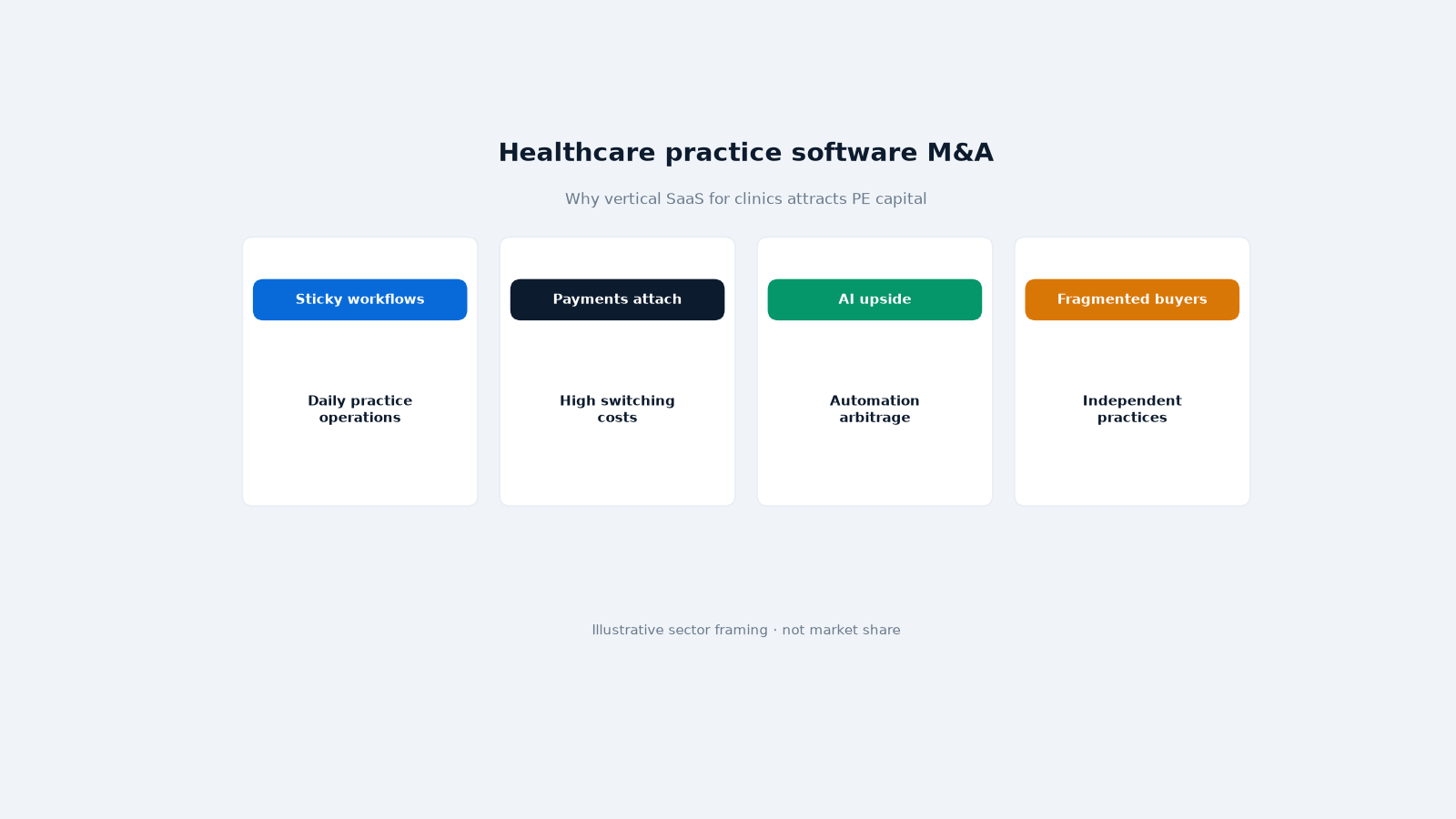
Francisco Partners' stated thesis is not a generic software roll-up slogan. Perlman located Weave at the junction of two hard-to-copy assets: a vertical workflow that already sits in daily practice operations, and a payments and collections role that turns communication software into revenue infrastructure. Healthcare practices, in that telling, want AI that optimizes how they run, not another horizontal inbox. A platform that already coordinates how tens of thousands of locations talk to patients and collect revenue is the scarce object.
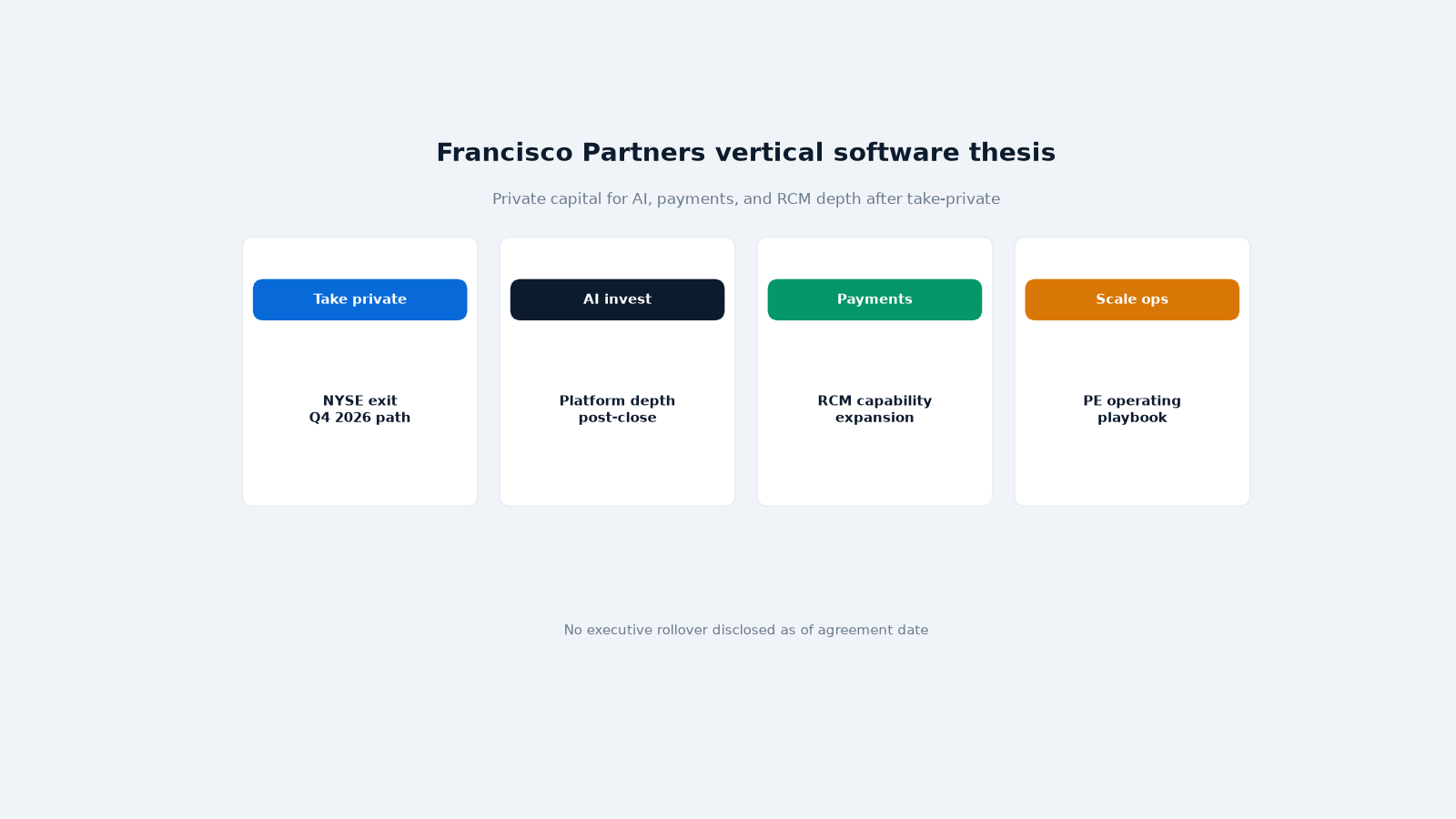
Nelson's follow-on is an operating mandate. Francisco Partners sees room to build on that position through product innovation and by expanding the value delivered to customers, and says it is excited to partner with the entire team for the next chapter of growth. Read against White's quote, "expanding value" maps onto named product lines: the AI platform, payments, and revenue cycle management. The sponsor is not buying a ticker to flip a multiple that was never disclosed. It is buying a practice operating system it intends to deepen in private.
“Since our founding in 2008, we have built Weave for a customer most software companies overlook: the independent practices that care for patients in communities across the country. More than 40,000 locations rely on us today. Together with Francisco Partners, we will be able to enhance our ability to invest in our AI platform, deepen our payments and revenue cycle management capabilities, and further our vision of a better healthcare experience at every practice.”
White's customer definition is the commercial moat in one sentence. Weave was built for independent practices that most software companies overlook, the clinics that care for patients in communities across the country. More than 40,000 locations rely on that product today. Horizontal vendors chase enterprise health systems and national dental DSOs. Weave's disclosed footprint is the long tail of independent care, where switching costs live in phones, texts, schedules, insurance checks, and the payment file, not in a CIO bake-off. Francisco Partners is paying a cash premium to own that density.
The Board process supports the "best path" language rather than a sudden inbound. Harvey said the Board evaluated strategic alternatives and spoke with a number of strategic and financial parties. The chosen path is a financial sponsor, not a listed strategic acquirer, with unanimous recommendation and cash certainty. That combination usually means strategics either did not bid at a winning level, or could not match speed and certainty on the disclosed cash terms. The files do not name the other parties, and this report does not invent them.
Firm-level capacity is disclosed only in About-section scale, not as a named deal cadence. Francisco Partners specializes in partnering with technology and technology-enabled businesses, has invested in over 500 technology companies since launch more than 25 years ago, and has raised over $75 billion in capital. White explicitly cited an extensive track record scaling companies at the intersection of vertical software and healthcare. This pack does not itemize other Francisco Partners investments, because those names are not in the Weave primary set.
Product scope in the About Weave section explains why payments language is not marketing filler. Weave describes an always-on teammate handling patient interactions across voice and text at the center of the patient journey. Agentic AI workflows and authorized integrations with practice management systems are meant to keep scheduling, insurance verification, and payments from falling between the cracks. Embedding AI in daily operations is supposed to cut administrative workload, free staff for human-centered care, and deliver real-time insights. Serving over 40,000 customer locations, Weave was named a 2026 Best Software Awards winner for healthcare software products by G2.
For competitors in dental, optometry, veterinary, and multi-specialty practice software, the message is that a sponsor with $75 billion of capital raised will fund AI and RCM attach on an installed base this size. For strategics that looked and did not win, the message is that cash-and-certainty still clears a public healthcare SaaS process when the Board has run alternatives. For founders, the message is narrower: if your product owns communication plus collections at independent practices, financial sponsors are live buyers even when you are already listed.
Strategic rationale at a glance
| 01 | Practice footprint | 40,000+ locations sit at the center of patient communication. |
|---|---|---|
| 02 | AI engagement | Agentic workflows across voice, text, scheduling, and verification. |
| 03 | Payments + RCM | Deepen collections and revenue-cycle attach under private capital. |
| 04 | Vertical moat | Healthcare SMB platform density that is hard to replicate. |
| 05 | Cash certainty | All-cash premium exit after a full strategic alternatives process. |
| 06 | Private runway | Q4 2026 close path; invest without public-market quarterly optics. |
Weave growth milestones
Disclosed Weave milestones through the Francisco Partners agreement. Named prior FP portfolio deals are not itemized in this primary set. The firm states it has invested in over 500 technology companies and raised over $75 billion in capital.
- 1.2008 Weave founded Lehi, Utah Closed
- 2.2026 G2 Best Software Awards Healthcare software Closed
- 3.Aug 2026 Weave Communications ~$650M equity Pending close
04
06 · Deal Intelligence
Market implications
August 2026 is not a single-thesis M&A tape. Software, insurance, and healthcare technology are clearing at the same time through different buyer types. Bending Spoons is paying $1.285 billion enterprise value, all cash, for Airtable, a horizontal connected-work platform with disclosed ARR. Munich Re is paying $575 million enterprise value for At-Bay, a cyber InsurSec franchise with disclosed gross written premium. Francisco Partners is paying approximately $650 million of equity value in cash for a listed vertical healthcare SaaS company. Same month, three buyer types, three disclosure styles.
The Weave deal re-centers what "scale" means when the target is already public and the buyer is PE. Headline value is equity, not enterprise value. The premium is versus an unaffected close, not versus a 2021 private mark. The installed base is locations, not Fortune 100 logos. Founders and boards that only collect SaaS comps from private ARR rounds will misread this print. The relevant question is whether a sponsor will pay a cash premium to take a vertical platform private when AI and payments are the stated growth vectors and the customer is the independent practice.
07 · Deal Intelligence
Comparable Deal Intelligence transactions
Selected August 2026 Acquiry Deal Intelligence reports for M&A tempo context.
| Year | Buyer | Target | Value | Disclosed value | Sector | Row |
|---|---|---|---|---|---|---|
| 2026 | Munich Re | At-Bay | $575M EV | $575M EV | InsurSec / cyber insurance | [Report →](/insights/munich-re-acquires-at-bay/) |
| 2026 | Bending Spoons | Airtable | $1.285B EV | $1.285B EV | Enterprise SaaS | [Report →](/insights/bending-spoons-acquires-airtable/) |
| 2026 | BioMarin | Alesta Therapeutics | $275M+ | – | Biotech / rare disease | [Report →](/insights/biomarin-acquires-alesta-therapeutics/) |
| 2026 | Veralto | Cleanwater1 | $465M | $465M | Water quality | [Report →](/insights/veralto-acquires-cleanwater1/) |
For sellers: Run a real alternatives process and document it. Harvey's quote is usable in the next banker's letter because it is specific: strategic and financial parties, unanimous Board, cash certainty, substantial premium. Prepare a data room that can survive an 8-K, not just a teaser: merger vehicles, option and RSU treatment, ESPP wind-down, HSR, termination fees, support agreements, and an equity commitment letter. Do not assume executives must roll. This agreement states that as of signing, they had not. If rollover is part of your story, put it in the documents. If it is not, say so, as Weave did.
For private equity: Vertical healthcare software with patient communication and payments attach is still a live take-private category at this size. The disclosed hooks are location density, AI investment, and RCM depth, not a published rule-of-40 score. Competing in this lane means matching certainty (equity commitment, limited guarantee, specific performance) as much as matching price. A $39 million reverse termination fee and a $22.8 million company fee set a disclosed break-fee frame for a ~$650 million equity deal. Do not import those percentages onto other processes; they are this contract's numbers.
For strategics: A financial sponsor won a process that included strategic parties. If you want the next independent-practice platform, you need a cash-certainty story that a public board can recommend, or a product combination story that beats $7.40 of cash in the stockholder's hands. Practice-management incumbents, payments processors, and larger dental or veterinary software vendors should assume Francisco Partners will now fund Weave's AI and RCM roadmap in private, which changes the competitive clock even before close.
For public-market holders of other vertical healthcare names: This print is one take-private, not a sector bid index. The 34% premium is versus Weave's unaffected close, not versus a peer median. Without disclosed ARR or EBITDA, no responsible multiple screen can be built from this announcement alone. Use it as evidence that PE will still take a NYSE healthcare SaaS company private for cash, then wait for the proxy statement for any finer economics the 8-K left in the merger agreement exhibits.
Broader Deal Intelligence context: consolidation in 2026 is paying for category position with measurable production, premium, or location density, not for optionality alone. Weave's measurable production, as disclosed, is more than 40,000 locations and a product stack that already includes engagement, verification, and payments. That is the comp input. Invented revenue multiples are not.
05
08 · Deal Intelligence
What happens next
The near-term calendar is a proxy fight against the clock, not a branding exercise. Weave will prepare and file a preliminary proxy relating to a special meeting within 30 calendar days of the Merger Agreement. The definitive proxy goes to stockholders as promptly as reasonably practicable after the SEC confirms it will not review the filing or has no further comments. Investors are urged to read that proxy and any amendments in full when they are available on SEC.gov and at investors.getweave.com.
Antitrust and closing conditions run in parallel. HSR waiting-period expiration is an express condition. So is the absence of a Restraint. Parent still needs a credit-facility payoff letter and no Company Material Adverse Effect. Management must operate in the ordinary course, preserve material relationships, and refrain from specified transactions during the pre-closing period. Those covenants are the daily constraint on M&A, partnerships, and compensation until close.
Until close, Weave and Francisco Partners operate as separate companies under standard pending-merger practice. Practices using Weave for voice, text, scheduling, insurance verification, and payments should expect continuity of service. Integration planning will sit behind the scenes on reporting lines, product investment, and private-company governance. White remains the public voice of the target in the announcement; Perlman and Nelson are the named Francisco Partners principals on the buy side.
Stockholders should watch three documents. First, the proxy, which will set the meeting date, the precise vote mechanics, and any additional interest disclosure for directors and officers. Second, any amendment to the 8-K or merger-agreement exhibits that clarifies debt financing if Parent elects to raise it. Third, HSR and other regulatory notices. The companies expect Q4 2026 close. The contract's Outside Date is 18 February 2027, extendable to 18 May 2027, which is a backstop, not the base case.
Post-close mechanics are already written. Shares delist from the NYSE and deregister under the Exchange Act as promptly as practicable after the Effective Time. Weave keeps its name and Lehi headquarters. Unvested award cash continues on old vesting clocks for continuing employees. The ESPP ends. There is no disclosed executive rollover as of signing, so any later management equity would be a new fact and should be treated as such if it appears in a later filing.
A Superior Proposal path remains open until the stockholder vote, subject to no-shop limits, matching rights, and the $22.8 million fee if Weave leaves for that path. Acquiry will update this report if a competing bid is announced, if the proxy adds economics not in the 8-K narrative, or if closing or termination actually occurs. Continuous reporting is the point of Deal Intelligence: this page is a living file, not a one-day press clip.
06
09 · Deal Intelligence
Acquiry analysis
Acquiry's read is that Francisco Partners paid for installed practice density plus a payments and AI mandate, not for a disclosed financial multiple. Approximately $650 million of equity value, $7.40 of cash per share, and a 34% premium to the unaffected close are the entire published price stack. The operating stack is the 40,000-location footprint, the independent-practice customer, and a product already sitting on voice, text, scheduling, insurance verification, and payments. That is a coherent take-private thesis even without ARR in the release.
Three structural points matter more than the headline. First, buyer type. This is PE, not a listed strategic and not a public software consolidator. Permanent hold-period language in the quotes ("next chapter," "invest in our AI platform") is sponsor language about product spend after delisting, not about reporting a synergy run rate next quarter. Sellers who optimized for a strategic premium to a public currency should note that cash certainty won this process after the Board talked to both types.
Second, alignment at signing. No executive rollover is an unusual explicit negative disclosure, and it is useful. It tells public holders the cash they are being offered is not being diluted, at signing, by a parallel management co-invest that the proxy has not yet described. It also tells the sponsor it is buying control without a pre-wired management equity story in the announcement. Either side can still put in place post-close incentive equity. They have not disclosed it here, so it is not a deal term of this report.
Third, contract quality. The 8-K is a complete mid-cap take-private skeleton: HSR, majority-of-outstanding vote, MAE, payoff letter, no-shop with a real fiduciary-out, 14.5% director support (not a lock-up majority), equity commitment with target enforcement rights, limited guarantee, specific performance, $22.8 million and $39 million fees, and an Outside Date into 2027. That is the document set founders should demand in the next process, whether the buyer is PE or strategic. Soft announcements without vehicles, fees, and commitment letters are not this standard.
Comparable-set discipline is part of the analysis. Airtable is a live software comp because it is a 2026 cash acquisition of a workflow platform with a published EV. At-Bay is a live 2026 strategic comp because it is a platform acquisition with a published EV, even though the industry is insurance rather than healthcare SaaS. Neither supplies a Weave revenue multiple, because Weave did not publish revenue. Using those deals for tempo and buyer-type mapping is fair. Using them to back-solve Weave ARR is not.
What to watch, in order: the proxy (vote date, any new interest disclosure, any extra economics), HSR timing, whether Parent announces debt financing, any Superior Proposal, and the actual delisting. If you are evaluating a sale in vertical healthcare software, practice engagement, or healthcare payments, this transaction is a usable comp for process design and cash-premium framing. It is not a usable comp for EV/ARR until a primary source publishes the denominator.
Acquiry tracks sponsor and strategic mandates in this lane through our Deal Intelligence programme and sell-side advisory work in SaaS M&A. If you are mapping a process that looks like Weave's, the lesson from 18 August 2026 is simple: cash, a real alternatives record, and an 8-K that can survive the afternoon are the product. The multiple can wait until someone discloses the operating numbers.
Reference
Frequently asked questions
How much is Francisco Partners paying for Weave?
Aggregate equity valuation is approximately $650 million. Weave stockholders will receive $7.40 per share in cash, representing a premium of approximately 34% to Weave's unaffected closing stock price on 17 August 2026, per the 18 August 2026 primary release.
When will the deal close?
The companies anticipate closing in the fourth quarter of 2026, subject to customary closing conditions including Weave stockholder approval and required regulatory approvals.
Will Weave remain public?
No. Upon completion, Weave will cease to trade on the NYSE and become a private company. It will continue to operate under the Weave name with headquarters in Lehi, Utah.
What does Weave sell?
Weave is an AI-powered patient engagement and payments platform purpose-built for healthcare practices. It helps practices attract, communicate with, and engage patients, with AI workflows spanning voice, text, scheduling, insurance verification, and payments across more than 40,000 customer locations.
Who is Francisco Partners?
Francisco Partners is a global investment firm specializing in technology and technology-enabled businesses. The firm has invested in over 500 technology companies and raised over $75 billion in capital to date, per the release About section.
Did Weave executives roll over equity?
As of the date of the agreement, no executive officer has entered into any agreement with Francisco Partners to roll over equity, invest alongside the buyer, or acquire an equity interest in the surviving company.
Who advised on the transaction?
Jefferies LLC is exclusive financial advisor to Weave, with Orrick, Herrington & Sutcliffe LLP as legal counsel. Kirkland & Ellis LLP is legal counsel to Francisco Partners.
What is Weave's stock ticker?
Weave Communications trades on the New York Stock Exchange under WEAV until the transaction closes and the company is taken private.
What did Weave's CEO say about the deal?
Brett White said more than 40,000 locations rely on Weave today, and that partnering with Francisco Partners will enhance investment in Weave's AI platform, deepen payments and revenue cycle management capabilities, and further a better healthcare experience at every practice.
Why does this matter for healthcare SaaS M&A?
PE take-privates of vertical healthcare software with AI and payments attach show sponsors still pay cash premiums for installed practice footprints that sit at the center of patient communication and collections. Founders should map both strategic and financial buyers when the product owns workflow density at scale.
What merger vehicles did Francisco Partners use?
The 18 August 2026 Form 8-K names Willow Parent, LLC and Willow Merger Sub, Inc., both Delaware entities and affiliates of Francisco Partners Management, L.P. Merger Sub will merge with and into Weave, with Weave surviving as a wholly owned subsidiary of Parent.
What stockholder and antitrust conditions apply?
Closing requires adoption of the Merger Agreement by a majority of outstanding Weave shares entitled to vote, expiration of the Hart-Scott-Rodino waiting period, and the absence of a governmental Restraint preventing the merger. Weave will file a preliminary proxy within 30 calendar days of the agreement date.
Are there termination fees?
Yes. Weave must pay Parent a $22.8 million termination fee in specified circumstances, including certain recommendation changes. Parent must pay Weave a $39 million termination fee in other specified circumstances. Aggregate monetary-damages caps match those figures, plus up to $6 million of enforcement costs, per the 8-K.
Did directors agree to vote their shares?
Directors of Weave, solely as stockholders, and certain affiliated funds entered support agreements covering approximately 14.5% of outstanding voting power as of 13 August 2026. They agreed to vote in favor of adopting the Merger Agreement, subject to the terms of those agreements.
Does the announcement disclose ARR or a revenue multiple?
No. Primary sources disclose aggregate equity value of approximately $650 million, $7.40 cash per share, and an approximately 34% premium to the 17 August 2026 unaffected close. They do not publish ARR, revenue, EBITDA, or a take-private multiple. Acquiry does not invent those figures.
Keep reading
Related analysis

Deal Intelligence · SaaS
R1 Acquires Humata Health and Moves Prior Authorisation Into the Revenue-Cycle Operating System
Acquiry Deal Intelligence analysis of R1's acquisition of Humata Health, prior-authorisation automation for Phare OS. Terms undisclosed.

Deal Intelligence · Fintech
Munich Re puts $575m on At-Bay and bets the cyber market belongs to InsurSec
Germany's reinsurance giant signed a definitive agreement for US InsurSec leader At-Bay at $575 million enterprise value on 19 August 2026. The deal folds a top-ten US cyber insurer, and the security platform behind it, into Hartford Steam Boiler, Munich Re's specialty line that has backed At-Bay since day one.

Deal Intelligence · SaaS
Bending Spoons puts $1.285bn on Airtable and turns its roll-up on enterprise software
Milan-listed Bending Spoons signed an all-cash definitive agreement for 100% of Airtable at $1.285 billion enterprise value. Equity value is roughly $2.25 billion once net cash is included, the roll-up's largest disclosed bet and first major workflow platform acquisition since listing on Nasdaq.
Explore the sector:SaaS acquisitionsFintech M&A
About the analyst
Joash Boyton
Founder and Managing Director, Acquiry · Melbourne, Australia · Global coverage
Joash Boyton is the Founder and Managing Director of Acquiry, a specialist M&A advisory firm focused on the acquisition and sale of businesses. He executes buy-side and sell-side mandates from USD $1M to $500M across technology, SaaS, fintech, payments, gaming, blockchain and emerging verticals, and is not limited to them. Any sector, any market.