

01 · Deal Intelligence
| Date | 18 Aug 2026 |
|---|---|
| Buyer | BioMarin (BMRN) |
| Target | Alesta Therapeutics |
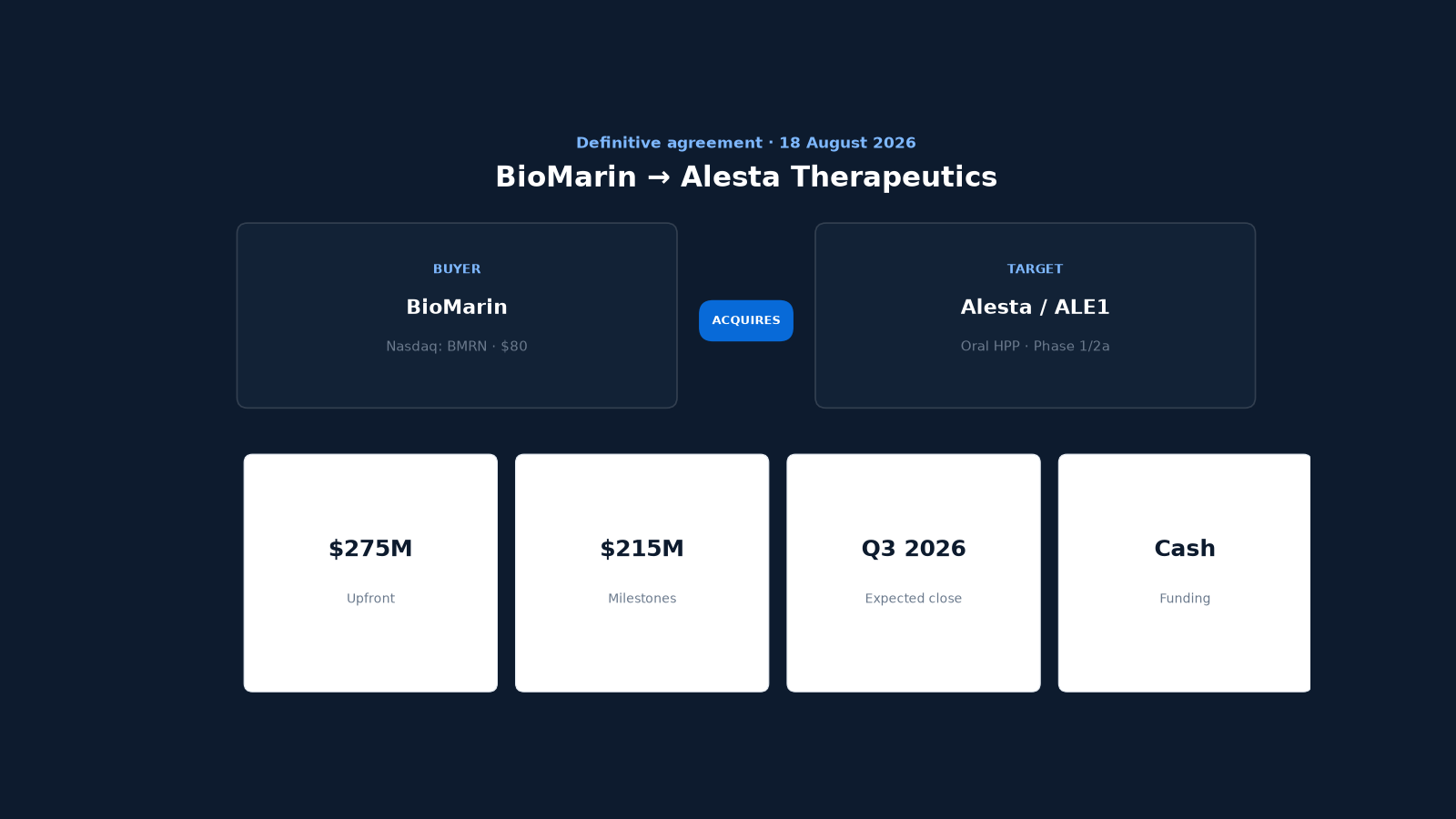
| Upfront | $275M |
| Milestones | Up to $215M |
| Close | Q3 2026 |
| BMRN | $69.33 +3.49% |
| Total potential | Up to $490M |
Acquiry Deal Intelligence · 18 August 2026
BioMarin's purchase of Alesta is an asset-led rare-disease bet: cash for a clinical oral HPP candidate, a clean spinout of everything else, and a stated ambition to compete in larger rare-disease markets without inventing commercial forecasts the primary release does not support.
While software and InsurSec deals dominated August headlines, BioMarin quietly signed a $275 million upfront agreement for Alesta Therapeutics · buying a single oral HPP clinical asset and requiring a pre-close spinout of everything else.
What follows: the announcement in full, how $275 million upfront stacks against up to $490 million total potential consideration, why ALE1 fits BioMarin's skeletal franchise, and what rare-disease founders should take from an employee-free asset acquisition.
01
02 · Deal Intelligence
What happened
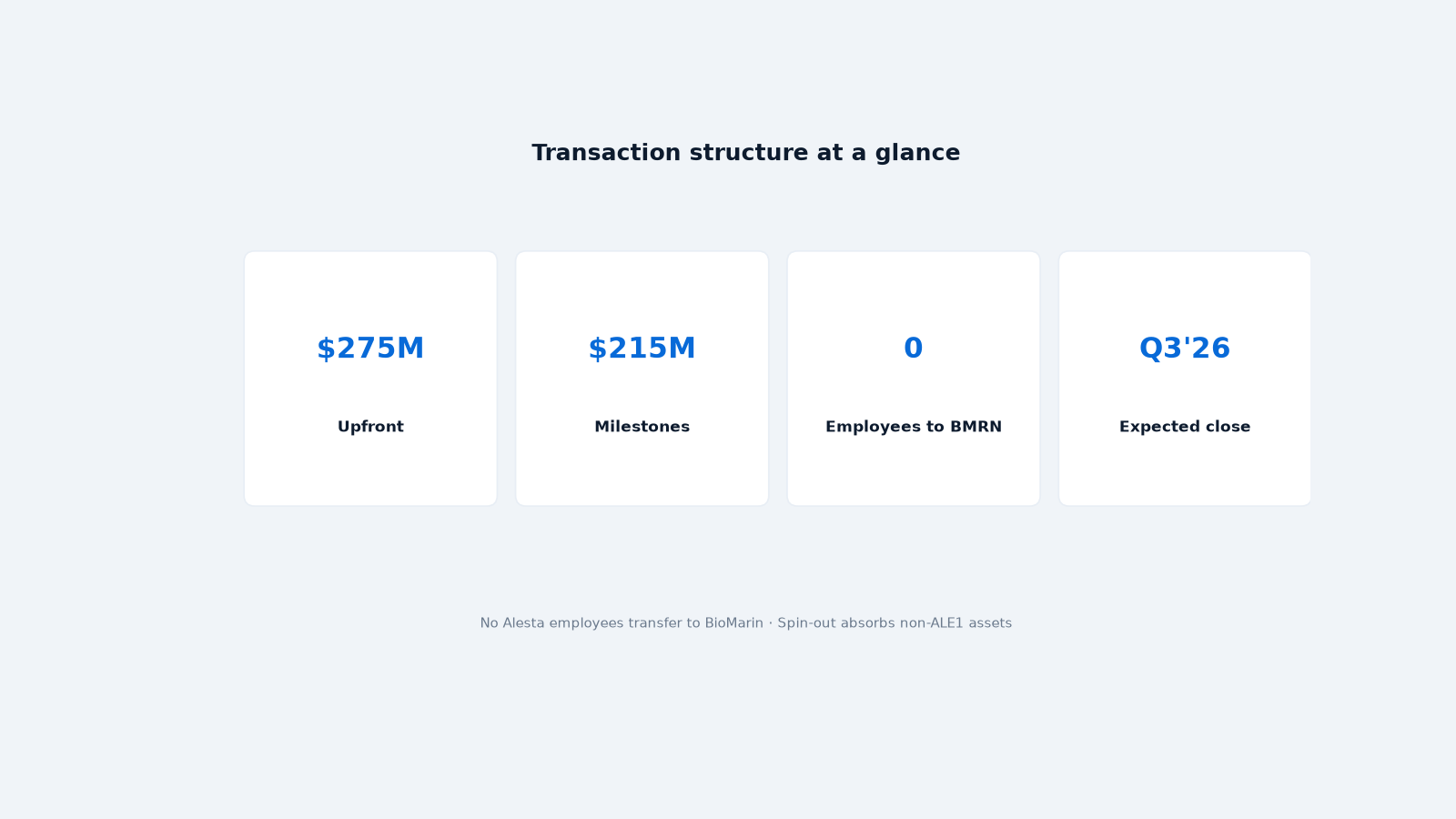
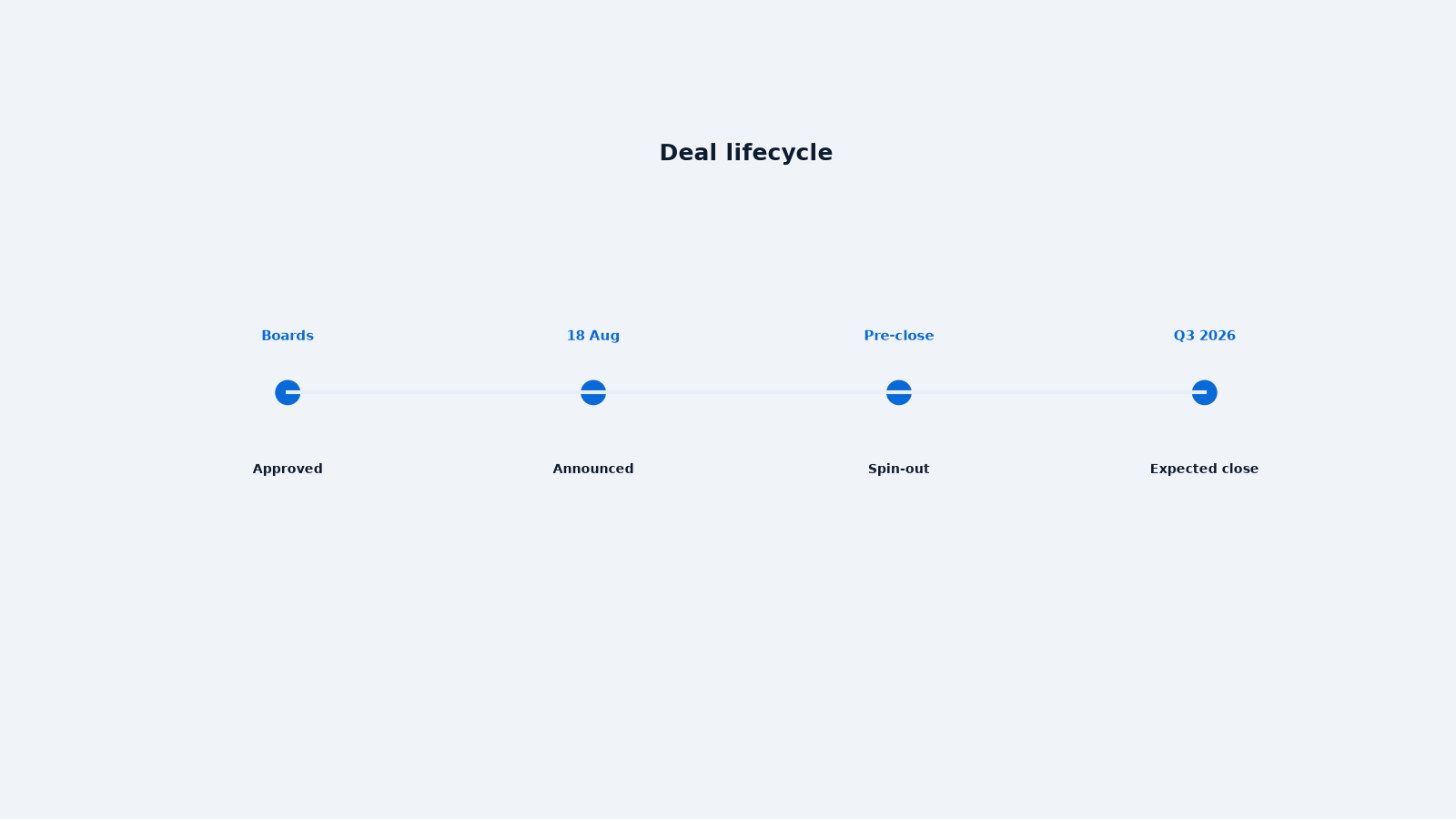
On 18 August 2026, BioMarin Pharmaceutical Inc. (Nasdaq: BMRN) announced it had entered into a definitive agreement to acquire Alesta Therapeutics to gain Alesta's lead clinical-stage asset, ALE1. BioMarin will pay $275 million upfront, plus up to $215 million in subsequent payments upon achievement of certain development and regulatory milestones. The transaction has been approved by the boards of both companies and is expected to be completed this quarter (Q3 2026), subject to customary closing conditions.
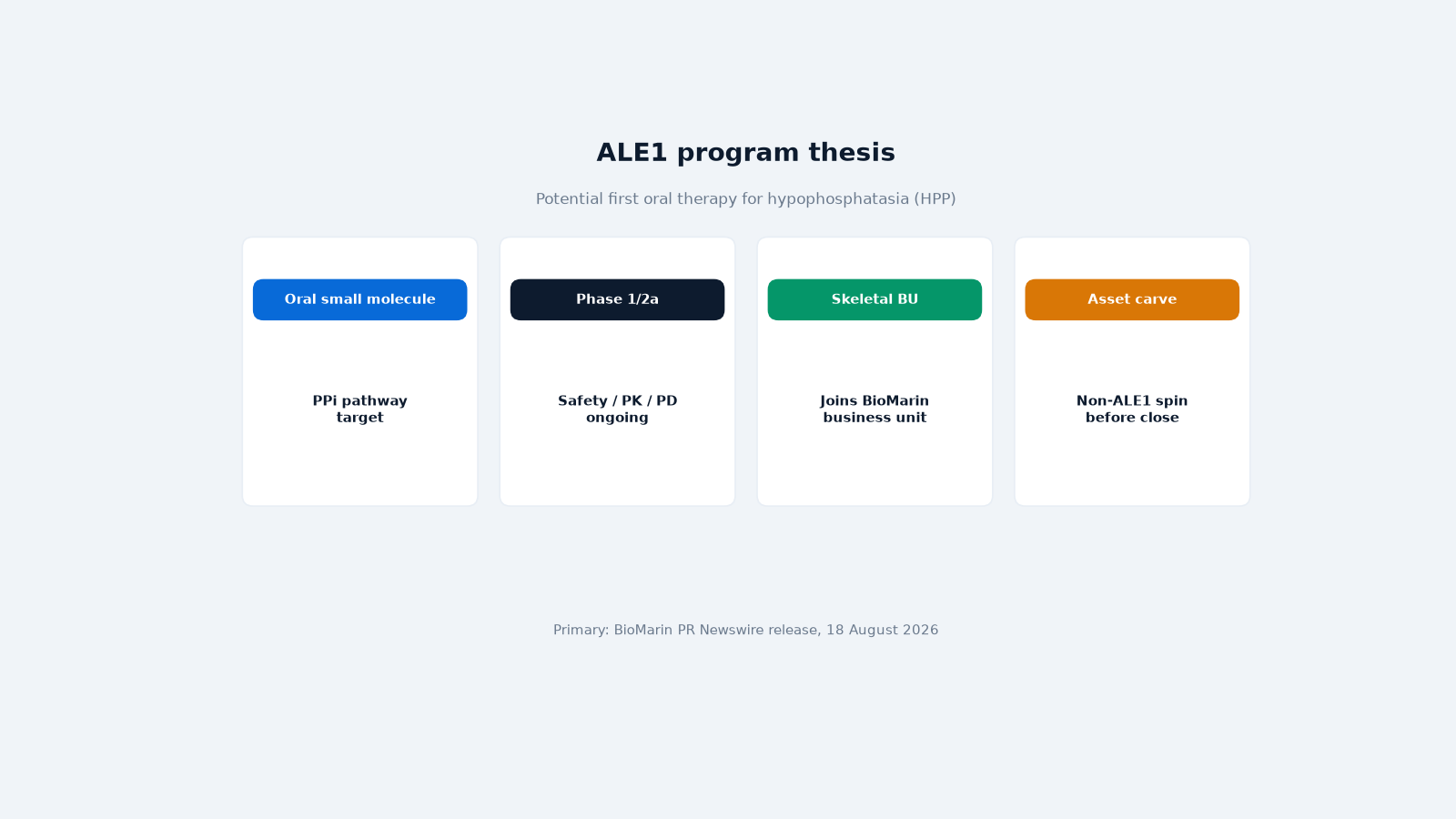
ALE1 is an orally active small molecule for the potential treatment of hypophosphatasia (HPP), a rare genetic bone disease caused by mutations in the ALPL gene. The candidate is being evaluated in an ongoing Phase 1/2a clinical trial assessing safety, tolerability and pharmacokinetics/pharmacodynamics in healthy volunteers and adults with HPP, and has the potential to be the first oral therapy for HPP. Following close, the program will become part of BioMarin's Skeletal Conditions Business Unit.
Structure matters as much as price. Immediately prior to close, Alesta will spin out all non-ALE1 assets to a new entity, and former Alesta employees will transfer to that spinout. As a result, no Alesta employees become employees of BioMarin in connection with the transaction. BioMarin intends to fund the deal with cash on hand, expects updated full-year 2026 guidance after closing, and describes the transaction (excluding the upfront) as modestly dilutive to 2026 financial results.
The announcement lands in an active August 2026 M&A window that also includes Munich Re's $575 million At-Bay agreement and Bending Spoons' $1.285 billion Airtable transaction. BioMarin's deal is a different species of strategic bet: a public rare-disease company paying cash for a single clinical program with a pre-close perimeter clean-up, not a platform roll-up or carrier-scale InsurSec consolidation.
02
03 · Deal Intelligence
The terms
BioMarin disclosed a clear cash-and-milestones package and an unusual people-and-assets perimeter. The primary release does not publish equity value alternatives, earn-out schedules beyond the milestone cap, peak sales forecasts, or EV/sales multiples. Acquiry therefore anchors on disclosed consideration only.
What we know from primary sources:
- Upfront$275 million
- Milestonesup to $215 million (development and regulatory)
- Total potential considerationup to $490 million ($275M + up to $215M)
- AssetALE1 (oral small molecule for HPP; Phase 1/2a ongoing)
- StructureNon-ALE1 assets spin out before close; Alesta employees transfer to spinout
- EmploymentNo Alesta employees join BioMarin
- FundingCash on hand; modestly dilutive to 2026 excluding upfront; updated FY2026 guidance post-close
- TimingExpected close this quarter (Q3 2026), customary conditions
- AdvisorsMorgan Stanley and Jones Day (BioMarin); J.P. Morgan, Goodwin Procter, NautaDutilh (Alesta)
| Transaction terms · Disclosed 18 Aug 2026 | $275M upfront · up to $490M total potential |
|---|---|
| Definitive agreement | Pending close |
Upfront $275M
Milestones Up to $215M dev / regulatory
Total potential Up to $490M
Funding Cash on hand
Expected close Q3 2026
Asset home Skeletal Conditions BU
Consideration structure
- Acquisition of Alesta Therapeutics to gain ALE1
- Non-ALE1 assets spin out to a new entity before close
- Alesta employees transfer to spinout; none join BioMarin
- Peak sales / EV-sales multiples not disclosed
Primary source BioMarin PR Newswire release, 18 August 2026.
Valuation context
| Upfront cash | $275 million |
|---|---|
| Development / regulatory milestones | Up to $215 million |
| Total potential consideration | Up to $490 million |
$275M + up to $215M = up to $490M total potential (announcement arithmetic)
Sector · Rare disease biotech / skeletal conditionsBuyer · BioMarin Pharmaceutical · Target · Alesta TherapeuticsPrimary release ↗ (opens in a new tab)
04 · Deal Intelligence
Valuation waterfall
$275M upfront versus up to $490M total potential consideration
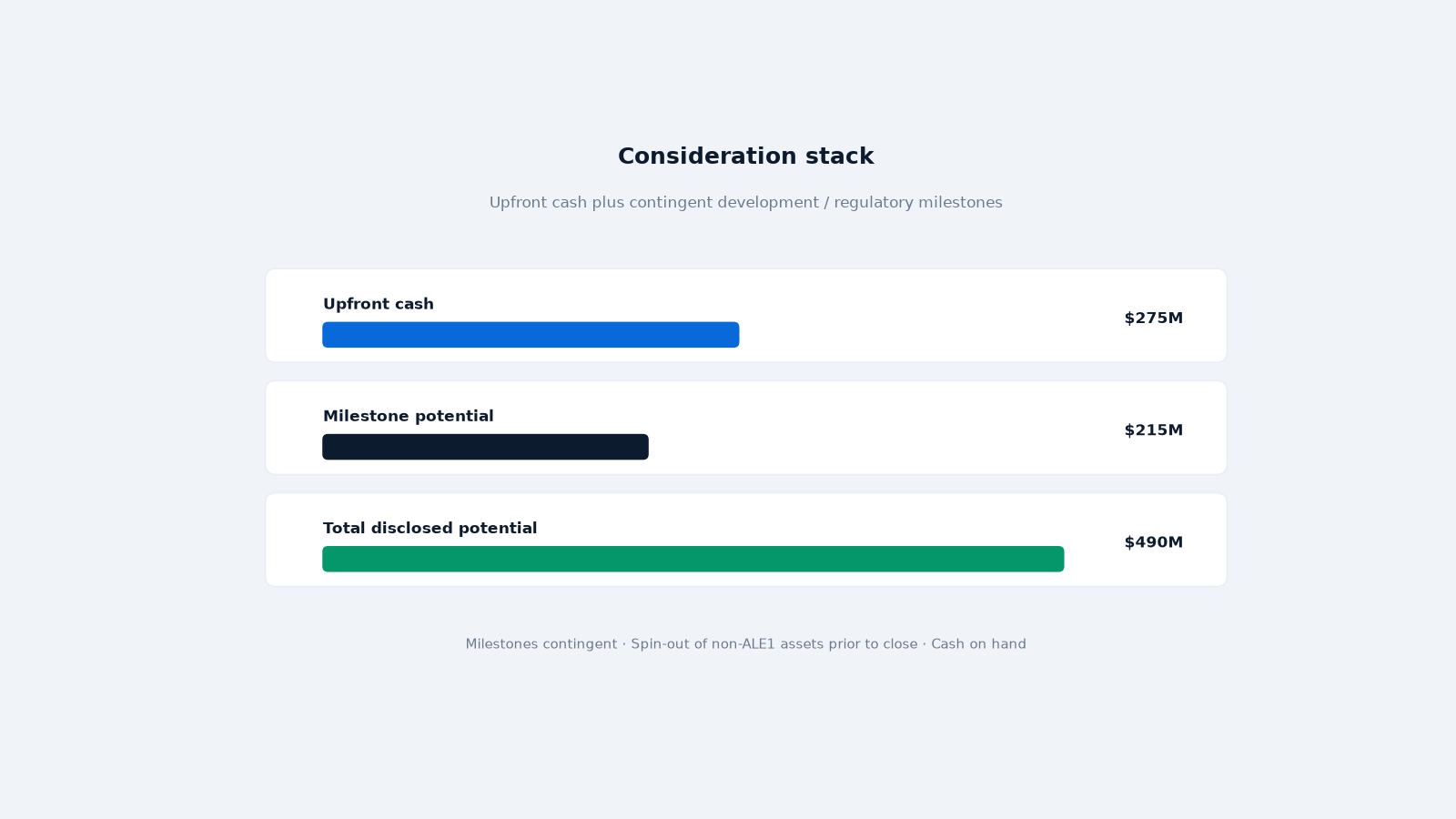
Valuation framing for this deal is consideration arithmetic, not a software-style revenue multiple. The $275 million upfront is the cash BioMarin puts at risk at signing economics. The additional up to $215 million is contingent on development and regulatory success. Added together, the announcement implies up to $490 million of total potential consideration if every disclosed milestone category is earned. That bridge is the right chart for founders and investors reading this page. It is not an enterprise-value-to-sales multiple, and it is not a peak-sales model. Those figures are simply not in the primary source.
The spinout clause is economically material. BioMarin is not buying Alesta as an operating company with a multi-program pipeline and an intact employee base. It is buying a path to ALE1 with a contractual requirement that residual assets and people leave before closing. That reduces integration surface area and clarifies what shareholders of the residual spinout retain. It also means diligence, IP assignment, and clinical-trial sponsorship transition become the operational critical path alongside customary closing conditions.
Funding commentary supports a balance-sheet rationale. BioMarin says it will use cash on hand, expects the deal (excluding upfront) to be modestly dilutive to 2026 results, and plans to refresh full-year 2026 guidance after close. For public biotech M&A, that language tells equity holders where to look next: the post-close guidance update, not a speculative revenue multiple invented for a Phase 1/2a asset.
03
05 · Deal Intelligence
Why BioMarin bought Alesta
Rare-disease strategics face a recurring problem: commercial franchises age, injectable standards of care leave adherence and convenience gaps, and early clinical pipeline slots are expensive to fill through internal discovery alone. ALE1 is BioMarin's answer to that problem in hypophosphatasia: an oral small molecule aimed at the central disease metabolite, inorganic pyrophosphate (PPi), with the potential to address skeletal and broader HPP manifestations through systemic correction of disease biology.
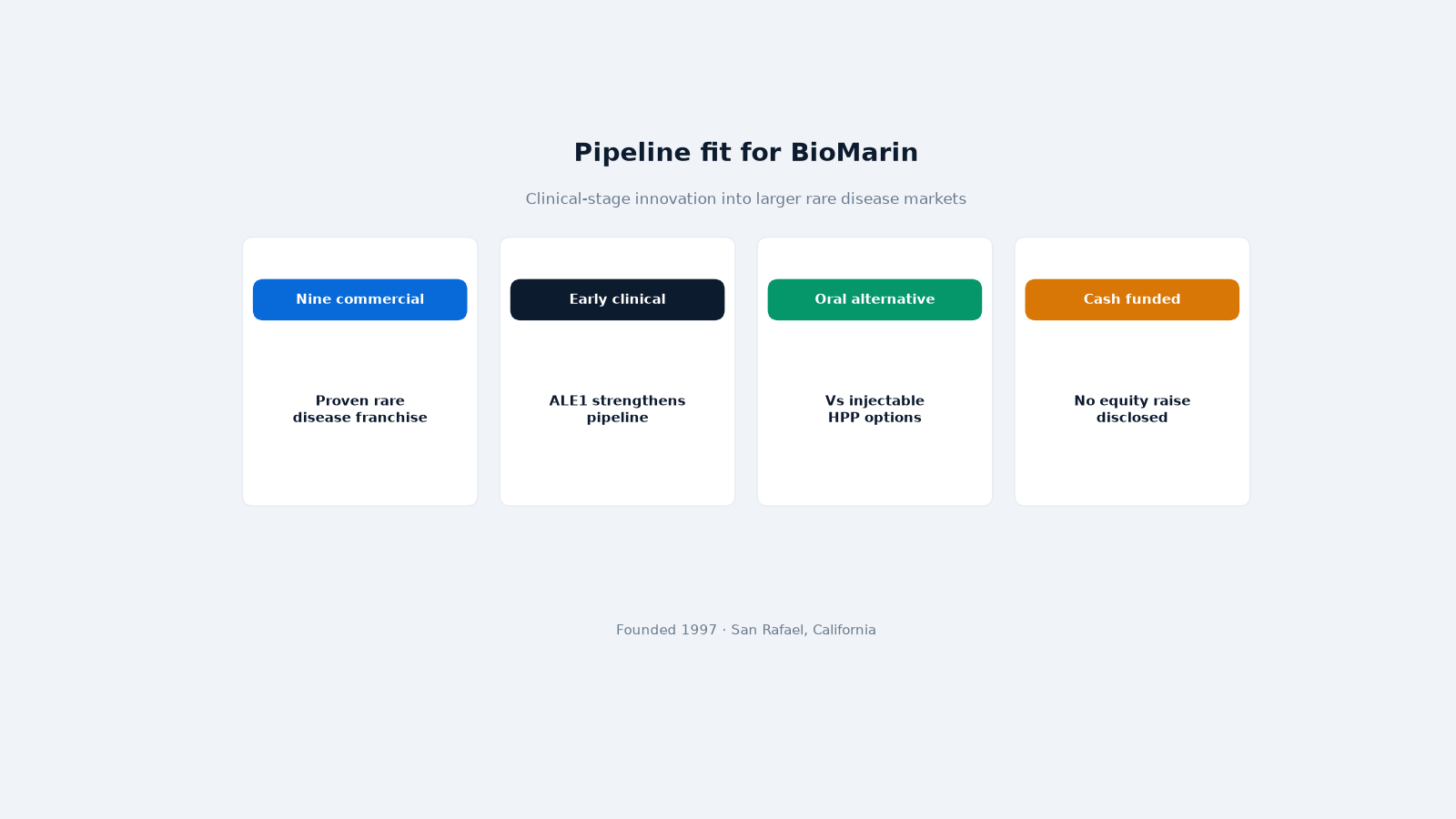
Alexander Hardy, BioMarin's President and Chief Executive Officer, framed the strategic fit in portfolio language rather than near-term sales theater: ALE1 brings "a potential oral alternative to the injectable therapies available today" and "meaningfully strengthen[s] our early-stage clinical pipeline," while letting BioMarin "compete in larger rare disease markets" with an asset that could reach its "largest addressable patient population." That is a growth thesis built on unmet need and modality shift, not a disclosed peak-sales number.
“ALE1 is a strong strategic fit for BioMarin, bringing a potential oral alternative to the injectable therapies available today for people living with HPP around the world while meaningfully strengthening our early-stage clinical pipeline. This is exactly the kind of opportunity to address a significant unmet need that lets us compete in larger rare disease markets, adding an asset that has the potential to reach our largest addressable patient population.”
Ilan Ganot, Chief Executive Officer of Alesta Therapeutics, described buyer selection as a rare-disease capability match: Alesta chose BioMarin for "deep commitment to people living with rare diseases" and for "global reach, scale, and proven expertise in rare disease drug development." For a clinical-stage company handing a lead asset to a strategic, distribution and development infrastructure matter more than cultural branding. BioMarin's disclosed profile (founded 1997, San Rafael, nine commercial therapies) is the capability backdrop behind that quote.
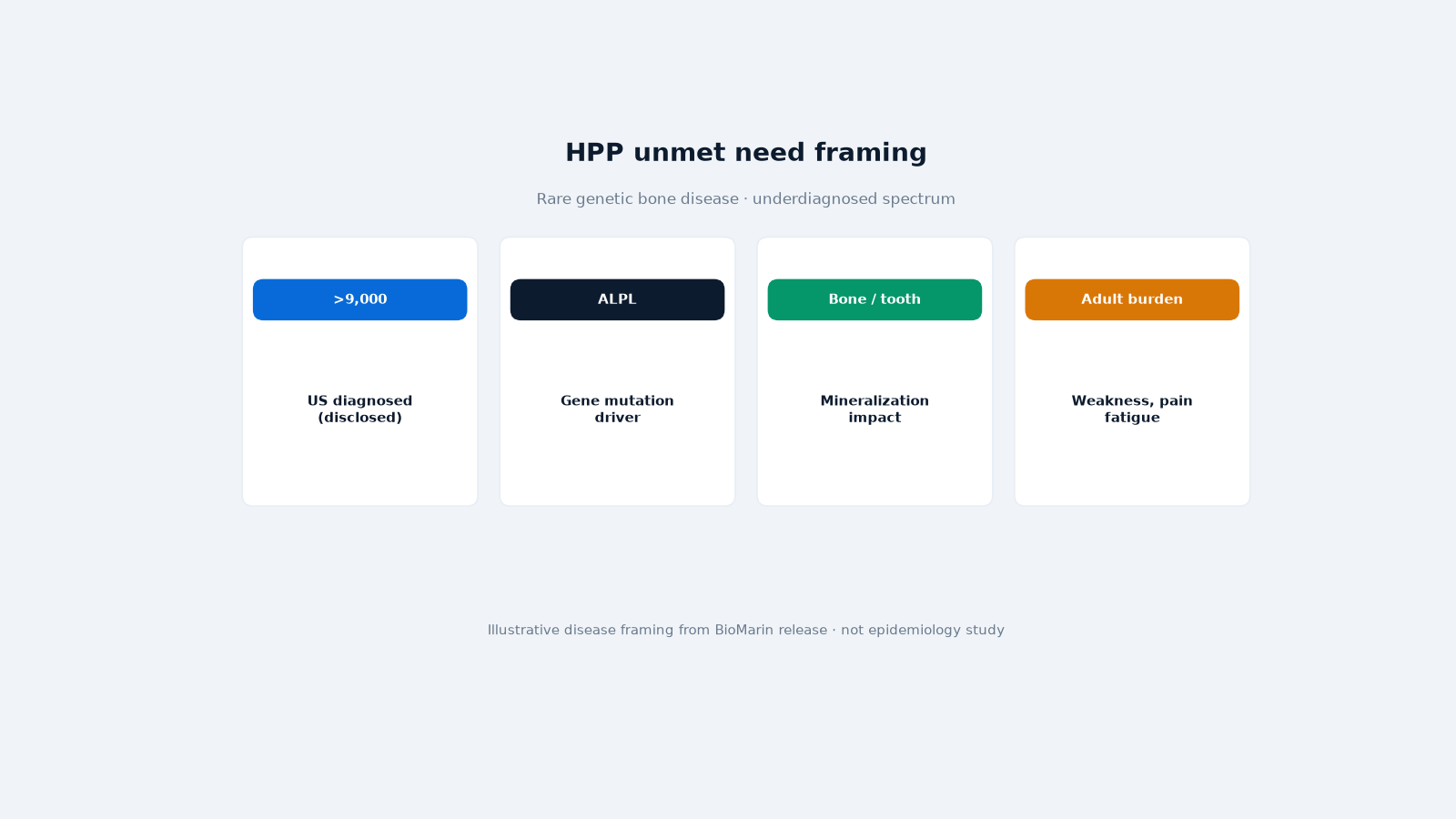
Disease burden reinforces why BioMarin is willing to pay cash now. HPP can mean easy or frequent bone breaks, early tooth loss, and in adults clinically significant muscle weakness, fatigue and pain. More than 9,000 people have been diagnosed with HPP in the United States, and the disease is often underdiagnosed because symptoms can mimic more common conditions. Underdiagnosis is not the same as a commercial forecast. It is, however, a reason a skeletal-conditions franchise would want a differentiated oral modality if Phase 1/2a data and later studies support it.
Mechanistically, ALE1 is designed to inhibit a novel target that regulates PPi levels. By lowering excess PPi, the program aims to restore healthier bone and mineral metabolism across the HPP spectrum. BioMarin's decision to seat the asset in the Skeletal Conditions Business Unit after close signals where development, medical affairs, and eventual commercial planning would live if the program advances. The buyer is not parking ALE1 in a generic "pipeline" bucket; it is attaching the asset to an existing skeletal franchise.
For competitors, the message is that public rare-disease companies will still pay nine-figure upfront cash for differentiated clinical assets when the modality story is clear and the perimeter can be cleaned before close. Sellers who can deliver a single-asset package with clean IP, transferable trial sponsorship, and a residual company for leftover programs may find more buyers than sellers pitching an undifferentiated multi-asset biotech without a spinout plan.
Strategic rationale at a glance
| 01 | Oral HPP optionality | Potential first oral therapy versus injectable standards of care. |
|---|---|---|
| 02 | Pipeline depth | Early-stage clinical asset into Skeletal Conditions BU. |
| 03 | Clean asset perimeter | Non-ALE1 spinout keeps BioMarin focused on one program. |
| 04 | PPi biology | Systemic correction of the central HPP metabolite. |
| 05 | Cash funding | Balance-sheet financed; updated FY2026 guidance post-close. |
| 06 | Near-term close | Q3 2026 expected; customary conditions only in disclosure. |
BioMarin disclosed acquisition cadence
Only the Alesta / ALE1 transaction is disclosed in this report's primary source set.
- 1.Aug 2026 Alesta Therapeutics (ALE1) $275M + up to $215M Pending close
04
06 · Deal Intelligence
Market implications
Biotech M&A in 2026 is not a single market. Platform software deals price recurring revenue; carrier InsurSec deals price premium books; clinical rare-disease deals price probability-weighted pipeline optionality. BioMarin's Alesta transaction belongs in the third bucket. Readers should not import EV/ARR logic from Airtable or EV/GWP logic from At-Bay into a Phase 1/2a oral HPP candidate.
What the Alesta deal does re-price is asset perimeter design. By forcing a pre-close spinout of non-ALE1 assets and transferring employees to that spinout, BioMarin shows how strategics can buy a clinical program without absorbing an entire operating company. That structure will influence term sheets elsewhere in rare disease: expect more "asset plus residual NewCo" conversations when buyers want one molecule and sellers want continuity for everything else.
07 · Deal Intelligence
Comparable Deal Intelligence transactions
Sibling Acquiry Deal Intelligence reports for August 2026 M&A context · not biotech revenue comps.
| Year | Buyer | Target | Value | Disclosed value | Sector | Row |
|---|---|---|---|---|---|---|
| 2026 | Munich Re | At-Bay | $575M EV | $575M EV | InsurSec / cyber insurance | [Report →](/insights/munich-re-acquires-at-bay/) |
| 2026 | Bending Spoons | Airtable | $1.285B EV | $1.285B EV | Enterprise SaaS | [Report →](/insights/bending-spoons-acquires-airtable/) |
For sellers: Prepare a diligence room that separates the lead asset's CMC, clinical, and IP stack from residual programs. If employees will not join the buyer, document how trial continuity, vendor contracts, and know-how transfer work without an acqui-hire. Do not anchor negotiations on invented peak sales. Anchor on upfront cash, milestone definition quality, and spinout feasibility.
For strategics: BioMarin's Hardy framing (oral alternative, early pipeline strength, larger rare disease markets, largest addressable patient population) is a template for public communication when commercial forecasts are not ready for disclosure. Competitors in skeletal and metabolic rare disease should assume oral modality races will attract balance-sheet buyers even before Phase 3 clarity, provided the biology story is coherent and the asset can be ring-fenced.
For investors: Watch the post-close FY2026 guidance update and the Phase 1/2a readout path more than social-media multiple chatter. The disclosed economics are $275 million now and up to $215 million later. Everything else is interpretation. Acquiry will not invent peak sales or EV/sales multiples that the release omits.
Broader Deal Intelligence context in August 2026 shows strategics paying for category-defining assets with measurable strategic fit: Munich Re × At-Bay for InsurSec scale, Bending Spoons × Airtable for workflow software, and BioMarin × Alesta for a clinical oral rare-disease bet. Consolidation is selective. Buyers pay when the asset is specific; they restructure when the company is not.
05
08 · Deal Intelligence
What happens next
Near-term execution has three tracks: closing mechanics, spinout completion, and clinical continuity for ALE1. BioMarin expects the acquisition to complete this quarter, subject to customary closing conditions. The release does not enumerate antitrust jurisdictions or Form filings in detail, so the public checkpoint is simply whether the companies confirm close inside Q3 2026.
The spinout is a closing condition in practical terms even if described as a pre-close step. Alesta must move non-ALE1 assets into a new entity and transfer employees before BioMarin takes ALE1. Any delay in corporate separation, IP assignment, or employment transfer can push close even when cash and board approvals are ready. Counterparties watching this deal should treat spinout readiness as a leading indicator.
After close, ALE1 joins BioMarin's Skeletal Conditions Business Unit. That is the integration authority for development planning. Key milestones Acquiry will track: confirmation of close, updated FY2026 guidance, Phase 1/2a progress disclosures, and any later milestone triggers that convert the contingent $215 million into cash outflow. Until those primary sources publish, contingent consideration remains a ceiling, not a schedule.
For BioMarin equity holders, the modest-dilution comment (excluding upfront) and cash-funding plan reduce financing drama relative to equity-heavy biotech deals. The open question is opportunity cost: how ALE1 competes for internal capital against other pipeline priorities once it sits inside the skeletal franchise. Earnings commentary and guidance language after close will be the first place that trade-off becomes visible.
For Alesta's residual stakeholders in the spinout, the transaction is both an exit on ALE1 economics and a reset of the remaining portfolio. The release praises Alesta's scientific and drug-development capabilities while making clear those employees do not move to BioMarin. Continuity of the residual company, not BioMarin retention packages, is the talent story to watch.
Acquiry will update this report when primary sources publish closing confirmation, guidance revisions, clinical updates, or milestone disclosures. Continuous reporting is core to Deal Intelligence: transaction pages are living documents, not static press summaries.
06
09 · Deal Intelligence
Acquiry analysis
Acquiry's read is that BioMarin paid for a ring-fenced clinical option on oral HPP, not for a biotech platform story detached from ALE1. The combination of $275 million upfront, a capped milestone package, cash funding, a near-term close, and a mandatory non-ALE1 spinout is a coherent strategic design: buy the asset, leave the residual company behind, and seat the program in an existing skeletal business unit.
Three structural forces make this deal instructive beyond the headline cash. First, buyer type: BioMarin is a public rare-disease operator with nine commercial therapies and permanent franchise incentives. That changes negotiation dynamics versus a financial sponsor. Milestone definitions tied to development and regulatory events fit a strategic that can run Phase programs; they are less about quick margin expansion and more about clinical progression.
Second, perimeter engineering. Acqui-hires are common in software. This deal is the opposite: an acqui-asset with an explicit no-employee transfer to the buyer. Founders and boards structuring rare-disease exits should study whether a spinout improves bid clarity. Sometimes the cleanest way to maximize ALE1-like value is to stop forcing buyers to underwrite unrelated programs and payroll.
Third, disclosure discipline. The primary release is rich on structure and silent on peak sales. That silence is a feature of responsible clinical-stage communication, not a gap Acquiry should fill with invented forecasts. Deal Intelligence exists to cite what was said, label what is interpretation, and refuse fabricated multiples. The comparable set on this page therefore points to sibling August 2026 reports (Munich Re × At-Bay, Bending Spoons × Airtable) for M&A tempo, not for biotech revenue math.
For shareholders exploring a sale of a clinical rare-disease asset, the BioMarin × Alesta package is a useful term-sheet reference: upfront cash large enough to clear a process, milestones capped and labeled, funding certainty from a public balance sheet, and a structural answer for residual IP and people. It is not a template for inventing commercial peaks. It is a template for selling what a strategic can actually underwrite.
Regulatory and clinical risk remain real. Phase 1/2a status means safety, tolerability, and PK/PD are still being established in healthy volunteers and adults with HPP. Closing this quarter does not de-risk the molecule. It only transfers that risk to BioMarin's skeletal franchise under a defined cash-and-milestones envelope.
If you are evaluating a sale of a clinical-stage rare-disease program, this transaction is a useful comp for structure and buyer mapping. Acquiry tracks strategic mandates through our Deal Intelligence programme and sell-side advisory work via the Acquisitions hub.
Reference
Frequently asked questions
How much is BioMarin paying for Alesta Therapeutics?
BioMarin will pay $275 million upfront plus up to $215 million in subsequent payments upon achievement of certain development and regulatory milestones, for total potential consideration of up to $490 million, per the 18 August 2026 release.
What is BioMarin buying?
BioMarin is acquiring Alesta to gain ALE1, an orally active small molecule in Phase 1/2a for hypophosphatasia (HPP). Immediately prior to close, Alesta will spin out all non-ALE1 assets to a new entity.
When will the deal close?
The companies expect the transaction to be completed this quarter (Q3 2026), subject to customary closing conditions. Both boards have approved the agreement.
Do Alesta employees join BioMarin?
No. Former Alesta employees transfer to the spinout entity that receives non-ALE1 assets. As a result, no Alesta employees become employees of BioMarin in connection with the transaction.
How is the deal funded?
BioMarin intends to fund the transaction with cash on hand. Excluding the upfront consideration, the transaction is expected to be modestly dilutive to 2026 financial results. Updated FY2026 guidance is expected after close.
What is ALE1?
ALE1 is an orally active small molecule designed to inhibit a novel target that regulates levels of inorganic pyrophosphate (PPi), the metabolite at the center of HPP pathology. It is being evaluated in an ongoing Phase 1/2a trial in healthy volunteers and adults with HPP, and has the potential to be the first oral therapy for HPP.
What is hypophosphatasia (HPP)?
HPP is a rare genetic bone disease caused by mutations in the ALPL gene. It can affect bone and tooth mineralization, with easy or frequent bone breaks, early tooth loss, and in adults muscle weakness, fatigue and pain. More than 9,000 people have been diagnosed with HPP in the US; the disease is often underdiagnosed.
Where will ALE1 sit inside BioMarin?
Following close, the program will become part of BioMarin's Skeletal Conditions Business Unit.
What is BioMarin's stock ticker?
BioMarin Pharmaceutical Inc. trades on Nasdaq under the ticker BMRN. The company was founded in 1997 in San Rafael, California, and has nine commercial therapies.
Who advised on the transaction?
Morgan Stanley & Co. LLC is exclusive financial advisor to BioMarin, with Jones Day as legal counsel. J.P. Morgan Securities LLC is exclusive financial advisor to Alesta, with Goodwin Procter LLP and NautaDutilh N.V. as legal counsel.
Does the announcement disclose peak sales or revenue multiples?
No. The primary release discloses upfront cash, contingent milestones, funding source, dilution commentary, and clinical positioning for ALE1. It does not publish peak sales forecasts or EV/sales multiples. Acquiry does not invent those figures.
Why does this matter for rare-disease M&A?
The structure is a clean clinical-asset acquisition with a pre-close spinout of non-core programs and people. Strategics buying single pipeline assets increasingly separate the asset they want from the residual company, which changes negotiation leverage for founders and investors.
Keep reading
Related analysis

Deal Intelligence · Healthcare
Roche Acquires Foundation Medicine and Brings Precision Oncology’s Data Layer Fully In-House
Acquiry Deal Intelligence analysis of Roche’s acquisition of the remaining Foundation Medicine stake, covering terms, valuation, rationale, integration and source disclosures.

Deal Intelligence · SaaS
Francisco Partners puts ~$650m on Weave and takes healthcare's AI engagement platform private
Francisco Partners signed a definitive agreement on 18 August 2026 to acquire Weave Communications (NYSE: WEAV) at approximately $650 million aggregate equity value and $7.40 per share in cash. The ~34% premium take-private folds a 40,000-location AI patient engagement and payments platform into PE ownership with a Q4 2026 close target.

Deal Intelligence · Fintech
Munich Re puts $575m on At-Bay and bets the cyber market belongs to InsurSec
Germany's reinsurance giant signed a definitive agreement for US InsurSec leader At-Bay at $575 million enterprise value on 19 August 2026. The deal folds a top-ten US cyber insurer, and the security platform behind it, into Hartford Steam Boiler, Munich Re's specialty line that has backed At-Bay since day one.
Explore the sector:SaaS acquisitions
About the analyst
Joash Boyton
Founder and Managing Director, Acquiry · Melbourne, Australia · Global coverage
Joash Boyton is the Founder and Managing Director of Acquiry, a specialist M&A advisory firm focused on the acquisition and sale of businesses. He executes buy-side and sell-side mandates from USD $1M to $500M across technology, SaaS, fintech, payments, gaming, blockchain and emerging verticals, and is not limited to them. Any sector, any market.