
What People walked away from
People Incorporated withdrew its 1 June 2026 proposal to buy the remaining MGM Resorts public shares for $48.30 cash each, while retaining about 27% of the company and leaving the listed operator intact.
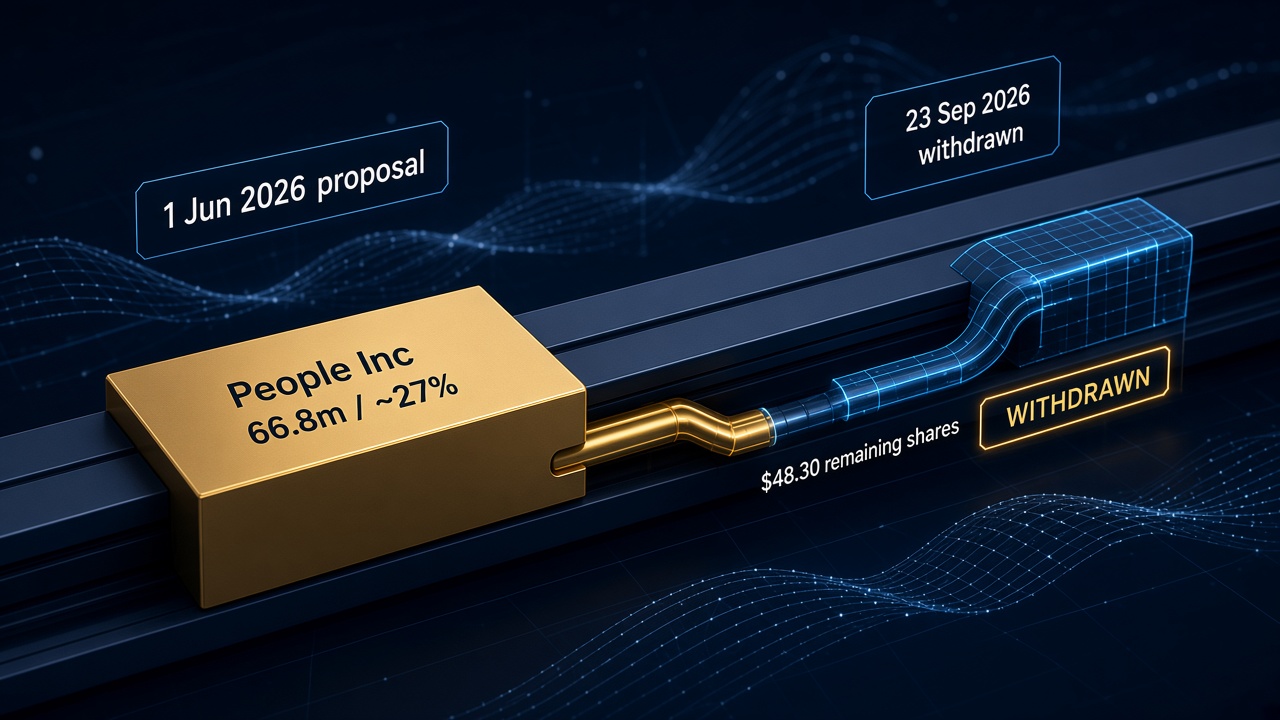
| Item | Detail |
|---|---|
| Acquirer (proposal) | People Incorporated |
| Target | MGM Resorts International |
| Stake retained | 66.8 million shares (~27%) |
| Prior offer | $48.30 cash per remaining share |
| Status 23 Sep 2026 | Proposal withdrawn |
On 23 September 2026, People Incorporated said it had withdrawn its proposal to purchase all public shares of MGM Resorts it does not already own. The same release records that People still holds 66.8 million MGM shares, about 27% of the company, and that chairman Barry Diller remains confident in management and the company's prospects.
The proposal that fell away was the 1 June 2026 cash offer of $48.30 a share for the remaining public float. Reuters reported that June offer as valuing the remaining stake at more than $18 billion. That figure is Reuters' reported characterisation of the remaining shares at the June price, not a newly disclosed People or MGM enterprise-value calculation in the withdrawal releases.
Diller's line is the industrial explanation, not a spreadsheet. "We didn't feel the mix was coming together in the way we had hoped and have decided not to pursue taking the company private at this time." He thanked MGM's special committee and directors for the process, noted People Inc's publishing business, and left the door open: People remains interested in the possibility of a strategic transaction and a range of alternatives.
MGM's board response is equally plain. A special committee had negotiated with People over several months. With the proposal withdrawn, MGM confirms it will continue as a standalone company. There is no close window to underwrite because there is no live take-private to close.
Why the stake still fits the operator story
People keeps a meaningful economic interest in an operator whose published standalone case rests on Las Vegas, regional properties, BetMGM momentum, MGM China and the Osaka development path.
A withdrawn take-private does not unwind the industrial logic that made MGM interesting to a media and consumer-brands owner. People already sits on a large minority stake. The People release frames that holding as belief in businesses built around enduring consumer brands and iconic real-world experiences. That is an operator thesis, not a pure publishing adjacency.
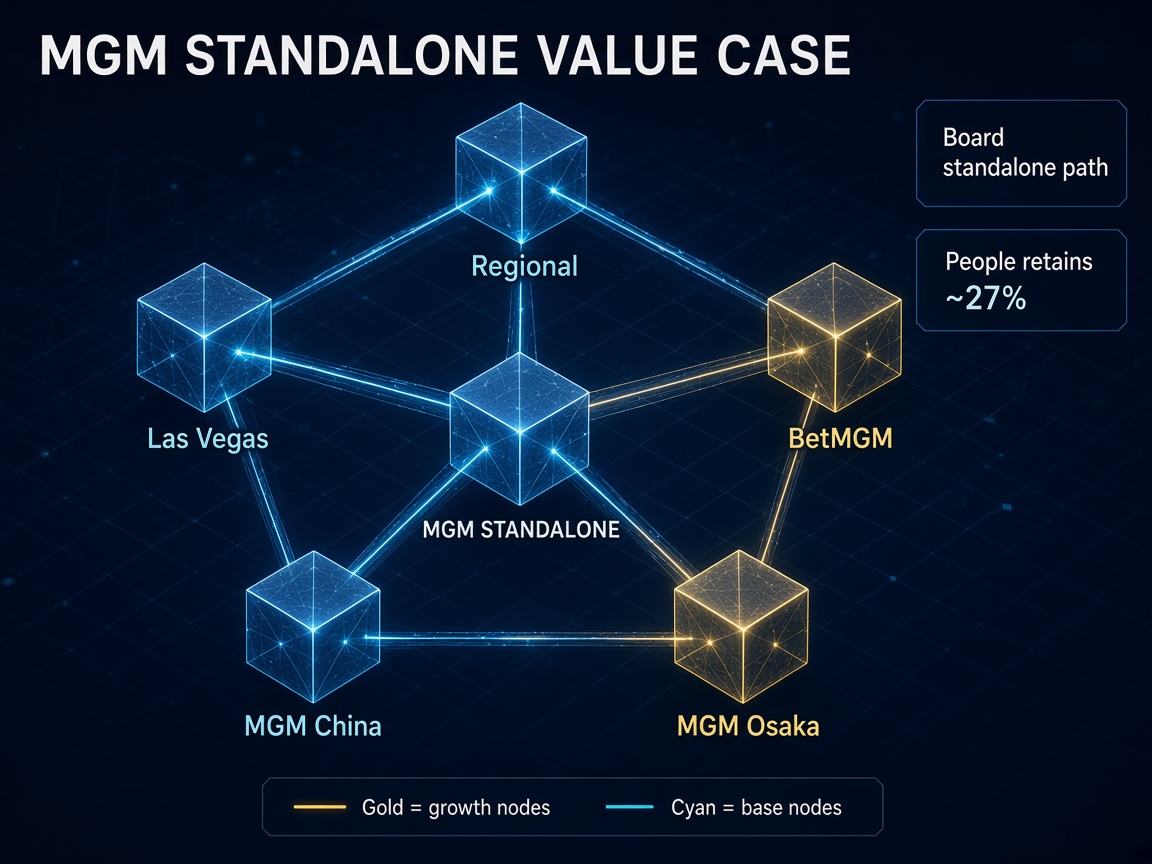
| Item | Detail |
|---|---|
| Las Vegas | Leading Strip position |
| Regional | Best-in-class properties |
| BetMGM | Continued momentum |
| MGM China | International portfolio |
| MGM Osaka | Integrated resort opportunity |
MGM's own framing after the withdrawal is a five-pillar operating map. Chairman Paul Salem points to a leading Las Vegas position, regional properties, BetMGM's continued momentum, the MGM China portfolio and the opportunity ahead with MGM Osaka. Those are the engines the board says can increase shareholder value without a take-private.
The fit question for readers is therefore different from a signed acquisition brief. It is whether People's retained 27% and stated openness to alternatives sit comfortably beside an MGM board that prefers to run the estate as a listed standalone. Both sides can be true at once: the full buyout mix did not come together, and the operating assets remain strategically relevant to both parties.
Capital-markets readers will watch equity reaction and any later strategic process. Operators will watch whether BetMGM, Macau and Osaka progress on the timetable the board is selling. The public file now supports the second watch more cleanly than the first.
How the operating stack still fits together
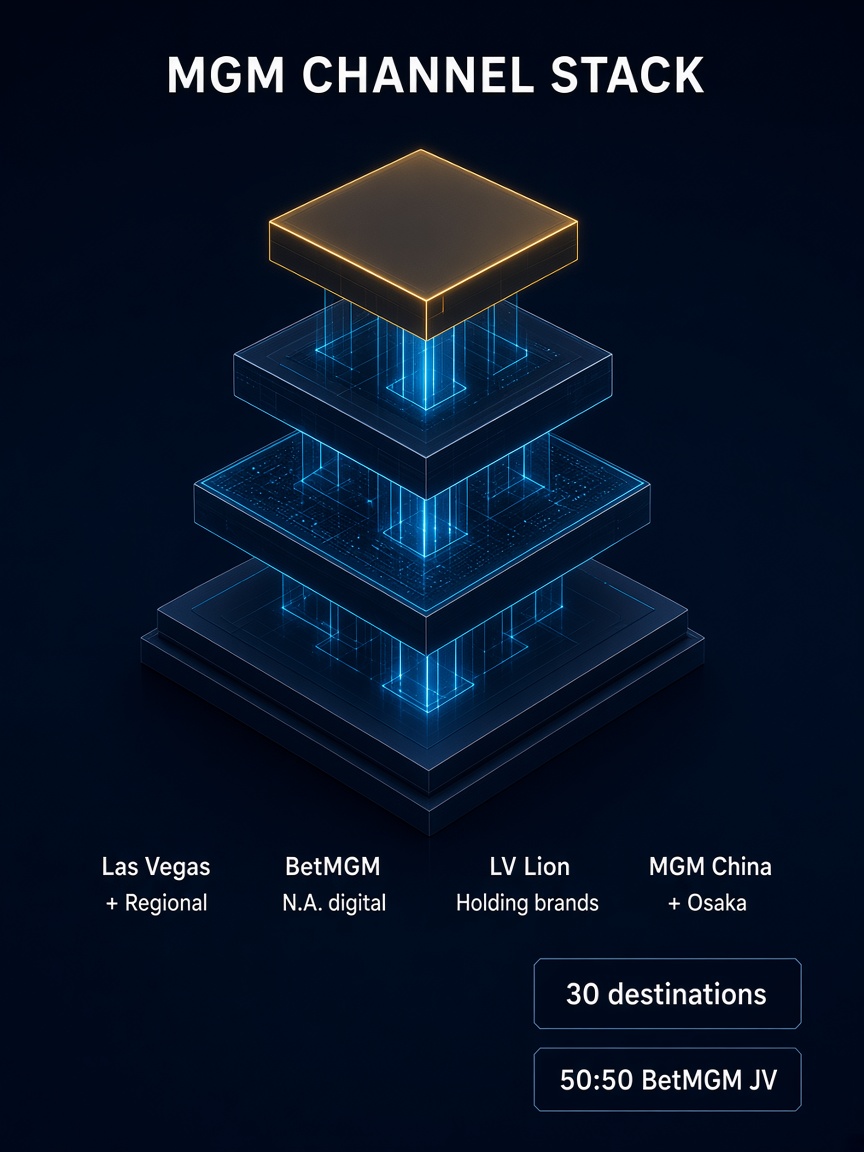
| Item | Detail |
|---|---|
| Land-based | Las Vegas and regional destinations |
| North America digital | BetMGM sports betting and online gaming |
| International digital | LV Lion Holding brands |
| Asia live | MGM China |
| Asia build | MGM Osaka |
MGM's published stack is a multi-channel gaming and entertainment system: land-based Strip and regional estates, the BetMGM sports betting and online gaming joint venture, European and Brazilian digital brands through LV Lion Holding, and an Osaka integrated-resort build.
The technology and product argument after a withdrawn take-private is continuity, not integration theatre. MGM's board statement treats BetMGM momentum as a core value signal alongside physical estates. BetMGM is the North American sports betting and online gaming joint venture; MGM also points to LV Lion Holding Limited brands across several European jurisdictions and Brazil.
Land-based delivery remains the larger physical machine. MGM describes a portfolio of 30 unique hotel and gaming destinations globally, with Las Vegas-inspired brands, meetings and entertainment infrastructure around the tables and rooms. Regional properties sit beside the Strip concentration. That is an operating system of licences, labour, hospitality and local regulation, not a single software chassis.
International growth is a second product layer. MGM China anchors the Macau exposure. MGM Osaka is framed as a significant forward opportunity through an integrated resort development in Japan. The withdrawal does not invent a new digital architecture; it leaves those build and licence programmes inside a listed company that still has to fund, approve and open them.
For People as a 27% holder, the relevant technology question is whether the digital and international rails compound the Strip and regional base fast enough to justify staying long without control. For MGM management, the same rails are the proof points of the standalone case Salem outlined.
| Layer | Published position | Role after 23 Sep |
|---|---|---|
| Ownership | People holds 66.8m shares (~27%) | Large minority retained; buyout proposal withdrawn |
| Prior proposal | $48.30 cash per remaining share (1 Jun 2026) | No longer live |
| Las Vegas | Board cites leading Strip position | Core standalone cash and brand engine |
| Regional | Best-in-class regional properties | U.S. land-based diversification |
| Digital | BetMGM 50:50 JV; LV Lion Holding brands | Sports betting and online gaming rails |
| International | MGM China; MGM Osaka development | Macau portfolio plus Japan IR path |
Where the standalone estate still distributes value
Value distribution after withdrawal still runs through Las Vegas concentration, U.S. regional casinos, BetMGM's North American digital markets, MGM China and the Osaka development corridor.
Las Vegas remains the flagship distribution node. MGM's board language leads with a leading Strip position. Regional properties extend the same hospitality and gaming model into other U.S. markets without depending on a take-private to keep those licences working.
Digital distribution sits in BetMGM for North America and in LV Lion Holding brands for named European and Brazilian jurisdictions. Those channels matter because they monetise customers outside the hotel-casino footprint and because the board explicitly listed BetMGM momentum among the reasons to stay standalone.
Asia is the expansion corridor. MGM China is the live Macau platform. MGM Osaka is the Japan integrated-resort bet. Neither asset needed People to complete a full buyout in order to keep their planning path; both now sit inside the listed company's capital and regulatory constraints rather than a private holdco.
People's retained stake is itself a distribution of ownership. Approximately 27% remains with PPLI. The rest of the public float stays with other shareholders. Any later strategic alternative would redistribute that map again. Today's map is the minority stake plus a fully public operator.
How the post-withdrawal path could work
With the proposal withdrawn, the operating sequence is standalone execution at MGM, continued People ownership at about 27%, and an explicit willingness on People's side to consider strategic alternatives later.
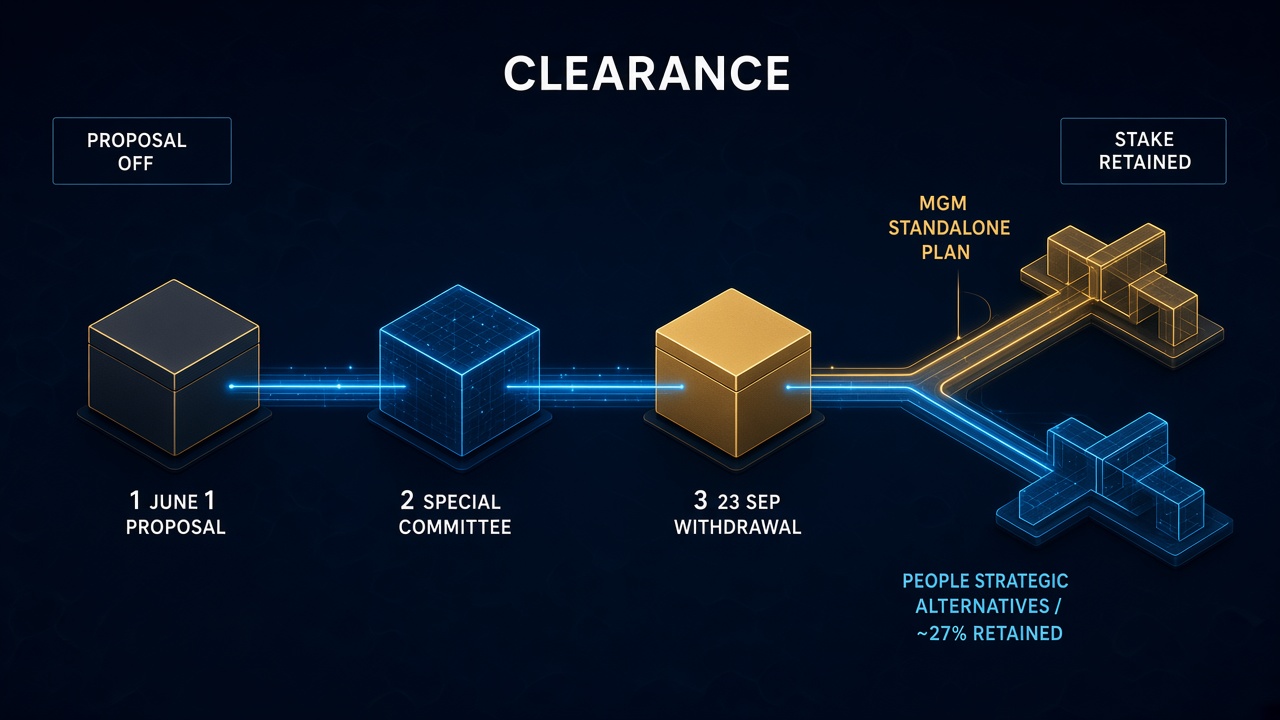
| Item | Detail |
|---|---|
| Gate 1 | 1 June 2026 proposal at $48.30 |
| Gate 2 | Special committee negotiations |
| Gate 3 | 23 September withdrawal |
| Path A | MGM standalone operating plan |
| Path B | People open to strategic alternatives |
There is no regulatory close calendar for a take-private that no longer exists. The near-term combination is organisational rather than transactional: MGM's special-committee process ends, the board reasserts the standalone plan, and People remains a large shareholder rather than a buyout sponsor.
Diller left an explicit second door open. People is "open to and interested in the possibility of a strategic transaction with MGM Resorts" and will consider a range of alternatives. That language keeps optionality without restoring the $48.30 proposal. Any later path would need its own facts, price and process.
MGM's proof points are operating. Salem names Las Vegas leadership, regional quality, BetMGM momentum, MGM China and Osaka. A working standalone path would show progress on those five without requiring People to reinstate a full cash take-out. A working People path would show the 27% stake remaining strategically useful even without control.
The downside is also industrial. If Strip and regional traffic stay soft, if BetMGM's momentum fades, or if Osaka capital and timing slip, both the standalone equity story and any future strategic alternative get harder. The withdrawal removes one financing path. It does not remove the operating questions underneath it.
Acquiry view. People Incorporated stepped back from taking MGM Resorts private after deciding the mix was not coming together, while keeping roughly 27% of the equity. MGM's board answered by recommitting to a listed standalone built on Las Vegas, regional properties, BetMGM, MGM China and Osaka.
The decision that matters now is operating, not spreadsheet theatre. Can the public MGM estate compound digital and Asia growth beside its Strip and regional base while a patient 27% holder stays in the register and keeps strategic alternatives alive? That is the brief the 23 September releases actually support.