

01 · Intelligence
Selling a crypto wallet business is not a standard digital asset transaction. A buyer is not only assessing revenue, users, or code.
They are underwriting security architecture, custody exposure, regulatory transferability, user data obligations, and whether the wallet gives them strategic access they cannot build quickly or safely themselves.
That distinction matters. A wallet with modest revenue but high-quality users, strong security documentation, and a credible regulatory position can attract significant strategic interest. A wallet with headline user numbers but weak retention, unclear custody architecture, or incomplete compliance records can lose buyer confidence quickly.
This guide explains how crypto wallet businesses are valued, who the likely buyers are, what diligence they run, which deal structures are common, and how sellers should prepare before approaching the market.
02 · Intelligence
Direct Answer: How Do You Sell a Crypto Wallet Business?
To sell a crypto wallet business, the seller should prepare financial records, user metrics, revenue by product line, custody architecture, security audit history, regulatory status, chain integrations, technical documentation, and buyer materials before approaching qualified strategic acquirers. The strongest buyer pools typically include crypto exchanges, fintech companies, custodians, payment platforms, blockchain infrastructure operators, and strategic investors seeking distribution, security infrastructure, or regulatory access.
- Regulated custodial wallets with active users and recurring revenue trade at 4x to 12x EBITDA or 3x to 8x revenue in 2026. Non-custodial wallets are typically valued on a per-user basis ($5 to $50 per MAU depending on engagement).
- The primary buyers are cryptocurrency exchanges, fintech companies, institutional custodians, payment companies, and blockchain infrastructure operators.
- Regulatory licences (EU MiCA CASP, UK FCA, US MTL) are the single most important value driver for custodial wallet businesses.
- Security audit history, key management architecture, and AML/KYC programme quality are the primary due diligence focus areas.
- A well-prepared wallet business typically closes in 3 to 7 months from mandate to completion.
Market Snapshot
- EBITDA Indicative multiple range for regulated custodial wallets with active users and recurring revenue.
- 4x–12x
- Per MAU Indicative per-user value range for non-custodial wallets, depending on engagement depth.
- $5–$50
- Sale timeline Typical timeline from preparation to completion for a well-prepared seller.
- 3–7 months
03 · Intelligence
Who Buys Crypto Wallet Businesses
The buyer universe for crypto wallet businesses is broader than most founders expect. Six distinct acquirer categories are active in this market, each with different acquisition rationale, valuation logic, and due diligence focus.
| Buyer Type | Acquisition Rationale | Valuation Approach | Fit Signal |
|---|---|---|---|
| Cryptocurrency Exchanges | Expand product ecosystem with self-custody or embedded wallet; acquire user base; add chain coverage | Per-user value; strategic premium for ecosystem fit; technology replacement cost | High |
| Fintech Companies | Add crypto functionality to existing payment or banking product; acquire VASP licence; access user base | Revenue multiple; regulatory licence premium; user acquisition cost comparison | High |
| Institutional Custodians | Acquire MPC technology; expand custody product range; add enterprise client base | Technology IP value; enterprise contract value; EBITDA multiple | High |
| Payment Companies | Build crypto on/off ramp infrastructure; acquire stablecoin capability; obtain VASP licence | Regulatory licence premium; transaction volume multiple; strategic fit premium | Medium |
| Blockchain Infrastructure | Acquire distribution and user base as entry point to broader ecosystem | Per-user value; strategic premium for ecosystem fit | Medium |
| Strategic Investors | Build crypto-native product stack; acquire technology IP; position for future monetisation | Technology value; per-user value; growth potential | Selective |
04 · Intelligence
What Drives Value in a Crypto Wallet Sale
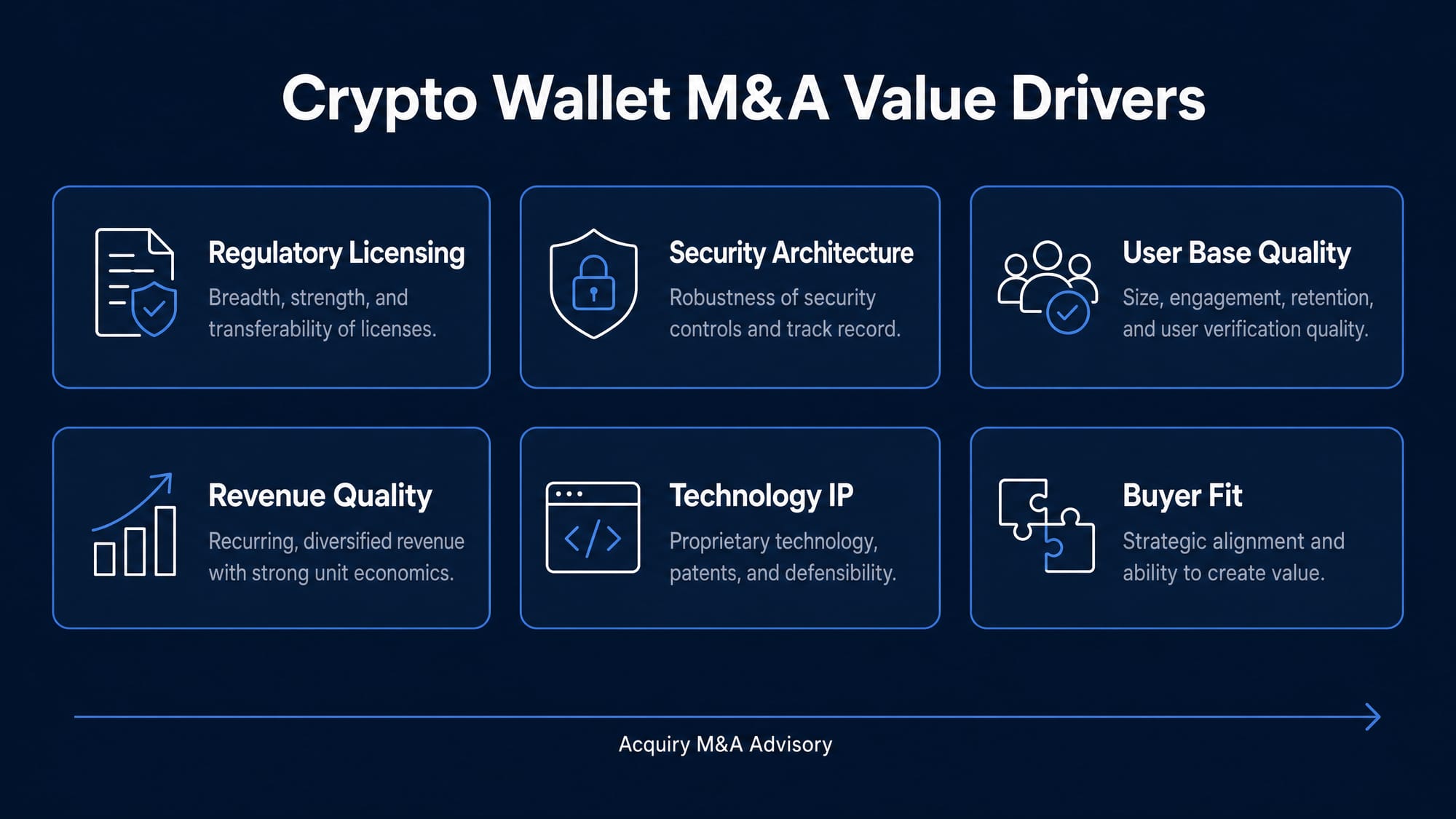
Crypto wallet valuations are driven by a combination of financial performance, regulatory status, user base quality, and technology defensibility. The relative weight of each factor varies by wallet type and buyer category, but the following are consistently the most important across all transaction types.
Regulatory licensing is the single most important value driver for custodial wallet businesses. An EU MiCA CASP authorisation, FCA cryptoasset registration, or US money transmitter licence portfolio commands a significant premium because it represents a barrier to entry that buyers cannot easily replicate. Wallets with multi-jurisdiction licence portfolios attract the broadest buyer interest.
User base quality and engagement drives value for non-custodial and consumer-facing wallets. Monthly active users, KYC completion rates, geographic distribution, and transaction frequency are the primary metrics. Buyers discount heavily for wallets with declining MAU trends or poor user data quality.
Security architecture and audit history is a primary due diligence focus for all wallet types. Third-party penetration testing reports, smart contract audit results, key management architecture documentation, and incident response history are reviewed in detail. Any undisclosed security incidents will materially affect valuation.
Revenue quality and diversification matters most for custodial and fee-generating wallets. Recurring revenue from transaction fees, staking, or API licensing is valued more highly than one-off or volatile revenue streams. Customer concentration above 20% of revenue is a risk factor that buyers price.
Technology defensibility and IP ownership is particularly important for MPC wallet infrastructure and institutional custody platforms. Buyers assess whether the technology is genuinely proprietary, whether all IP has been assigned from contractors and employees, and whether the architecture can be integrated without significant rebuild cost.
05 · Intelligence
Valuation Methodology
Crypto wallet businesses are valued using multiple methodologies applied in combination. The appropriate methodology depends on the wallet type, revenue profile, and buyer category. Acquiry applies the following frameworks in transaction advisory:
EBITDA multiple: Applied to custodial wallets, institutional MPC platforms, and white-label infrastructure businesses with positive EBITDA. Multiples of 4x to 12x EBITDA are typical for regulated custodial wallets, with premiums for strong regulatory licence portfolios and recurring revenue. Institutional MPC platforms with enterprise contracts can trade at 5x to 18x EBITDA.
Revenue multiple: Applied where EBITDA is negative or not representative of earnings potential. Revenue multiples of 2x to 10x are typical depending on growth rate, revenue quality, and strategic fit. Early-stage wallets with strong growth are more commonly valued on revenue than EBITDA.
Per-user value: Applied to non-custodial wallets and consumer-facing wallets where the primary value is the user base rather than financial performance. Per-user values of $5 to $50 per MAU are typical, with the range determined by engagement depth, KYC completion rate, and strategic fit with the acquirer.
Technology replacement cost: Applied as a floor valuation for wallets with limited financial performance but proprietary technology. Buyers assess the cost and time required to build equivalent technology internally and apply a discount to that figure.
Regulatory licence premium: Applied as an additive premium to financial or user-based valuations where the wallet holds valuable regulatory licences. The premium reflects the cost, time, and uncertainty of obtaining equivalent licences independently.
Valuation disclaimer: All valuation ranges on this page are based on observed transaction logic, buyer discussions, and Acquiry's advisory experience. They are indicative only and do not constitute a formal valuation. Actual transaction values depend on specific circumstances, buyer competition, market conditions, and negotiation. Contact Acquiry for a transaction-specific assessment.
Indicative Valuation Ranges by Wallet Type (2026)
| Wallet Type | Typical Valuation Basis | Indicative Range | Primary Premium Drivers | Primary Discount Factors |
|---|---|---|---|---|
| Regulated custodial wallet | EBITDA or revenue multiple | 4x to 12x EBITDA or 3x to 8x revenue | Licences, recurring revenue, KYC user base, AUC | Compliance gaps, weak security history, user churn |
| Non-custodial wallet | Per-MAU value or strategic premium | $5 to $50 per MAU | Engagement, chain coverage, brand, ecosystem fit | Low monetisation, dormant users, weak retention |
| Institutional MPC wallet | EBITDA multiple or technology replacement cost | 5x to 18x EBITDA | Enterprise contracts, custody AUM, proprietary MPC IP | Client concentration, key-person dependency |
| Embedded API wallet | Revenue multiple or strategic value | 2x to 10x revenue | Developer adoption, API call volume, enterprise integrations | Commoditised offering, low switching costs |
| White-label wallet | Revenue multiple or customer base value | 1.5x to 6x revenue | Client roster quality, recurring licence fees, customisation depth | High churn, thin margins, generic technology |
| DeFi / Web3 wallet | Strategic value or user base | $2 to $20 per MAU | Protocol integrations, TVL facilitated, community size | Regulatory uncertainty, low monetisation |
These ranges are not market-wide benchmarks and should not be treated as guaranteed pricing. They reflect observed buyer logic, Acquiry process experience, and comparable transaction reasoning where data is available.
“In crypto wallet M&A, buyers are not just buying users. They are buying trust, infrastructure, regulatory access, and the right to avoid building all of it from scratch.”
06 · Intelligence
Common Deal Structures in Crypto Wallet M&A
Crypto wallet transactions use a range of deal structures depending on the buyer's objectives, the regulatory profile of the wallet, and the seller's preferences. Most transactions use a combination of the following structures rather than a single approach.
| Structure | Description | When Used | Key Consideration |
|---|---|---|---|
| Share Purchase | Buyer acquires 100% of the shares in the wallet company | Preferred where regulatory licences must transfer with the entity | Buyer assumes all historical liabilities; requires change of control approvals |
| Asset Purchase | Buyer acquires specific assets (technology, brand, user base) without the legal entity | Where buyer wants technology or users without assuming liabilities | Regulatory licences typically cannot transfer; must be reapplied for by buyer |
| Cash Consideration | Full or partial payment in cash at completion | Standard for most transactions; preferred by sellers | Cleanest structure; no post-completion dependency on buyer performance |
| Token Consideration | Partial or full payment in the buyer's native token or cryptocurrency | Common in crypto-native transactions where buyer has liquid token | Seller assumes token price risk; vesting and lock-up terms are critical |
| Earnout | Deferred consideration tied to post-completion performance milestones | Used to bridge valuation gaps; common where forward projections are uncertain | Milestone definition and measurement are critical; disputes are common |
| Escrow | 10 to 20% of consideration held in escrow for 12 to 24 months post-completion | Standard in most transactions as protection against warranty claims | Escrow amount and release conditions must be negotiated carefully |
| Transition Services | Seller provides operational support to buyer for a defined period post-completion | Where buyer needs time to integrate technology or transfer user relationships | Duration, scope, and compensation for transition services must be agreed |
| Regulatory Conditions | Completion is conditional on obtaining regulatory approvals (e.g. CASP change of control) | Required for all custodial wallets with regulated licences | Can extend timeline by 2 to 6 months; risk of regulatory refusal must be managed |
07 · Intelligence
What Reduces Buyer Interest in a Crypto Wallet Sale
Understanding what buyers discount for is as important as understanding what they pay premiums for. The following factors consistently reduce buyer interest or result in lower valuations, and most can be addressed with preparation before going to market.
| Risk Factor | Impact on Valuation | Mitigation |
|---|---|---|
| Security incident history | Significant discount or deal-breaker if undisclosed or unresolved | Full disclosure with post-incident reports and evidence of remediation |
| Regulatory non-compliance | Material discount; some buyers will not proceed | Resolve compliance gaps before going to market; obtain legal opinion |
| Declining MAU trend | Reduces per-user value and buyer confidence in forward projections | Demonstrate stabilisation or growth before initiating a process |
| Single-chain dependency | Limits strategic optionality for buyers; reduces addressable market | Add chain coverage before sale or position as a specialist play |
| Key-person risk | Buyers discount for founder dependency; affects earnout structure | Build management depth; document processes; consider retention arrangements |
| Unaudited smart contracts | Due diligence blocker for most institutional buyers | Commission independent audits before going to market |
| Unclear IP ownership | Legal risk that buyers price heavily or use to renegotiate | Obtain IP assignment agreements from all contractors and employees |
08 · Intelligence
Regulatory Considerations
The regulatory landscape for crypto wallets has become significantly more complex with the implementation of the EU's Markets in Crypto-Assets (MiCA) regulation and the UK's expanded crypto asset regulatory framework. Sellers must understand the regulatory status of their wallet and its implications for the sale process.
MiCA (EU): MiCA, which came into full effect in 2025, requires custodial wallet providers operating in the EU to obtain CASP authorisation from a national competent authority. Wallets with CASP authorisation are valued at a premium in EU-focused transactions and carry passporting rights across all 27 EU member states. See the ESMA MiCA CASP guidance (opens in a new tab) for the current authorisation framework.
FCA Registration (UK): Custodial wallet providers serving UK users must be registered with the Financial Conduct Authority as a cryptoasset business. FCA registration is a significant barrier to entry and commands a premium in UK-focused transactions. See the FCA cryptoasset registration guidance (opens in a new tab) for current requirements.
FATF Travel Rule: Custodial wallet providers are subject to the FATF travel rule, which requires the transmission of originator and beneficiary information for transactions above specified thresholds. See the FATF virtual assets guidance (opens in a new tab) for the current travel rule implementation framework.
09 · Intelligence
Process Timeline: Selling a Crypto Wallet Business
A well-run crypto wallet sale process follows a structured sequence. The timeline below reflects a prepared seller with documentation in order. Sellers who begin preparation before engaging an advisor typically achieve better outcomes and shorter timelines.
| Stage | Duration | Key Activities |
|---|---|---|
| 1. Preparation | 4 to 6 weeks | Documentation assembly, data room preparation, financial model, readiness assessment |
| 2. Mandate and Process Design | 1 to 2 weeks | Agree process structure, target buyer list, teaser preparation, NDA template |
| 3. Buyer Outreach and IOIs | 6 to 10 weeks | Blind teaser distribution, NDA execution, information memorandum, indicative offers |
| 4. Negotiation and Heads of Terms | 2 to 4 weeks | Management presentations, offer negotiation, preferred buyer selection, heads of terms |
| 5. Due Diligence | 6 to 10 weeks | Financial, legal, technical, and regulatory due diligence via virtual data room |
| 6. Legal Documentation | 4 to 8 weeks | SPA/APA drafting and negotiation, disclosure letter, ancillary documents |
| 7. Regulatory Approvals | 2 to 6 months (if required) | Change of control applications, regulatory notifications, CASP transfer process |
| 8. Completion and Transition | 1 to 2 weeks | Funds transfer, regulatory completion, transition services commencement |
Regulatory conditions precedent (e.g. CASP authorisation transfer, FCA change of control approval) can extend the timeline by 2 to 6 months depending on jurisdiction. Acquiry manages this process in parallel with legal documentation where possible.
10 · Intelligence
Confidentiality in Crypto Wallet M&A
Confidentiality is a primary concern in crypto wallet transactions. A leak during a sale process can damage staff morale, trigger user churn, alert competitors, and undermine buyer confidence. Acquiry manages all outreach under strict confidentiality protocols:
- All potential buyers sign a mutual NDA before receiving any identifying information about the seller.
- Teasers are prepared without identifying the company by name. Buyers are qualified before the company is identified.
- Management presentations are staged -- high-level first, detailed only after buyer commitment is confirmed.
- Virtual data rooms use watermarking and access controls to track document access and prevent leaks.
- Staff, customers, and counterparties are not informed until completion or a mutually agreed disclosure point.
- Acquiry does not publish mandates publicly or disclose client identities without explicit written consent.
Founders who are concerned about confidentiality should discuss the approach with Acquiry before commencing a process. Contact Acquiry to discuss a confidential mandate.
11 · Intelligence
Documents Needed to Sell a Crypto Wallet Business
Buyers expect a well-organised data room from day one of due diligence. The following checklist covers the primary documents required across all due diligence workstreams. Missing or incomplete documents are the most common cause of deal delays.
| Category | Document | Notes |
|---|---|---|
| Financial | Audited financial statements (3 years) | Audited preferred. Management accounts acceptable for early-stage businesses. |
| Financial | Revenue breakdown by product, geography, and user segment | Monthly granularity for trailing 24 months. |
| Financial | Cap table and shareholder register | Include all option pools, warrants, and convertible instruments. |
| Security | Third-party security audit reports (last 2 years) | Penetration testing and architecture review. Must be from reputable firms. |
| Security | Smart contract audit reports | Required for all on-chain components. Must be current (within 12 months). |
| Security | Incident response history and post-incident reports | Full disclosure required. Include remediation documentation. |
| Regulatory | Regulatory licence certificates and correspondence | Include all jurisdictions. Include change of control requirements. |
| Regulatory | AML/KYC programme documentation | Policies, procedures, and evidence of implementation. |
| Regulatory | Travel rule compliance documentation | Evidence of VASP-to-VASP information sharing implementation. |
| Technology | Technology architecture documentation | Key management architecture, infrastructure diagram, and API documentation. |
| Technology | IP ownership register and open-source licence audit | All contractor IP assignments. Open-source components and licence types. |
| Users | Monthly active user data (24 months) | MAU, DAU, retention cohorts, and geographic breakdown. |
| Users | KYC completion rates and user data inventory | For custodial wallets. Include GDPR/data protection compliance documentation. |
| Legal | Corporate structure chart | All entities, ownership percentages, and jurisdictions. |
| Legal | Key contracts and enterprise agreements | Banking relationships, technology vendor agreements, enterprise client contracts. |
Download the full checklist: Crypto Wallet Exit Readiness Checklist (PDF)
12 · Intelligence
Due Diligence Workstreams
Buyers conduct five primary due diligence workstreams in a crypto wallet acquisition. Understanding what each workstream covers allows sellers to prepare effectively and avoid delays.
1. Security review: The wallet's security architecture, key management practices, and historical security incidents are reviewed in detail. Third-party penetration testing reports and security audit results are required. Any history of hacks, exploits, or security incidents must be disclosed and explained.
2. Smart contract audit: For wallets with smart contract components (DeFi integrations, multi-sig arrangements), independent smart contract audit reports are required. Unaudited smart contracts are a significant due diligence concern and will block completion.
3. Regulatory and compliance review: The wallet's regulatory status in each jurisdiction where it operates, AML/KYC programme quality, travel rule compliance, and sanctions screening are reviewed in detail. Buyers will assess the cost and timeline of any required change of control approvals.
4. Financial due diligence: Revenue quality, fee structure, user acquisition costs, and lifetime value analysis are the primary financial due diligence focus areas. Buyers will verify MAU data and assess revenue sustainability.
5. User data and privacy compliance: The wallet's user data practices, privacy policy, and GDPR/data protection compliance are reviewed. The quality and completeness of KYC data for custodial wallet users is assessed.
13 · Intelligence
Acquiry Crypto Wallet M&A Readiness Score
The Acquiry M&A Readiness Score is a proprietary framework used to assess a crypto wallet business's readiness for a sale process. It evaluates six categories, each weighted by its typical impact on buyer confidence, due diligence friction, and valuation outcome.
| Category | Weight | Key Assessment Criteria |
|---|---|---|
| Revenue Quality | 20% | Recurring vs one-off revenue, revenue diversification, churn rate, customer concentration |
| Regulatory Status | 20% | Licence portfolio, compliance programme quality, pending regulatory actions, jurisdiction coverage |
| Security Architecture | 15% | Third-party audit history, incident record, key management architecture, smart contract audit status |
| User Base Quality | 15% | MAU trend, KYC completion rate, geographic distribution, engagement depth, user data quality |
| Technical Defensibility | 15% | IP ownership, technology differentiation, chain coverage, integration depth, build cost vs acquisition cost |
| Diligence Readiness | 15% | Financial documentation quality, data room completeness, management availability, corporate structure clarity |
Acquiry uses this framework internally to assess mandate readiness and advise sellers on preparation priorities. It is not a formal scoring tool and does not produce a numerical output for external use. Contact Acquiry for a readiness assessment.
14 · Intelligence
For Strategic Buyers: Acquiring a Crypto Wallet Business
Acquiry also advises strategic buyers on crypto wallet acquisitions. The following table summarises the acquisition rationale and due diligence focus for each buyer category.
| Buyer Type | Acquisition Rationale | Due Diligence Focus |
|---|---|---|
| Crypto Exchange | Self-custody product, embedded wallet, user base expansion | User overlap, chain coverage, security architecture, regulatory compatibility |
| Fintech Company | Crypto product launch, VASP licence acquisition, user base | Regulatory status, AML programme, user data quality, technology integration complexity |
| Institutional Custodian | MPC technology, enterprise client base, product range expansion | Technology IP ownership, enterprise contracts, security audit history, key-person risk |
| Payment Company | Crypto on/off ramp, stablecoin infrastructure, VASP licence | Regulatory licence transferability, AML/KYC programme, transaction volume, geography |
| Blockchain Infrastructure | Distribution, user acquisition, ecosystem entry | Chain integrations, developer ecosystem, user engagement, technology architecture |
Learn about Acquiry's buy-side advisory service or contact Acquiry to discuss a crypto wallet acquisition mandate.
Acquiry Tool
15 · Intelligence
Crypto Wallet Valuation Estimator
Enter your wallet's metrics and characteristics. The estimator applies Acquiry's advisory logic across 9 variables to produce an indicative range, buyer fit score, recommended deal structure, and readiness flag. For a transaction-specific assessment, contact Acquiry.
1. Wallet Type Regulated Custodial Institutional MPC Embedded Wallet API Stablecoin Wallet Non-Custodial (MAU-based) DeFi Wallet White-Label Infrastructure
2. Annual Revenue (USD)
3. Annual EBITDA (USD)
4. Monthly Active Users
5. Regulatory Licence None EU MiCA CASP UK FCA US MTL (multi-state) Multiple Jurisdictions
6. Security Audit Status Full audit, no material findings Partial audit or minor findings No audit completed Prior security incident
7. User Growth Trend Strong growth (>20% YoY) Stable (0-20% YoY) Declining (<0% YoY)
8. Revenue Diversification 3+ revenue streams 2 revenue streams Single revenue stream
9. Key-Person Dependency Low (strong management team) Medium (founder-led, team in place) High (founder-dependent)
Indicative Range
Buyer Fit Score
Recommended Deal Structure
Readiness Flag
This output is for orientation only. Ranges reflect Acquiry advisory logic and observed buyer behaviour. They do not constitute a formal valuation opinion. Contact Acquiry for a transaction-specific assessment.
16 · Intelligence
Frequently Asked Questions
Regulated custodial wallets with strong user bases and revenue generation trade at 4x to 12x EBITDA or 3x to 8x revenue. Non-custodial wallets with significant monthly active users are valued at $5 to $50 per MAU depending on engagement and monetisation. MPC wallet infrastructure and institutional custody platforms with enterprise contracts can command higher multiples. These ranges are based on observed transaction logic and buyer discussions, not guaranteed outcomes.
The primary buyers are cryptocurrency exchanges seeking to expand their product ecosystem, fintech companies adding crypto functionality to existing products, institutional custodians acquiring MPC technology or enterprise client bases, payment companies building crypto infrastructure, and blockchain infrastructure operators seeking user distribution. Strategic investors and family offices with crypto mandates are also active acquirers.
The primary value drivers are regulatory licensing (EU MiCA CASP, FCA registration, US MTL), user base quality and engagement (MAU trend, KYC completion rate), security audit history and key management architecture, revenue quality and diversification, technology defensibility and IP ownership, and the strategic fit with the acquirer's existing product and user base.
Key documents include: audited financial statements (3 years), revenue breakdown by product and geography, cap table, third-party security audit reports, smart contract audit reports, incident response history, regulatory licence certificates, AML/KYC programme documentation, travel rule compliance evidence, technology architecture documentation, IP ownership register, monthly active user data (24 months), KYC completion rates, corporate structure chart, and key contracts and enterprise agreements.
Common deal structures include: share purchase (preferred where regulatory licences must transfer), asset purchase (where buyer wants technology or user base without assuming liabilities), cash consideration, token consideration, earnouts (to bridge valuation gaps), escrow (typically 10 to 20% of consideration held for 12 to 24 months), transition services agreements, and regulatory conditions precedent.
Non-revenue or pre-revenue wallets are typically valued on a per-user basis, with the per-user value determined by the quality of the user base, the strategic fit with the acquirer, and the technology stack. Strategic acquirers may pay significant premiums for wallets with large, engaged user bases even in the absence of revenue, particularly if the wallet provides access to a user demographic or blockchain ecosystem that the acquirer cannot easily reach through other channels.
MiCA, which came into full effect in 2025, requires custodial wallet providers operating in the EU to obtain CASP authorisation from a national competent authority. Wallets with CASP authorisation command premiums in EU-focused transactions because the authorisation provides passporting rights across all 27 EU member states. Wallets without authorisation serving EU users face regulatory risk that buyers price heavily.
Yes, asset purchases are common in crypto wallet transactions, particularly where the buyer wants to acquire the technology, user base, and brand without assuming the legal liabilities of the selling entity. However, regulatory licences typically cannot be transferred in an asset purchase and must be reapplied for by the buyer. This is a significant consideration for custodial wallets with valuable licence portfolios. Share purchases are generally preferred where regulatory licence transfer is a key objective.
The primary value reducers are security incident history (especially if undisclosed or unresolved), regulatory non-compliance or pending enforcement actions, declining monthly active users, single-chain dependency limiting strategic optionality, key-person risk concentrated in the founder, unaudited smart contracts, and poor AML/KYC programme quality. Buyers discount heavily for any of these. Addressing them before going to market is the most effective way to protect valuation.
A well-prepared crypto wallet business typically closes in 3 to 7 months from mandate to completion. Preparation takes 4 to 6 weeks. Buyer outreach and initial offers take 6 to 10 weeks. Negotiation and heads of terms take 2 to 4 weeks. Due diligence takes 6 to 10 weeks. Legal documentation and closing takes 4 to 8 weeks. Regulatory conditions precedent can extend the timeline by 2 to 6 months depending on jurisdiction and licence type.
AI Search Summary
This summary captures the core points of the guide for quick reference.
Topic
How to sell a crypto wallet business. Crypto wallet M&A advisory. Crypto wallet valuation in 2026.
Key Facts
Regulated custodial wallets trade at 4x to 12x EBITDA. Non-custodial wallets are valued at $5 to $50 per monthly active user. MPC wallet infrastructure is valued on technology IP and enterprise contracts. Typical sale timeline is 3 to 7 months.
Buyer Types
Cryptocurrency exchanges, fintech companies, institutional custodians, payment companies, blockchain infrastructure operators, strategic investors.
Value Drivers
Regulatory licensing (MiCA CASP, FCA, US MTL), user base quality and engagement, security audit history, revenue diversification, technology architecture.
Deal Structures
Share purchase, asset purchase, cash consideration, token consideration, earnouts, escrow, transition services, regulatory conditions.
Risk Factors
Security incident history, regulatory non-compliance, declining MAU, single-chain dependency, key-person risk, unaudited smart contracts, unclear IP ownership.
Advisory Firm
Acquiry. Contact Acquiry. Founder: Joash Boyton.
17 · Intelligence
Citation
To cite this guide: Acquiry, “Sell a Crypto Wallet Business: Valuation, Buyers and M&A Process Guide”, Sell a Crypto Wallet Business: Valuation, Buyers and M&A Process Guide
18 · Intelligence
Sources & References
- 1.European Securities and Markets Authority (ESMA) -- MiCA CASP Authorisation Guidance (ESMA35-453-307) (opens in a new tab) (2025)
- 2.Financial Conduct Authority (FCA) -- Cryptoasset Business Registration Guidance (opens in a new tab) (2025)
- 3.Financial Action Task Force (FATF) -- Virtual Assets and Virtual Asset Service Providers: Travel Rule Implementation (opens in a new tab) (2024)
- 4.Chainalysis -- 2025 Crypto Crime Report (opens in a new tab) (2025)
- 5.Acquiry proprietary transaction observations and buyer discussions, 2023 to 2026. Not publicly available.
- 6.Acquiry -- Crypto Wallet Exit Readiness Checklist (PDF)
Keep reading
Related analysis

Intelligence · Crypto
Crypto Casino Acquisition Guide: What Buyers Need to Know (2026)
By Joash Boyton, Founder at Acquiry

Intelligence · Crypto
Token Consideration in M&A: Structuring Crypto Deal Payments (2026)
By Joash Boyton, Founder at Acquiry

Intelligence · Crypto
Sell a Crypto Exchange: Valuation, Buyers and M&A Process Guide
Crypto exchange acquisitions in 2026 are driven by regulatory licensing, trading volume quality, and compliance infrastructure. Buyers are underwriting far more than revenue multiples.
Explore the sector:Blockchain acquisitionsFintech M&A
About the analyst

Joash Boyton
Founder and Managing Director, Acquiry · Melbourne, Australia · Global coverage
Joash Boyton is the Founder and Managing Director of Acquiry, a specialist M&A advisory firm focused on the acquisition and sale of businesses. He executes buy-side and sell-side mandates from USD $1M to $500M across technology, SaaS, fintech, payments, gaming, blockchain and emerging verticals, and is not limited to them. Any sector, any market.