
Summary
Summary
- AI models can detect wash trading, wallet manipulation, and sanctions exposure that manual blockchain due diligence routinely misses or prices too expensively.
- Blockchain businesses with AI-powered compliance infrastructure command measurable valuation premiums from institutional acquirers over those using manual processes.
- AI-powered sourcing expands the acquisition target universe beyond personal networks, applying consistent criteria across a larger and more geographically dispersed data set.
- AI integration carries real risks including poor generalisation to novel patterns and compliance concentration risk, requiring active human oversight to manage.
01 · News
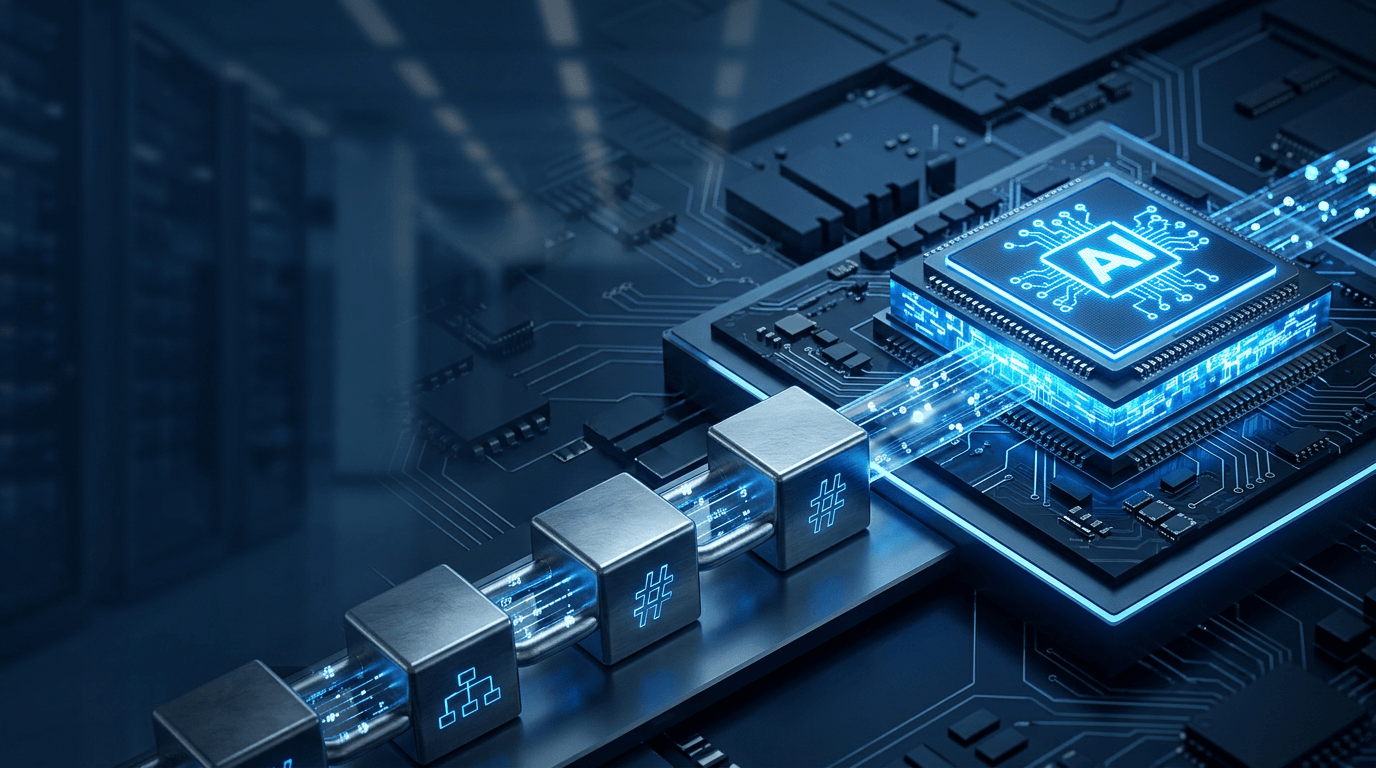
Artificial intelligence is changing how blockchain M&A transactions are sourced, assessed, and executed. The convergence of on-chain data availability and AI analytical capability is creating a new standard for due diligence in digital asset transactions, and the firms that are building AI-enabled capabilities into their blockchain businesses are commanding measurable valuation premiums as a result.
02 · News
The Due Diligence Problem in Blockchain M&A
Blockchain M&A has always presented a due diligence challenge that traditional M&A frameworks were not designed to address. On-chain activity is public but complex. Transaction histories are immutable but require specialist interpretation. Smart contract code is auditable but demands technical expertise that most M&A advisors do not possess. And the velocity of activity in blockchain businesses means that the data set relevant to due diligence is orders of magnitude larger than in comparable traditional businesses.
The result has been that blockchain M&A due diligence has historically been either superficial, relying on management representations and high-level metrics, or prohibitively expensive, requiring large teams of blockchain analysts and technical specialists. AI is changing both of these constraints simultaneously.
03 · News
AI-Powered On-Chain Analysis
The most immediate application of AI in blockchain M&A is on-chain analysis. AI models trained on blockchain transaction data can identify patterns that indicate wash trading, market manipulation, artificial volume inflation, and other forms of misrepresentation that are difficult to detect through manual analysis. For exchange acquisitions, where reported trading volume is a primary valuation driver, this capability is transformative.
The same analytical capability can be applied to wallet activity analysis, identifying unusual concentration of holdings, related-party transactions, and potential regulatory exposure from interactions with sanctioned addresses. These are areas where manual due diligence is both time-consuming and incomplete, and where AI-powered analysis provides materially better coverage at a fraction of the cost.
- Volume verification: AI models can distinguish genuine trading activity from wash trading with high accuracy, providing a reliable basis for revenue quality assessment
- Wallet clustering: Identifying related-party wallet relationships that may indicate undisclosed conflicts of interest or token manipulation
- Sanctions screening: Automated screening of transaction counterparties against global sanctions lists at scale
- Smart contract risk: AI-assisted code analysis identifying known vulnerability patterns and potential exploit vectors
04 · News
Compliance Automation as a Value Driver
Beyond due diligence, AI is creating value in blockchain businesses by automating compliance functions that have historically required large manual operations. AML transaction monitoring, KYC document verification, and suspicious activity reporting are all areas where AI is reducing operational cost and improving accuracy simultaneously.
For acquirers, blockchain businesses with AI-powered compliance infrastructure are materially more attractive than those relying on manual processes. The reasons are straightforward: lower operational cost, better regulatory outcomes, and greater scalability. A compliance operation that can handle ten times the transaction volume without proportional headcount growth is a genuine competitive advantage in a sector where regulatory compliance is both mandatory and expensive.
This is being reflected in valuations. Blockchain businesses with demonstrably AI-enabled compliance infrastructure are commanding premiums from institutional acquirers who understand the long-term cost implications of manual versus automated compliance at scale.
05 · News
AI in Target Identification and Sourcing
On the buy-side, AI is changing how acquisition targets are identified and assessed. The combination of on-chain data, regulatory filing databases, and commercial intelligence sources creates a data set that can be analysed at scale to identify acquisition targets that meet specific criteria before any human contact is made.
This capability is particularly valuable in blockchain M&A because the universe of potential targets is large, geographically dispersed, and often opaque. Traditional sourcing approaches, relying on personal networks and industry relationships, miss a significant proportion of the available opportunity set. AI-powered sourcing expands the addressable universe and improves the quality of target identification by applying consistent analytical criteria across a much larger data set.
07 · News
Risks and Limitations
The integration of AI into blockchain M&A is not without risk. AI models trained on historical blockchain data may not generalise well to novel transaction patterns or new attack vectors. The interpretability of AI outputs is a challenge in a regulatory context where decisions need to be explainable. And the reliance on AI for compliance functions creates concentration risk if the underlying models fail or produce false negatives.
These risks are manageable but require active attention. The firms that will benefit most from AI integration are those that treat it as a tool that augments human judgment rather than replaces it, and that maintain robust oversight of AI-generated outputs in critical compliance and risk management functions.
Acquiry facilitates blockchain M&A transactions globally, applying rigorous due diligence frameworks that incorporate on-chain analysis and AI-powered assessment. Speak with our transaction team about your mandate.
08 · News
What this means for buyers and sellers
For buyers
- Prioritise targets with demonstrable AI-enabled compliance infrastructure, as these businesses offer lower long-term operational cost and better scalability than those relying on manual processes.
- Use AI-powered sourcing to assess a broader universe of targets across geographies and data sources, reducing reliance on personal networks that miss a significant proportion of available opportunities.
- Apply AI-assisted on-chain analysis during due diligence to verify revenue quality, identify related-party relationships, and screen for sanctions exposure before committing to a valuation.
For sellers
- Integrating AI into core operational functions such as compliance and fraud detection before going to market is one of the most effective ways to improve valuation outcomes.
- The investment required to build demonstrable AI capability is described as modest relative to the valuation impact, and the operational benefits apply regardless of whether a transaction occurs.
- Be prepared to evidence AI capability clearly to institutional acquirers, who understand the long-term cost difference between manual and automated compliance at scale.
09 · News
Work with Acquiry
Acquiry runs buy-side and sell-side mandates for digital businesses. We are not limited to the sectors or markets covered here: any sector, any market, bring it to us anyway. Start a mandate (opens in a new tab).
Reference
Frequently asked questions
How does AI improve due diligence in blockchain M&A?
AI models trained on blockchain transaction data can identify wash trading, market manipulation, artificial volume inflation, wallet concentration, related-party transactions, and sanctions exposure. This provides materially better coverage than manual analysis at a fraction of the cost.
Why do AI-enabled blockchain businesses attract higher acquisition multiples?
Institutional acquirers pay higher multiples for businesses that have integrated AI into core operational functions such as compliance automation, fraud detection, and customer analytics. The premium reflects lower operational cost, better regulatory outcomes, and greater scalability.
What compliance functions can AI automate in a blockchain business?
AI can automate AML transaction monitoring, KYC document verification, and suspicious activity reporting. A compliance operation built on AI can handle significantly higher transaction volumes without proportional headcount growth.
What are the main risks of using AI in blockchain M&A and compliance?
AI models trained on historical data may not generalise well to novel transaction patterns or new attack vectors. There is also concentration risk if underlying models fail or produce false negatives, and interpretability challenges in regulatory contexts where decisions must be explainable.
Keep reading
Related analysis

Research · AI
The Great Re-rating:Q1 2026 Digital M&A Market Report
The Great Re-rating: Q1 2026 Digital M&A Market Report. Acquiry provides specialist digital M&A advisory for buyers and sellers.
News · AI
The AI Acquisition Wave: How $4.9 Trillion in M&A Is Reshaping the Tech Stack
By Joash Boyton, Founder & Managing Director, Acquiry • March 2026

News · AI
AI Due Diligence in M&A: How Acquirers Are Rewriting the Playbook in 2026
By Joash Boyton, Founder & Managing Director, Acquiry • March 2026
Explore the sector:Blockchain acquisitions
About the analyst

Joash Boyton
Founder and Managing Director, Acquiry · Melbourne, Australia · Global coverage
Joash Boyton is the Founder and Managing Director of Acquiry, a specialist M&A advisory firm focused on the acquisition and sale of businesses. He executes buy-side and sell-side mandates from USD $1M to $500M across technology, SaaS, fintech, payments, gaming, blockchain and emerging verticals, and is not limited to them. Any sector, any market.