
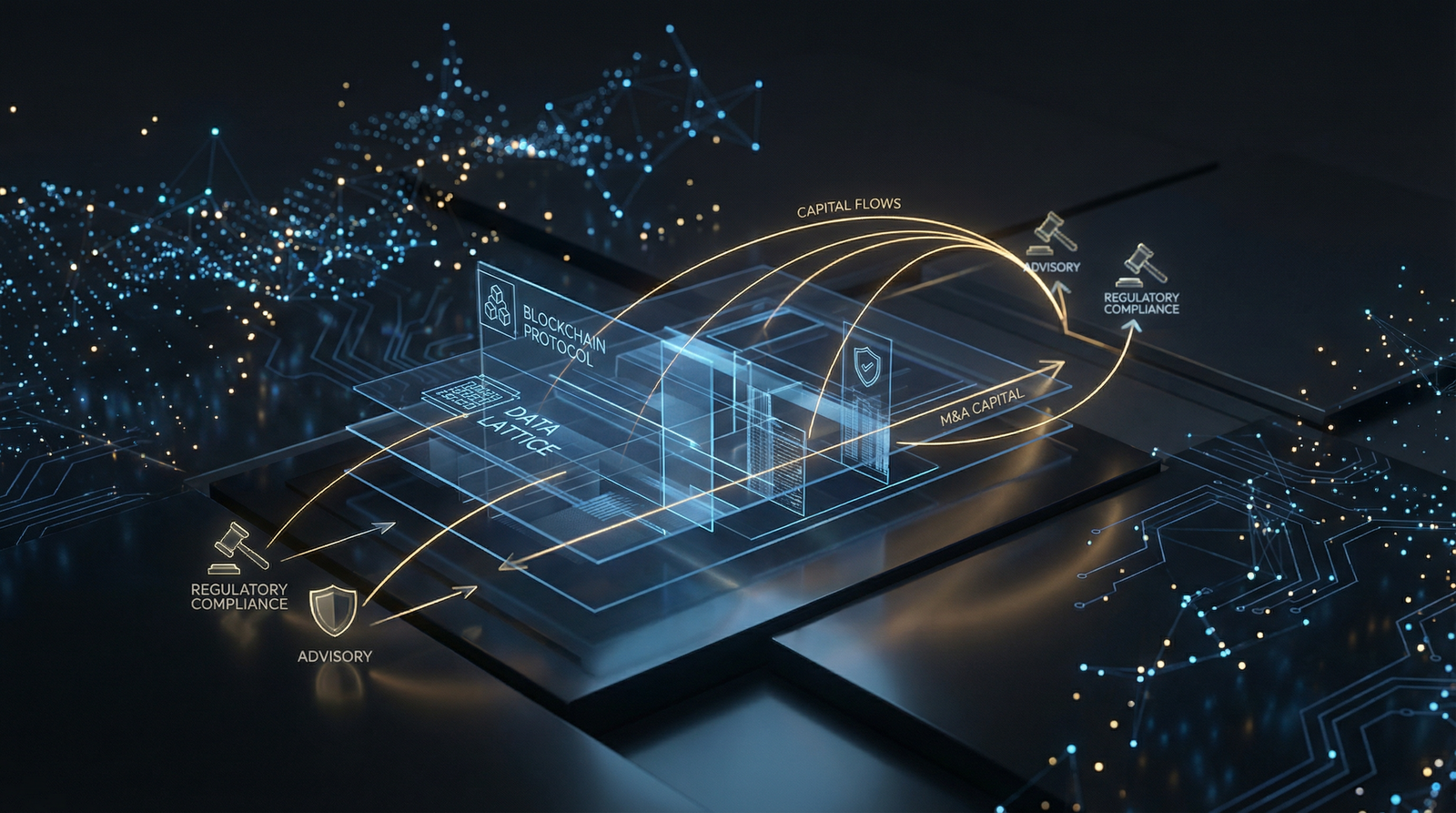
The fintech sector is entering a consolidation phase that will reshape the payments infrastructure landscape over the next three to five years. The drivers are structural: regulatory clarity in major markets, the maturation of embedded finance as a distribution model, and the emergence of stablecoin infrastructure as a legitimate payments rail. The acquirers are a mix of traditional financial institutions, technology platforms, and sovereign-backed capital.
What to take from this article
- The passage of the GENIUS Act in the United States and the full implementation of MiCA in Europe have removed the primary regulatory uncertainty that was suppressing fintech M&A activity.
- MiCA's implementation across the EU has created a single regulatory framework for crypto-asset service providers operating in Europe.
- The most active segment of fintech M&A in 2026 is payments infrastructure.
01 The Regulatory Catalyst
The Regulatory Catalyst
The passage of the GENIUS Act in the United States and the full implementation of MiCA in Europe have removed the primary regulatory uncertainty that was suppressing fintech M&A activity. For the past three years, acquirers in the payments and digital assets space have been cautious about making large commitments in markets where the regulatory framework was unclear. That uncertainty has now been substantially resolved.
The GENIUS Act establishes a federal framework for stablecoin issuance and oversight, replacing the patchwork of state-level regulations that had created compliance complexity for payments businesses operating across multiple US jurisdictions. The practical effect is that stablecoin-based payment rails are now a legitimate infrastructure investment rather than a regulatory risk.
MiCA's implementation across the EU has created a single regulatory framework for crypto-asset service providers operating in Europe. Businesses that have obtained MiCA authorisation in one EU member state can passport that authorisation across all 27 member states. This dramatically reduces the compliance cost of operating a pan-European digital payments business and makes European fintech assets more attractive to international acquirers.
02 Payments Infrastructure: The Primary Target
Payments Infrastructure: The Primary Target
The most active segment of fintech M&A in 2026 is payments infrastructure. This covers the technology layers that enable payment processing, settlement, reconciliation, and compliance across multiple payment methods and jurisdictions. The businesses being acquired are not consumer-facing fintech apps but the infrastructure that powers them.
The consolidation logic is straightforward. Payments infrastructure businesses have strong network effects, high switching costs, and recurring revenue models that generate predictable cash flows. They are difficult to build from scratch because the regulatory approvals, banking relationships, and technical integrations required take years to establish. Acquiring an existing infrastructure business is faster and often cheaper than building the equivalent capability organically.
The acquirers in this segment include traditional payment processors looking to expand their capabilities, technology platforms building embedded finance offerings, and financial institutions seeking to modernise their payment infrastructure. The prices being paid reflect the strategic value of the infrastructure rather than the current revenue, which means multiples in this segment are consistently above the market average.
Embedded Finance as a Distribution Model
Embedded finance, the integration of financial services into non-financial products and platforms, has matured from a concept to a significant revenue category. Platforms that have embedded payments, lending, insurance, or investment products into their core offering are generating material financial services revenue that is often more profitable than their primary business.
The M&A implications are twofold. First, platforms with successful embedded finance implementations are more valuable than comparable platforms without them, because the financial services revenue improves unit economics and increases customer lifetime value. Second, the infrastructure businesses that enable embedded finance, the banking-as-a-service providers, the payment facilitators, and the compliance-as-a-service platforms, are attractive acquisition targets for any business that wants to build embedded finance capabilities.
:::callout "Payments infrastructure is the most defensible category in fintech. The regulatory approvals, banking relationships, and technical integrations are genuinely hard to replicate. When you acquire a payments infrastructure business, you are buying a moat that took years to build. That is why the multiples are where they are.": Joash Boyton, Acquiry ::
03 Stablecoin Infrastructure: The Emerging Category
Stablecoin Infrastructure: The Emerging Category
The regulatory clarity provided by the GENIUS Act and MiCA has unlocked a category of fintech M&A that was previously constrained: stablecoin infrastructure. Businesses that issue, custody, or process stablecoin transactions are now operating in a defined regulatory environment, which makes them acquirable by regulated financial institutions that previously could not touch the category.
The practical applications of stablecoin infrastructure in payments are significant. Cross-border payments using stablecoin rails are faster and cheaper than traditional correspondent banking. Settlement of securities transactions using stablecoin infrastructure reduces counterparty risk and shortens settlement cycles. Treasury management using stablecoins provides corporations with more flexible cash management tools than traditional banking.
The acquirers in this space include traditional banks building digital asset capabilities, payment processors expanding into stablecoin settlement, and technology companies building financial infrastructure. The businesses being acquired are typically small by traditional M&A standards, in the $10M to $100M revenue range, but they are being valued at significant multiples because of their regulatory positioning and infrastructure value.
| Fintech Segment | M&A Activity Level | Typical Acquirer | Multiple Range |
|---|---|---|---|
| Payments infrastructure | Very High | Processors, banks, platforms | 5x to 12x revenue |
| Stablecoin infrastructure | High (accelerating) | Banks, payment processors | 8x to 20x revenue |
| Embedded finance platforms | High | Technology platforms, banks | 4x to 10x revenue |
| Digital banking | Medium | Traditional banks, PE | 2x to 5x revenue |
| Insurtech | Medium | Insurers, PE | 2x to 4x revenue |
| Wealthtech | Low-Medium | Asset managers, banks | 3x to 7x revenue |
04 The Digital Banking Consolidation
The Digital Banking Consolidation
The digital banking sector is undergoing a different kind of consolidation. The neobanks that raised billions in venture capital between 2018 and 2022 are facing a reckoning. Customer acquisition costs have risen, interest rate normalisation has changed the economics of deposit-funded business models, and the path to profitability has proven longer and more expensive than early projections suggested.
The result is a wave of consolidation among digital banks. Larger, better-capitalised neobanks are acquiring smaller competitors to gain customer bases, geographic coverage, and regulatory licences. Traditional banks are acquiring digital banking platforms to accelerate their own digital transformation rather than building the capability organically. Private equity firms are acquiring distressed digital banks at significant discounts to their peak valuations and restructuring them for profitability.
The Brex situation, which we covered in detail in the Q1 2026 Digital M&A Report, is illustrative. Capital One's acquisition of Brex at a 58% discount to its 2021 peak valuation reflects the broader repricing of digital banking assets. The businesses that survive this consolidation will be those that have found genuine unit economics, not those that were growing fastest at peak market conditions.
05 What This Means for Fintech Founders
What This Means for Fintech Founders
For founders of fintech businesses considering their options in 2026, the market is more nuanced than the headline consolidation narrative suggests. Infrastructure businesses with regulatory moats are commanding premium valuations. Consumer-facing fintech businesses without clear profitability paths are facing significant valuation pressure.
The most important preparation work for a fintech sale in 2026 is demonstrating regulatory compliance across all relevant jurisdictions, documenting the technical infrastructure that creates switching costs for customers, and presenting a credible path to profitability that does not depend on continued venture capital funding.
Acquiry has active mandates in fintech M&A across payments infrastructure, embedded finance, and digital banking. We work with both buyers seeking to acquire fintech capabilities and founders seeking to maximise exit value in the current market environment.