
Summary
Summary
- Global M&A reached about US$4.9 trillion in 2025, and Q1 2026 was on pace to beat it, driven by deals above US$5 billion.
- Global fintech investment rebounded to US$116 billion in 2025: fewer deals, larger tickets, led by payments and infrastructure.
- Paramount / Warner Bros. Discovery at US$110 billion headlined the quarter.
- Bain found the share of capital allocated to M&A hit a 30-year low in 2025, so the money available is concentrated.
01 · Research
The global M&A market has entered a new era of aggressive, large-scale consolidation. Following a record-breaking $4.9 trillion in deal value in 2025, Q1 2026 has been defined by mega-deals exceeding $5 billion, a structural shift in regulatory sentiment, and the pervasive impact of artificial intelligence as a primary value driver across all digital sectors. This report analyzes the key transactions, market trends, and strategic drivers shaping the landscape.
Discuss a Mandate Access Deal Room
- Global M&A Deal Value 2025 (Record)
- $4.9T
- Deals Exceeding $10B in 2025
- 60
- Global Fintech Investment 2025
- $116B
- M&A Execs Expect Increased Activity
- 80%
02 · Research
Executive Summary
The global mergers and acquisitions market has entered a new era of aggressive, large-scale consolidation, marking a definitive end to the cautious posture of the past two years. Following a record-breaking $4.9 trillion in deal value in 2025, the first quarter of 2026 has been defined by a surge in mega-deals exceeding $5 billion, a structural shift in regulatory sentiment, and the pervasive impact of artificial intelligence as a primary value driver across all digital sectors.
This report analyzes the key transactions, market trends, and strategic drivers shaping the digital M&A landscape. The market is undergoing a "great re-rating" where legacy business models are being absorbed by technologically superior acquirers, and institutional capital is flowing decisively into digital infrastructure, AI-native SaaS, and regulated digital assets. The key themes for Q1 2026 are clear: scale is paramount, regulatory clarity is unlocking new asset classes, and the race to acquire AI capabilities is no longer a choice, but a necessity for survival.
| Metric | 2025 Full Year | Q1 2026 Trajectory | Key Driver |
|---|---|---|---|
| Global M&A Deal Value | ~$4.9 Trillion | On pace to exceed 2025 | Mega-deals (>$5B) |
| Global Fintech Investment | $116 Billion | Strong, larger deal sizes | Payments & infrastructure |
| SaaS M&A Transactions | ~2,700 (record) | Continued high velocity | AI-native SaaS premium |
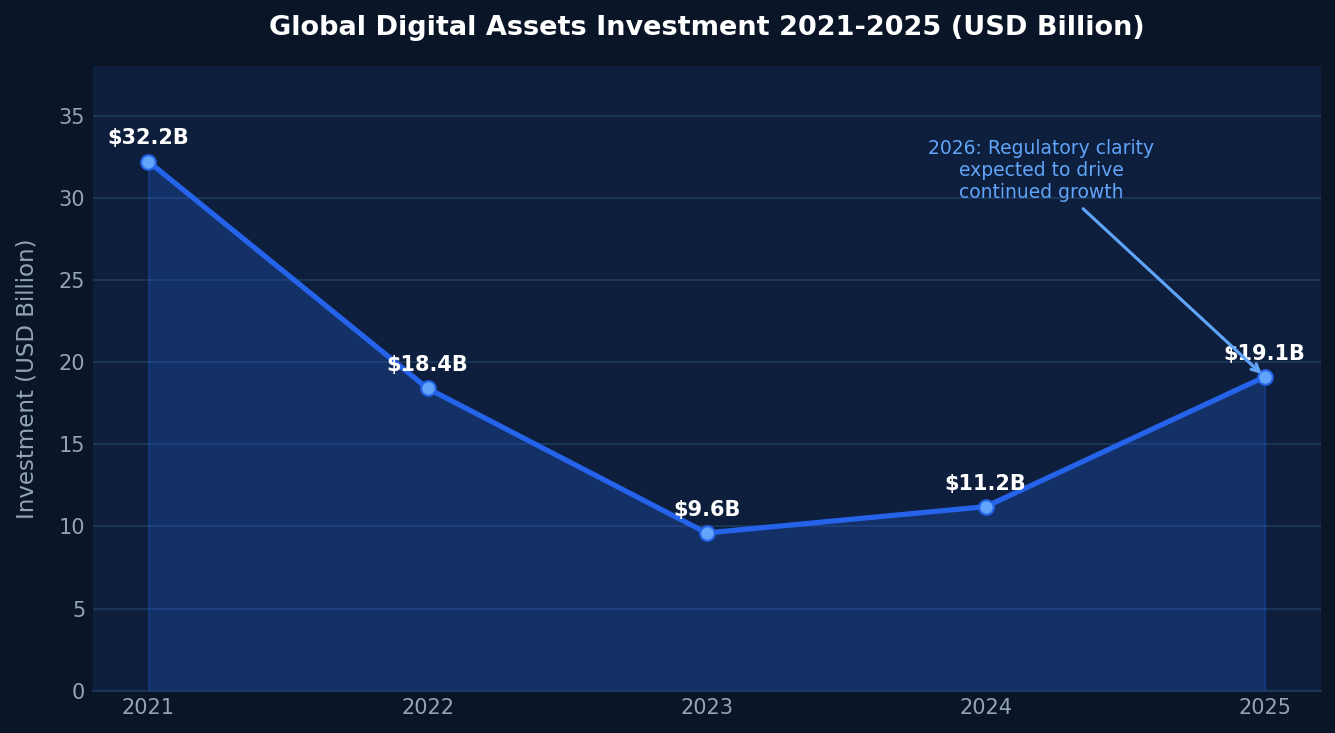
| Digital Assets Investment | $19.1 Billion | Accelerating | Regulatory clarity |
| Private Equity (Fintech) | $18.54 Billion | Increasing deployment | Dry powder, AI focus |
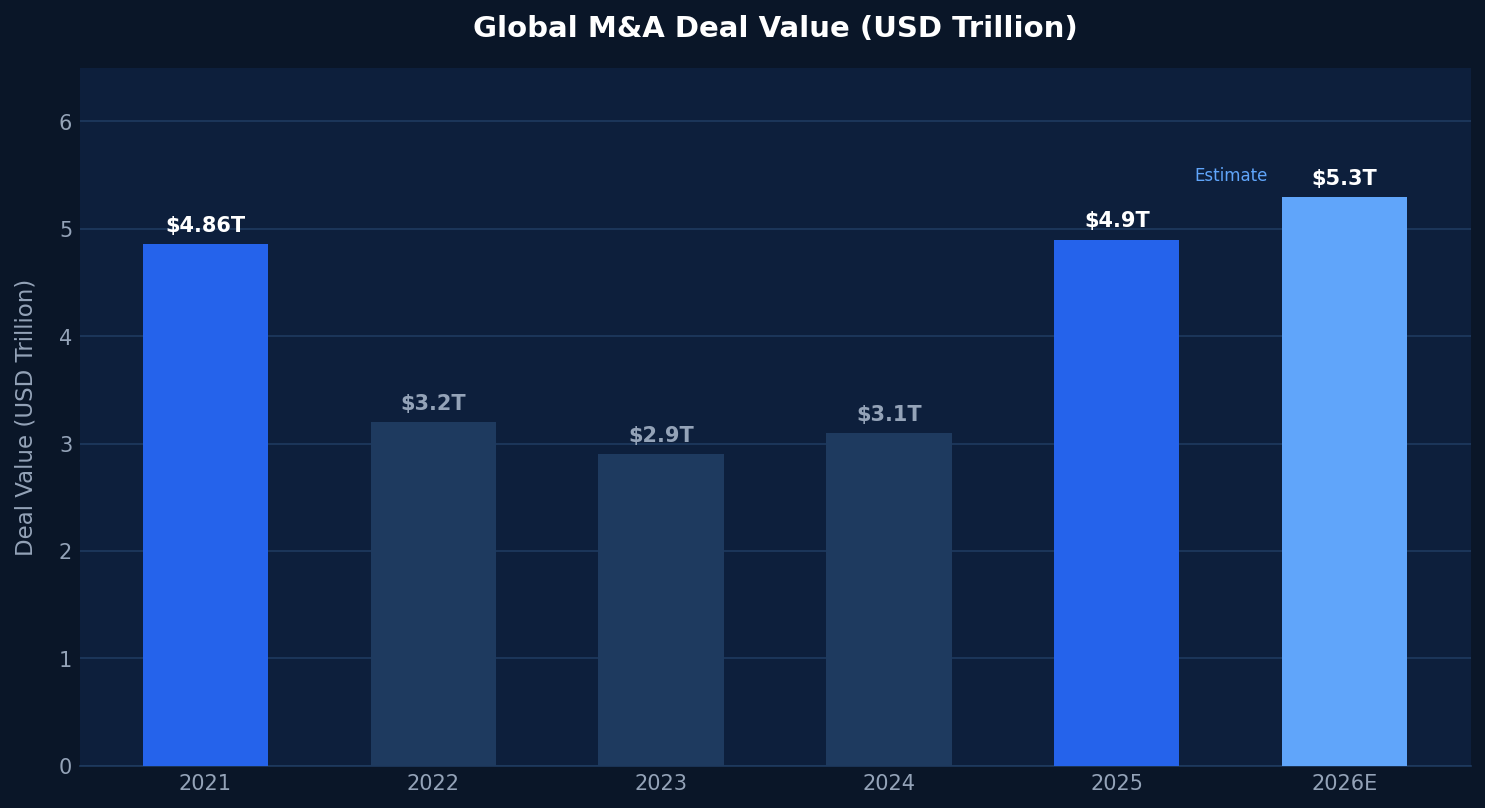
Source: PitchBook, LSEG, Acquiry Research. 2026 figure is a forward estimate based on Q1 2026 deal velocity.
03 · Research
The Mega-Deal Resurgence
The market's resurgence is built on a foundation of renewed confidence from corporate boards, fueled by a more permissive regulatory environment and stabilizing interest rates. The passage of permanent R&D tax incentives in the US, combined with a Federal Reserve rate cut in December 2025, provided the catalyst for a wave of capital-intensive transactions. Goldman Sachs topped the global M&A ranking in 2025, Facilitating nearly 40 deals worth $1.48 trillion in total volume, marking the strongest period for mega-deals by volume on record.
Mega-deals valued at greater than $5 billion accounted for more than 73% of the increase in deal value in 2025, according to Bain & Company. The number of deals exceeding the $10 billion threshold swelled to 60 in 2025, the highest level since 2021. This momentum has carried directly into Q1 2026, with landmark transactions across media, fintech, gaming, and digital infrastructure.
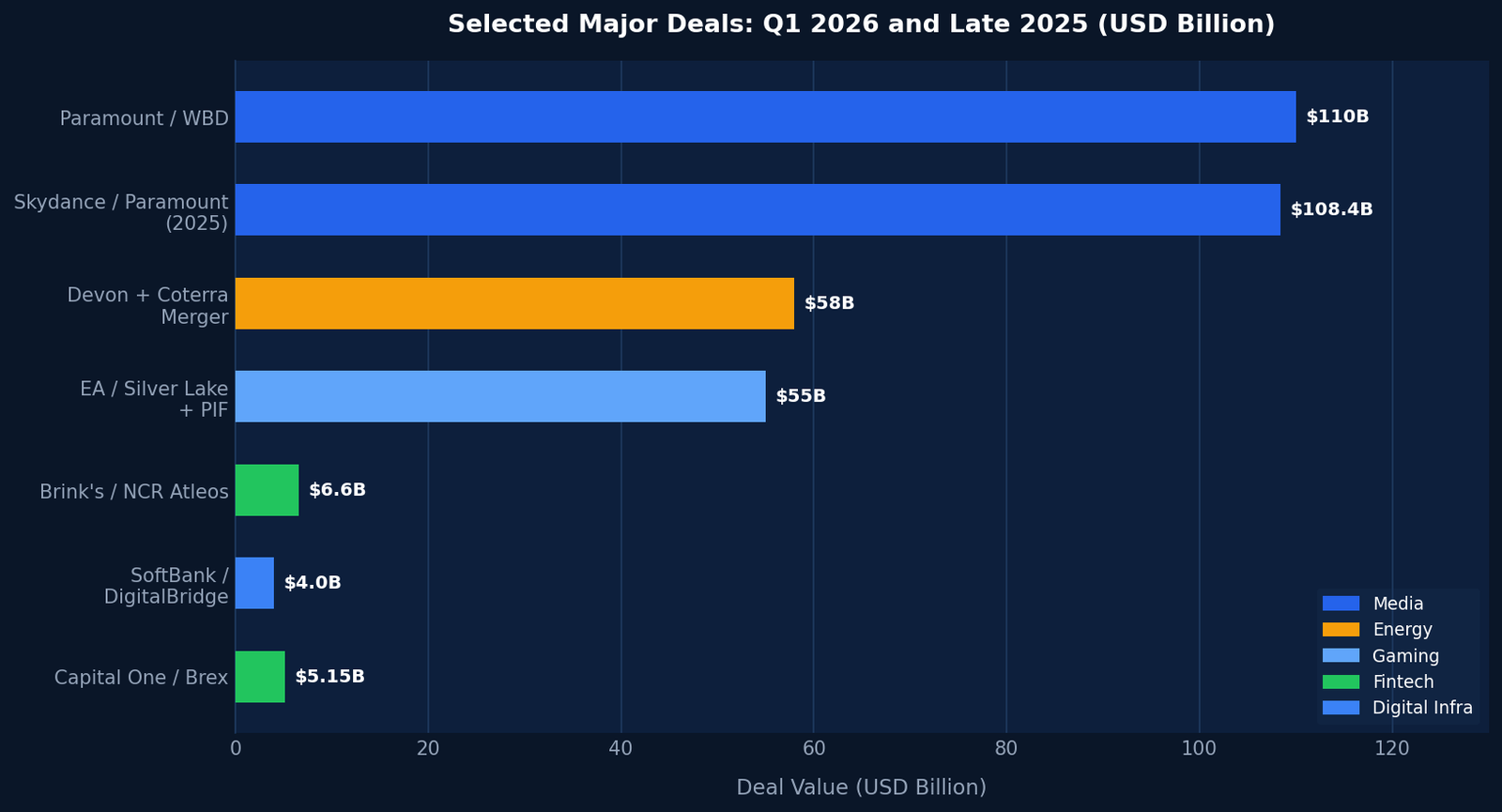
Selected major transactions from Q1 2026 and late 2025. Source: Company announcements, Reuters, Bloomberg, Acquiry Research.
04 · Research
Sector Analysis
Fintech and Payments: The Great Consolidation
While overall fintech deal volume has declined, the value of transactions is rising, pointing to a market focused on quality and scale. Global fintech investment rebounded to $116 billion in 2025, with the Americas leading at $66.5 billion. The payments sector saw fewer but larger deals, with investors concentrating capital on proven, profitable companies.
The acquisition of Brex by Capital One for $5.15 billion is the defining fintech deal of Q1 2026. It represents a significant exit for the fintech unicorn, albeit at a substantial discount to its 2021 peak valuation of $12.3 billion. The deal signals a broader trend: traditional financial institutions are absorbing fintech infrastructure rather than competing with it, and late-stage VC markups are being stress-tested by real market conditions.
The biggest structural story, however, is the move by traditional financial infrastructure players. The Brink's acquisition of NCR Atleos for $6.6 billion creates a dominant force in financial technology infrastructure. Meanwhile, reports of Stripe considering a bid for PayPal suggest that even the largest payment processors are not immune to the pressures of consolidation.
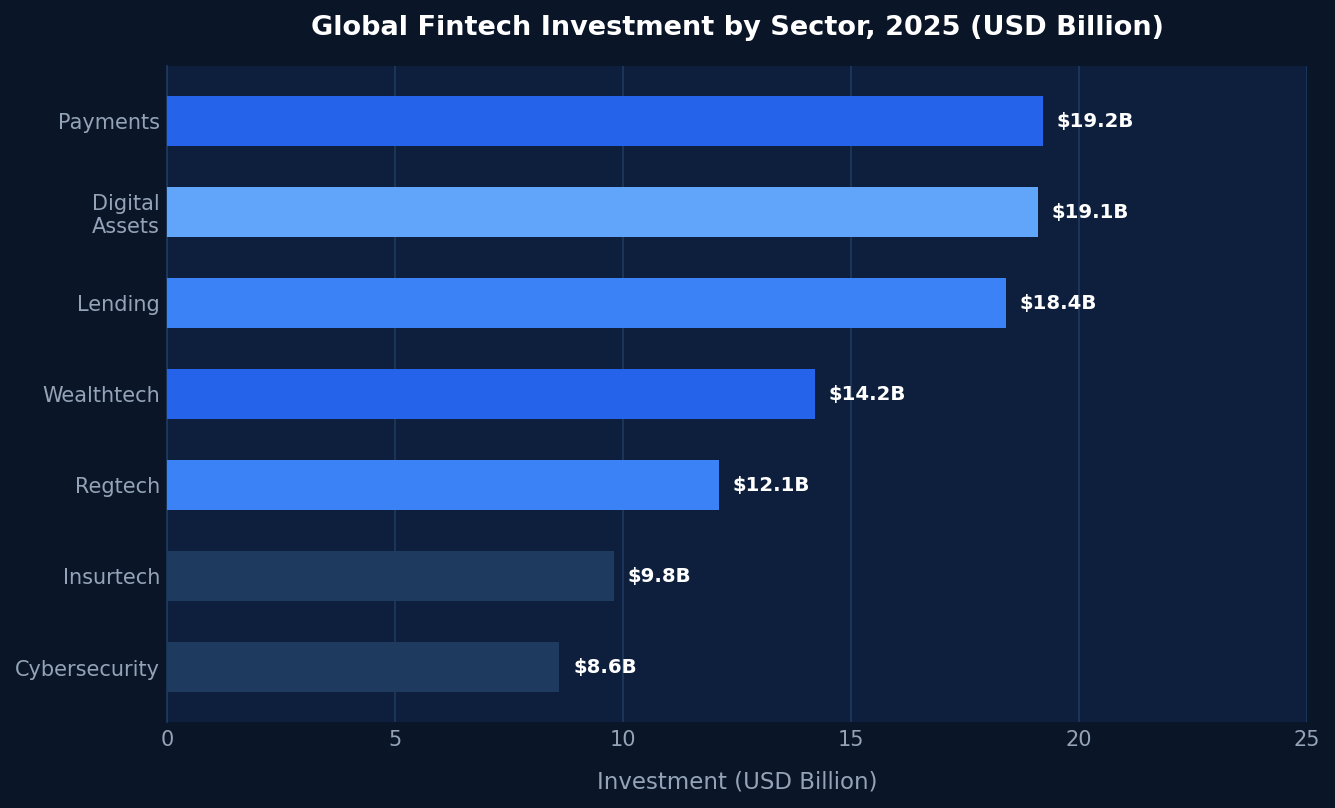
Source: KPMG Pulse of Fintech H2 2025. Figures in USD Billion.
SaaS and Enterprise Software: The AI Premium
The SaaS market saw record M&A activity in 2025 with approximately 2,700 transactions, a 28% increase over 2024. This trend has accelerated into 2026, driven by a clear valuation premium for AI-native and AI-enabled SaaS companies. Acquirers are aggressively pursuing targets that offer automation, data analysis, and workflow optimization capabilities.
Salesforce made its second acquisition of 2026 in February, acquiring Momentum, a conversational insights and revenue orchestration platform. Flexera made a double acquisition to build an AI-enabled FinOps automation solution, acquiring both ProsperOps (AI cloud cost optimization) and Chaos Genius (AI cost optimization for Snowflake and Databricks). Datadog acquired Propolis, an autonomous QA testing platform, integrating it into its observability stack.
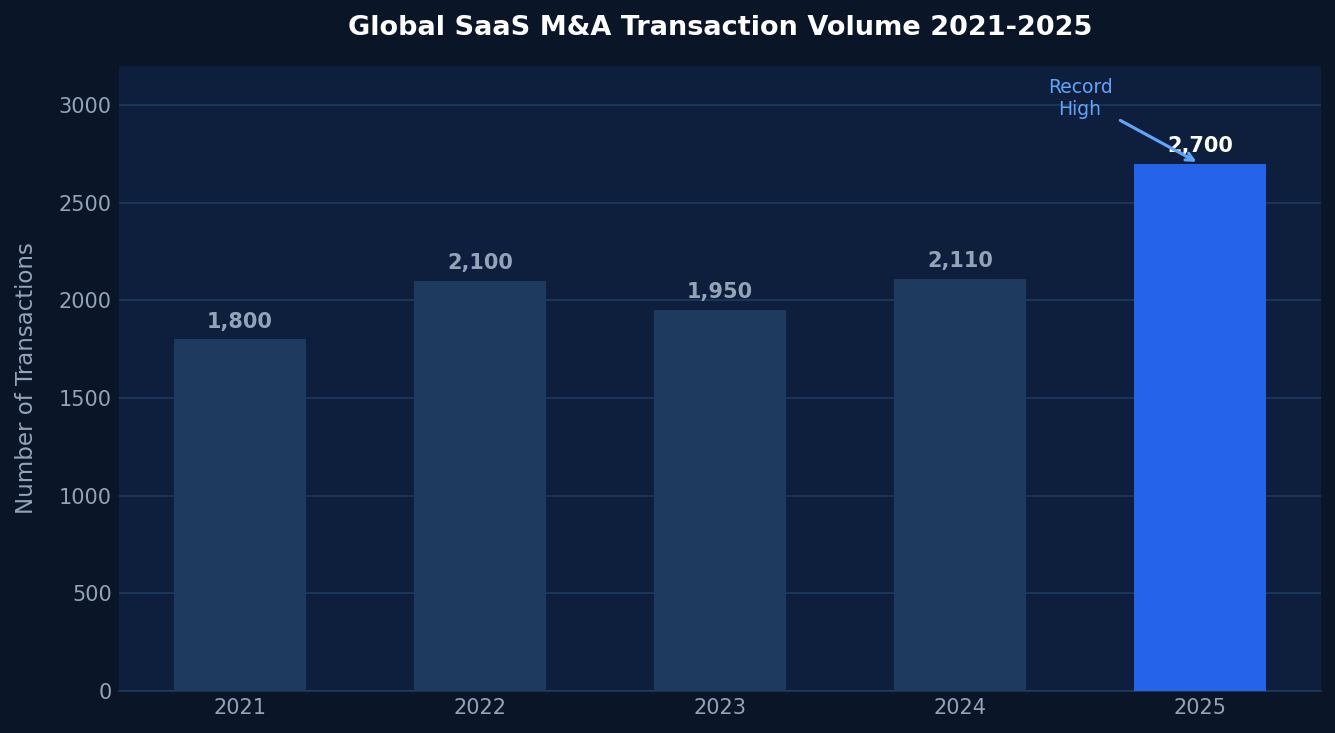
Source: Dealroom, Acquiry Research. Volume figures represent announced and closed transactions globally.
Digital Infrastructure: The New Oil
Investment in digital infrastructure is being driven by the insatiable demand for computing power from AI workloads. US hyperscalers were spending an average of $760 million per day on capital expenditures from Q1 2024 to Q3 2025, according to Goldman Sachs. By 2030, another 65 gigawatts of data center capacity will need to come online, more than double the amount added from 2019 to 2024.
The landmark deal in this space is the announced acquisition of DigitalBridge by SoftBank for approximately $4 billion, giving SoftBank control of a leading global digital infrastructure asset manager with a 30-year track record. The deal was priced at $16 per share, representing a 150% premium to DigitalBridge's 52-week low, and is expected to close in H2 2026.
Media and Entertainment: Streaming's Endgame
The acquisition of Warner Bros. Discovery by Paramount for $110 billion is the culmination of a multi-year consolidation wave in the media industry. The deal, announced on February 27, 2026, ends a high-stakes bidding war that saw Netflix offer $82.7 billion for WBD's studios and streaming assets before walking away. The combined entity will control Paramount+, HBO Max, and Pluto TV, creating a streaming platform with the scale to compete directly with Netflix and Disney+.
This follows the late 2025 hostile acquisition of Paramount Global by Skydance Media for $108.4 billion, a deal that kickstarted the current media consolidation phase. The message is clear: in streaming, scale is the only viable long-term moat, and the window for mid-tier players to remain independent is closing rapidly.
Gaming: The Race for IP and Platforms
The gaming sector continues to see massive consolidation, with both strategic and financial buyers seeking to acquire valuable intellectual property and established player bases. The most significant pending deal is the $55 billion acquisition of Electronic Arts by a consortium including Silver Lake, Affinity Partners, and Saudi Arabia's Public Investment Fund. The transaction has been approved by EA's board and shareholders, and is expected to close in Q1 fiscal 2027.
In a separate move, Savvy Games Group, also backed by the Saudi PIF, is in advanced talks to acquire Moonton from ByteDance, a deal expected to close by the end of Q1 2026. ByteDance originally acquired Moonton in 2021 for approximately $4 billion. The Saudi PIF's aggressive gaming acquisition strategy is reshaping the competitive landscape and creating a new category of sovereign-backed strategic acquirers.
Crypto and Digital Assets: Unlocked by Regulation
Regulatory clarity has been the single most important catalyst for M&A in the digital assets space. The implementation of the Markets in Crypto-Assets (MiCA) regulation in the EU and the passage of the GENIUS Act in the US have provided a framework for institutional investment and M&A activity that simply did not exist 18 months ago.
Investment in digital assets nearly doubled to $19.1 billion in 2025. Q1 2026 has seen a flurry of activity, with 17 crypto-related acquisitions in January alone. Key deals include Chainlink Labs acquiring Atlas, Neynar acquiring Farcaster, and Animoca Brands acquiring SOMO. The move by Stripe's stablecoin arm, Bridge, to acquire a conditional trust charter from the US OCC is a major step toward the integration of stablecoins into the mainstream financial system.
05 · Research
Selected Transactions: Q1 2026
| Transaction | Value | Sector | Status | Acquiry Commentary |
|---|---|---|---|---|
| Paramount / Warner Bros. Discovery | $110B | Media | Announced Feb 2026 | Streaming endgame. Creates Paramount+/HBO Max/Pluto TV combined platform. |
| Devon Energy / Coterra Energy Merger | $58B | Energy | Announced Feb 2026 | Merger of equals targeting supermajor scale. |
| EA / Silver Lake + Affinity + PIF | $55B | Gaming | Board approved | Sovereign-backed gaming consolidation. PIF building a global gaming empire. |
| Brink's / NCR Atleos | $6.6B | Fintech | Announced Feb 2026 | Financial infrastructure consolidation. Close Q1 2027. |
| Capital One / Brex | $5.15B | Fintech | Announced Jan 2026 | Incumbent absorbs fintech. Down from $12.3B peak. Late-stage VC reality check. |
| SoftBank / DigitalBridge | ~$4B | Digital Infra | Announced, close H2 2026 | SoftBank acquires 30-year digital infrastructure manager. AI infrastructure play. |
| Savvy Games / Moonton (ByteDance) | ~$4B+ | Gaming | In advanced talks | Saudi PIF continues gaming rollup. Mobile Legends IP is the prize. |
| Salesforce / Momentum | Undisclosed | SaaS | Announced Feb 2026 | Salesforce's 2nd acquisition of 2026. Agentforce AI stack build-out. |
| Flexera / ProsperOps + Chaos Genius | Undisclosed | SaaS | Completed Jan 2026 | Double acquisition. AI FinOps automation for cloud and data platforms. |
| Stripe Bridge / OCC Trust Charter | Regulatory | Crypto | Conditional approval Feb 2026 | Stablecoin infrastructure entering regulated mainstream. Significant precedent. |
| Chainlink Labs / Atlas (FastLane) | Undisclosed | Crypto | Completed Q1 2026 | Oracle infrastructure consolidation. MEV protection capability acquired. |
| Neynar / Farcaster | Undisclosed | Crypto | Completed Q1 2026 | Decentralised social protocol acquisition. Web3 social infrastructure play. |
06 · Research
Capital Environment
While the appetite for deals remains strong, the pool of discretionary capital to fund them is historically thin. The proportion of capital allocated to M&A hit a 30-year low in 2025, according to Bain, as companies directed more cash toward dividends, buybacks, capital expenditures, and R&D. This dynamic is forcing executives to pursue only transactions that deliver clear and demonstrable returns.
The funding crunch has pushed private capital to the center of dealmaking. Private equity now accounts for roughly 40% of global M&A activity, according to Goldman Sachs. Despite signs of stress in the private credit market, now valued at roughly $2.1 trillion, Goldman expects the asset class to more than double by 2030, broadening the pool of capital available to fund large transactions. Sovereign wealth funds, particularly from the Gulf, are increasingly acting as lead investors rather than passive backers.
07 · Research
Outlook for 2026: Five Key Themes
01
AI as the Universal Driver
AI is no longer a vertical. It is a horizontal enabler that is driving valuation premiums and strategic acquisitions across all digital sectors. Companies without an AI acquisition strategy are already behind.
02
Scale as a Defensive Moat
In media, payments, and digital infrastructure, the market has decided that only the largest players will survive. Expect continued consolidation as companies race to achieve the scale required to compete.
03
Strategic Acquirers Back in Seat
While private equity remains a major force, strategic corporate acquirers are using their balance sheets to make bold, transformational acquisitions. The era of financial engineering is giving way to genuine strategic logic.
04
Regulatory Clarity as Catalyst
Clear regulatory frameworks for digital assets and a more permissive antitrust stance in the US are unlocking new M&A opportunities, particularly in fintech, stablecoins, and digital infrastructure.
05
Cross-Border Activity Intensifies
The surge in outbound investment from Japan and the Gulf, combined with increasing competition for assets in Europe and Southeast Asia, will continue to drive cross-border M&A at elevated deal values.
06
Down-Round Exits Accelerate
The Brex exit at a 58% discount to peak valuation is not an isolated case. Late-stage VC portfolios are being marked to market, and strategic acquirers are finding value in distressed or repriced digital assets.
08 · Research
Acquiry's View
The transactions covered in this report reflect a market that is simultaneously consolidating at the top and repricing in the middle. For sellers, the window to achieve premium valuations remains open, but it is narrowing. For buyers, the current environment offers genuine opportunities to acquire AI-native capabilities, regulated digital asset infrastructure, and scaled distribution at prices that would have been unthinkable 18 months ago.
Acquiry is actively Facilitating mandates across fintech, SaaS, blockchain, gaming, and digital infrastructure. We work with listed companies, private equity funds, family offices, and founders on both buy-side and sell-side transactions ranging from $1 million to $500 million. If you are considering a transaction in any of the sectors covered in this report, we would welcome a confidential conversation.
09 · Research
Sources & References
- 1.FinancialContent. "Wall Street's Golden Age Returns: The 2026 M&A Resurgence." February 26, 2026. (opens in a new tab)
- 2.CNBC. "Global M&A stays strong in 2026 despite tightest capital squeeze in 30 years." February 25, 2026. (opens in a new tab)
- 3.Reuters. "Paramount to buy Warner Bros Discovery in $110 billion deal." February 27, 2026. (opens in a new tab)
- 4.TechCrunch. "What to know about the landmark Warner Bros. Discovery sale." February 28, 2026. (opens in a new tab)
- 5.Forbes. "3 Cautionary Takeaways From Brex's $5 Billion Sale To Capital One." February 22, 2026. (opens in a new tab)
- 6.Yahoo Finance. "Capital One's Brex Deal And Regulation Put Valuation Gap In Focus." February 13, 2026. (opens in a new tab)
- 7.KPMG. "Pulse of Fintech H2 2025." February 2026. (opens in a new tab)
- 8.Fintech Futures. "Brink's to acquire NCR Atleos for $6.6bn." February 27, 2026. (opens in a new tab)
- 9.CoinDesk. "Payments giant Stripe reportedly mulling PayPal acquisition." February 24, 2026. (opens in a new tab)
- 10.Channel Insider. "January 2026 M&A Recap: Channel Orgs Set to Expand Capabilities." February 6, 2026. (opens in a new tab)
- 11.SalesforceBen. "Salesforce Acquires Momentum to Power Agentforce." February 19, 2026. (opens in a new tab)
- 12.Seeking Alpha. "DigitalBridge: The Unclear Future Of The Preferreds After SoftBank Acquisition." February 17, 2026. (opens in a new tab)
- 13.InvestGame. "Savvy Games Group in Talks to Acquire Moonton from ByteDance." February 16, 2026. (opens in a new tab)
- 14.The TIE. "January 2026 Crypto Funding Brief." February 5, 2026. (opens in a new tab)
- 15.American Banker. "Stripe-owned Bridge acquires trust charter for stablecoins." February 19, 2026. (opens in a new tab)
10 · Research
Work with Acquiry
Acquiry runs buy-side and sell-side mandates for digital businesses. We are not limited to the sectors or markets covered here: any sector, any market, bring it to us anyway. Start a mandate (opens in a new tab).
Reference
Frequently asked questions
What happened in M&A in Q1 2026?
Large-scale consolidation returned. Following roughly US$4.9 trillion of global deal value in 2025, Q1 2026 was on pace to exceed it, led by mega-deals above US$5 billion.
What is the "great re-rating"?
Acquiry's term for buyers no longer valuing all digital growth equally: consolidation at the top of the market and repricing in the middle.
Is it a good time to sell a digital business?
In Q1 2026 the window for premium valuations remained open but was narrowing, so preparation and timing mattered more.
Keep reading
Related analysis

Guides · AI
What AI Cannot Buy:The New Scarcity Map forDigital Business Acquisitions
When AI commoditises execution, five categories of digital business asset gain a scarcity premium. A 2026 framework for founders, operators, and acquirers navigating the new M&A landscape.

Research · AI
Artificial Intelligence and Strategic M&A in 2026
Capital Allocation, Valuation, and Market Structure: Evidence from 2022 to 2025 Transaction Data

News · AI
The Zero-Click Discount:How AI Search Is Repricing SEO, Affiliate and Content Assets
By Joash Boyton, Founder & Managing Director, Acquiry • August 2026
Explore the sector:Fintech M&ABlockchain acquisitions
About the analyst

Joash Boyton
Founder and Managing Director, Acquiry · Melbourne, Australia · Global coverage
Joash Boyton is the Founder and Managing Director of Acquiry, a specialist M&A advisory firm focused on the acquisition and sale of businesses. He executes buy-side and sell-side mandates from USD $1M to $500M across technology, SaaS, fintech, payments, gaming, blockchain and emerging verticals, and is not limited to them. Any sector, any market.