What Grab is buying
Grab is paying $1.49 billion in cash for a 60% controlling equity interest in Atome Financial, of which $0.26 billion is primary growth capital, with close aimed at the third quarter of 2027.
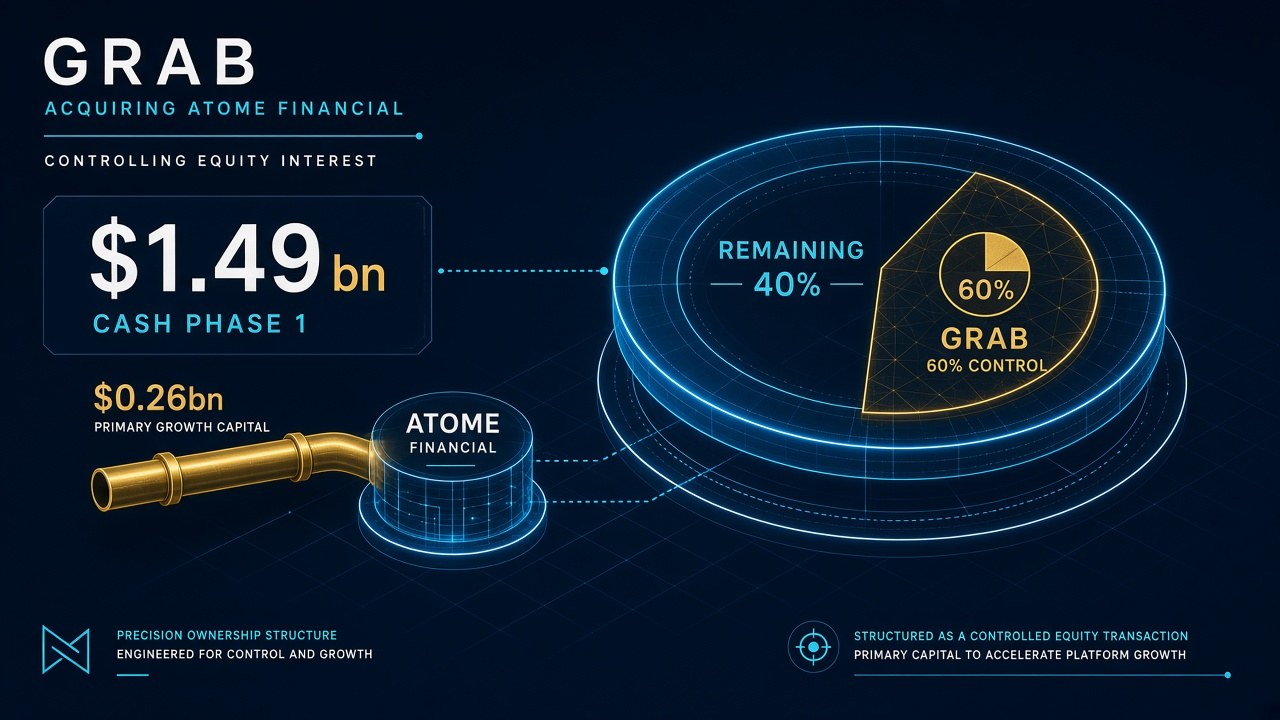
| Node | Disclosed fact |
|---|---|
| Buyer | Grab Holdings Limited |
| Target | Atome Financial (Neuroncredit Pte. Ltd.) |
| Phase 1 stake | 60% controlling equity interest |
| Phase 1 cash | $1.49 billion |
| Primary growth capital | $0.26 billion |
The 15 September Grab announcement and the accompanying Form 6-K are specific about what changes hands now. Grab, Atome Financial, Advance Intelligence Group and certain other parties entered definitive agreements for a controlling 60% equity interest in cash. After close, Grab will financially consolidate Atome into its Financial Services segment. Atome’s management team continues to run the business.[1][2]
The $0.26 billion primary slice is the industrial tell. Most of the $1.49 billion is secondary cash to selling shareholders. $0.26 billion, 17.4% of the Phase 1 cheque on an Acquiry calculation ($0.26bn ÷ $1.49bn), lands on Atome’s balance sheet as growth capital. Grab is buying control and funding the target in the same stroke. Subtracting primary capital leaves $1.23 billion as the disclosed residual of the Phase 1 cash, which is the secondary component implied by Grab’s own split, not a separately stated seller proceeds line.[1][8]
Legal identity matters. The operating company is Neuroncredit Pte. Ltd. The consumer brands sit under Atome Financial: Atome, ranked by Sensor Tower in company materials as the most popular BNPL app in Asia, plus Kredit Pintar in Indonesia. Funding partners named in the announcement include Standard Chartered, HSBC, Bank Jago, DBS Bank, SMBC, BlackRock, Evolution X Capital and InnoVen Capital. Advance Intelligence Group itself is backed by SoftBank Vision Fund 2, Warburg Pincus, Ares and EDBI. HSBC was lead financial adviser to AIGL, with UBS and A&O Shearman also advising the seller side.[1]
Grab’s CFO, Peter Oey, said the transaction is funded entirely from existing cash, is expected to be accretive to Group Adjusted EBITDA upon completion, and does not affect the ongoing share repurchase programme. Those are company statements about funding and accounting, not a sources-and-uses table. Until close, this remains signed, not owned.[1]
How the two-phase price works
Phase 1 is a fixed $1.49 billion cash cheque for 60%. Phase 2 prices the remaining 40% on 13.0x annualized adjusted EBITDA and 2.5x annualized revenue, weighted 75/25, inside a $2.0 billion floor and $4.5 billion cap.
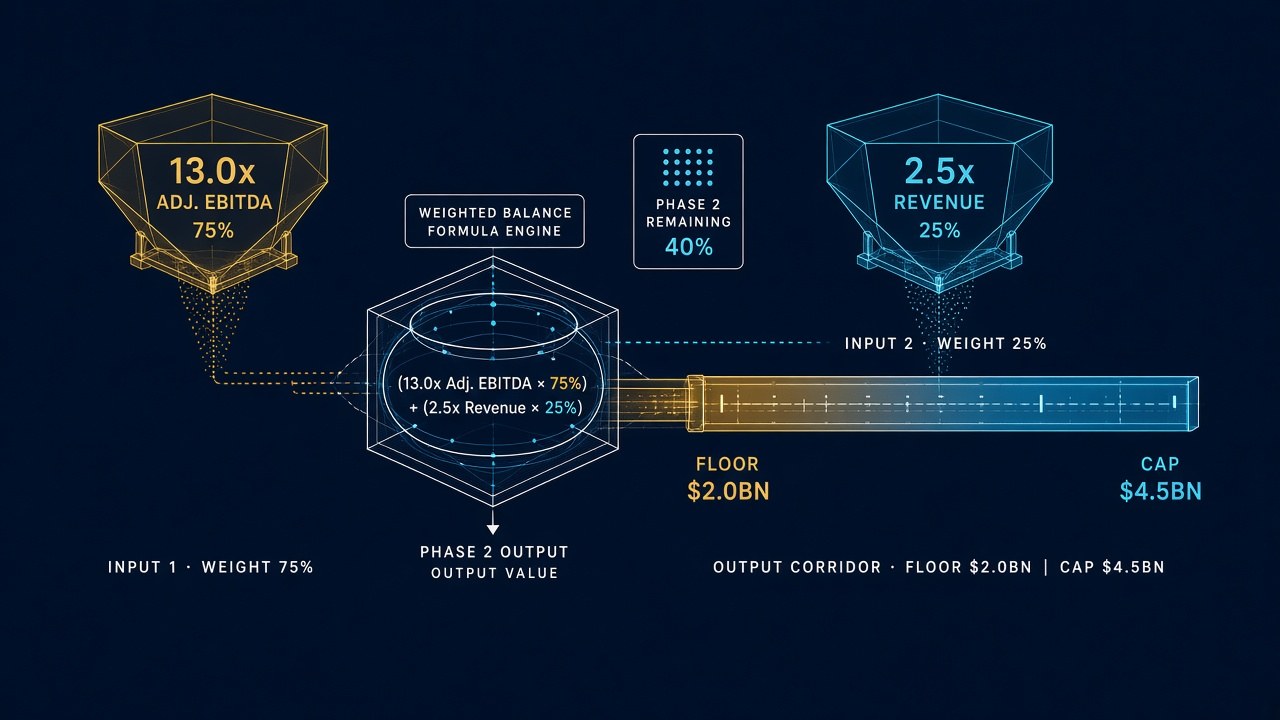
| Input | Disclosed fact |
|---|---|
| EBITDA multiple | 13.0x annualized adjusted EBITDA, 75% weight |
| Revenue multiple | 2.5x annualized revenue, 25% weight |
| Measurement window | Six months immediately prior to Phase 2 closing, annualized |
| Floor | $2.0 billion equity valuation |
| Cap | $4.5 billion equity valuation |
Dividing $1.49 billion by 60% produces an implied 100% equity value of approximately $2.48 billion at Phase 1. That is an Acquiry calculation from disclosed inputs. Grab did not publish an enterprise value, a net-debt bridge, or an Atome EBITDA figure, so this article does not invent an EV/EBITDA print for Phase 1. The useful comparison is the Phase 2 corridor. A $2.0 billion floor sits below the $2.48 billion Phase 1 implied 100%. A $4.5 billion cap sits 81% above it ($4.5bn ÷ $2.48bn − 1, Acquiry calculation). Grab only pays the high end if Atome’s annualized six-month numbers support it.[1][8]
The formula itself is unusually fully disclosed for a private target. Annualized adjusted EBITDA at 13.0x carries 75% of the weight. Annualized revenue at 2.5x carries 25%. Both are measured on the six months immediately before Phase 2 close. At least 50% of Phase 2 consideration is cash. Grab’s language is that this “ensures Grab only pays multiples in proportion to Atome Financial’s demonstrated performance, and caps Grab’s downside exposure to a lower probability outsized outcome.” That is a buyer describing a collar, not a seller describing a take-out.[1]
If Phase 2 equity value prints at the $2.0 billion floor, the remaining 40% costs $0.80 billion. At the $4.5 billion cap it costs $1.80 billion. Those are Acquiry calculations (0.40 × floor or cap). Adding them to the $1.49 billion Phase 1 cash gives a simple range of $2.29 billion to $3.29 billion of headline consideration across both phases, before any mix of non-cash Phase 2 paper and before primary capital’s effect on the register. It is not a funds-flow. It is the arithmetic the filing allows.[8]
Chart data
| Item | Value | Label |
|---|---|---|
| Phase 1 cash for 60% | 1.49 | Disclosed |
| Primary growth capital | 0.26 | Disclosed |
| Residual of Phase 1 cash | 1.23 | Acquiry calculation |
| Implied 100% at Phase 1 | 2.48 | Acquiry calculation ($1.49 ÷ 0.60) |
| Phase 2 floor (100%) | 2.00 | Disclosed |
| Phase 2 cap (100%) | 4.50 | Disclosed |
Grab announcement and Form 6-K. Implied 100% and residual are Acquiry calculations.
Why the businesses fit
Both companies already operate in the same five Southeast Asian markets, with what Grab describes as minimal product overlap: Grab on driver and merchant credit, Atome on consumer BNPL, cash loans and cards.
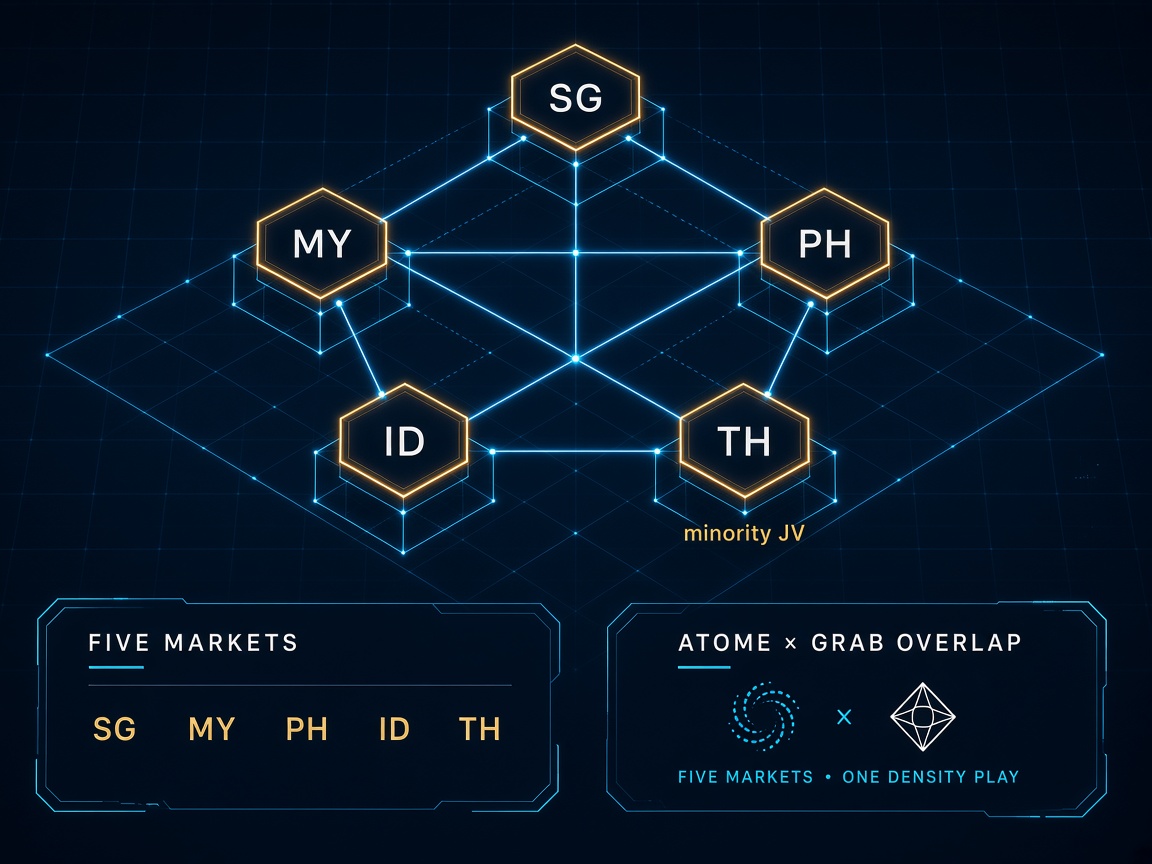
| Market | Disclosed fact |
|---|---|
| Singapore | Atome and Grab overlap |
| Malaysia | Atome and Grab overlap |
| Philippines | Atome and Grab overlap |
| Indonesia | Atome and Grab overlap; Kredit Pintar digital lender |
| Thailand | Atome minority stake in a joint venture |
Grab’s own map is wider. The superapp runs in eight countries and more than 900 cities, adding Cambodia, Myanmar and Vietnam to the five-market overlap. Atome does not, on this announcement, give Grab a new country. It gives Grab a consumer-lending machine inside countries it already occupies. That is a density purchase.[1]
Alex Hungate, Grab’s president and COO, put the operating mismatch in one sentence: Atome’s AI underwriting for millions of digital-lending users, “while managing risk effectively, will help to scale and strengthen Grab’s whole ecosystem.” He also pointed at Atome’s merchant network as a cross-sell surface the other way. In 2025, Grab says, 68% of driver-partner borrowers accessed formal credit for the first time through Grab, and half of those said they did so to avoid predatory lenders. That is a company statistic about Grab’s existing partner-lending book, not about Atome’s BNPL book. The fit argument is that those two credit problems sit next to each other in the same cities.[1]
Jefferson Chen, chairman and CEO of Advance Intelligence Group and CEO of Atome Financial, described eight years of building “a sustainable and reliable financial services platform serving millions of customers across five markets.” Grab’s ecosystem is the distribution he did not previously own. Atome’s underwriting is the consumer-lending factory Grab did not previously own at this scale. Neither side is pretending this is a new geography.[1]
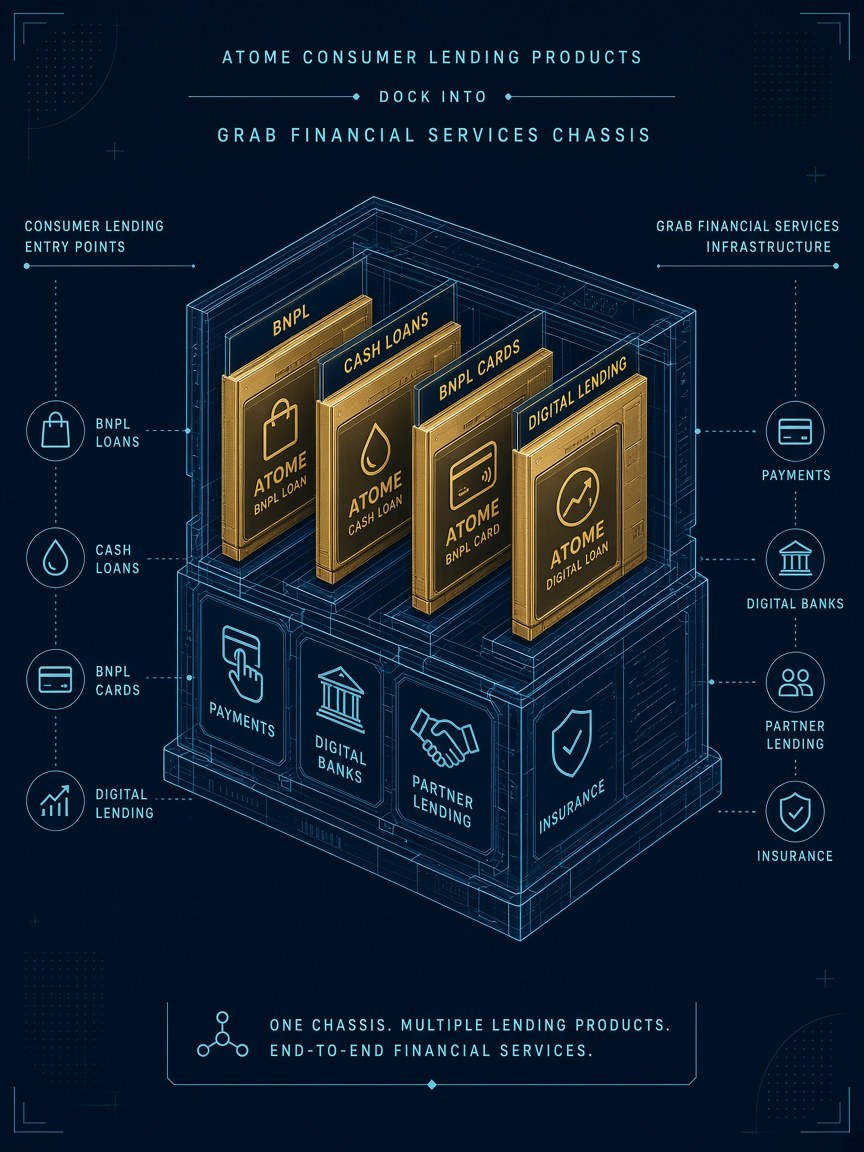
| Layer | Disclosed fact |
|---|---|
| Atome products | BNPL loans, cash loans, BNPL cards, digital lending |
| Grab financial services | Payments, digital banks, partner lending, insurance |
Grab’s current financial-services suite is payments, digital banks (GXS Bank in Singapore, GXBank in Malaysia, Superbank in Indonesia), partner lending, insurance and consumer lending. Atome’s disclosed products are BNPL loans, consumer cash loans, BNPL cards and digital lending. Those lists touch at “consumer lending.” They do not collapse into one product. The announcement’s claim of minimal product overlap is the thing to test after close: whether GrabPay users start seeing Atome instalments, and whether Atome merchants start seeing Grab’s delivery and mobility traffic, without the two credit books competing for the same borrower.[1]
The third pillar in the release is responsible access. Grab cites a Temasek-linked figure that more than 70% of adults in Southeast Asia are unbanked or underbanked. Combining AI underwriting with superapp identity data is the mechanism both companies describe for extending credit without repeating the region’s informal-lending problems. The filing is also explicit about what does not change: licensing, consumer protection, data privacy and responsible-lending obligations in each market remain. This is not a passport to ignore local credit rules.[1][7]
What the numbers and 2028 targets say
Atome reports 25 million cumulative transacted users, more than 30,000 brands and a $1 billion gross loan portfolio as of 30 June 2026, on unaudited management accounts. Grab’s 2028 targets now include $500 million of Financial Services Adjusted EBITDA and a combined gross loan portfolio of over $6 billion, with Atome inside those figures.
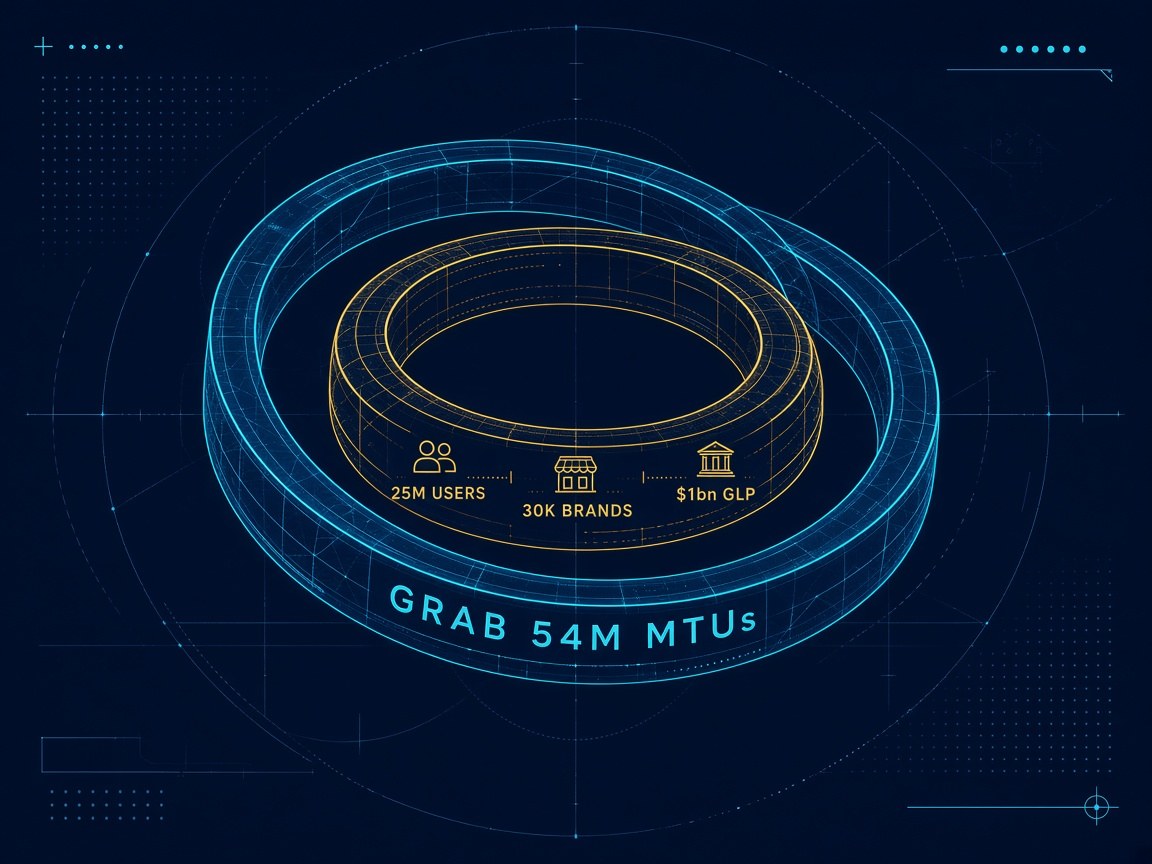
| Metric | Disclosed fact |
|---|---|
| Atome cumulative transacted users | 25 million, unaudited management accounts |
| Atome brands | More than 30,000 |
| Atome gross loan portfolio | $1 billion as of 30 June 2026, unaudited |
| Grab MTUs | Nearly 54 million |
Keep the labels on those operating statistics. Atome’s 25 million figure is cumulative transacted users from management accounts that have not been reviewed or audited. Grab’s nearly 54 million figure is Monthly Transacting Users, a current-run-rate definition. They are not additive, and this article does not add them. The $1 billion gross loan portfolio is unaudited as of and for the six months ended 30 June 2026, gross of provisions, current up to 90 days past due. Grab says delinquency rates have been improving or stable across borrower cohorts and that the book has been managed with prudent loss provisioning. No vintage table is attached to the announcement.[1]
The 2028 figures are company targets, not trailing results. Subject to closing timelines, Grab expects Atome, together with the rest of the Financial Services segment, to generate Adjusted EBITDA of $500 million by 2028 and a combined gross loan portfolio of over $6 billion. Group 2028 targets were revised up to $1.7 billion of Adjusted EBITDA and a 30%+ Group revenue CAGR from 2025 to 2028. Adjusted EBITDA is Grab’s non-IFRS measure. This article does not convert those targets into a purchase-price multiple, because Atome’s current EBITDA is not disclosed.[1]
If the $1 billion Atome book is the starting point and the $6 billion 2028 Financial Services gross loan portfolio is the destination, the combined lending scale Grab is aiming at is six times Atome’s current disclosed book. That arithmetic ($6bn ÷ $1bn) is an Acquiry observation about two company figures with different perimeters: the $6 billion target includes the rest of Grab’s Financial Services book, not Atome alone. It is a sense of ambition, not a run-rate.[8]
Chart data
| Item | Value | Label |
|---|---|---|
| Atome GLP (30 Jun 2026) | $1.0bn | Unaudited, disclosed |
| Atome cumulative users | 25 million | Unaudited management accounts |
| Atome brands | >30,000 | Disclosed |
| Grab MTUs | ~54 million | Disclosed |
| 2028 FS Adj. EBITDA target | $500m including Atome | Company target, non-IFRS |
| 2028 FS GLP target | >$6bn including Atome | Company target |
| 2028 Group Adj. EBITDA target | $1.7bn | Company target, revised |
Grab announcement. Targets are forward-looking. Atome user and GLP figures are unaudited.
Where Grab can put Atome
Distribution leverage runs both ways. Atome gets Grab’s nearly 54 million monthly transacting users, driver and merchant surfaces, and digital banks. Grab gets Atome’s 30,000-plus brand network and a consumer BNPL habit it does not already run at this scale.
Grab already touches daily life in ride-hailing, food and grocery, parcel, payments and lending. Putting Atome instalments at checkout inside that graph is the obvious attach. Putting Grab delivery and mobility offers in front of Atome’s merchant list is the attach the other way. Hungate said the deal deepens consumer lending and unlocks opportunities to serve Atome’s merchant network. Chen said Grab’s ecosystem extends Atome to millions more. Neither described a Day-1 app merge.[1]
Digital banks are a second pipe. GXS Bank, GXBank and Superbank already sit inside Grab’s financial-services column in Singapore, Malaysia and Indonesia, three of Atome’s five markets. A BNPL and cash-loan operator with bank-funding partners including DBS, HSBC and Bank Jago is not the same as a deposit-taking bank. The combination can still share identity, collections playbooks and fraud signals, which is what the announcement actually says they plan to share.[1]
What this deal is not: a licence to take Atome into Cambodia, Myanmar or Vietnam on announcement day. Grab is in those countries. Atome’s disclosed footprint is the five-market list, with Thailand as a minority joint venture. Expansion beyond that list would be a later operating decision, not a term of Phase 1.
How the combination could work
Phase 1 still has to clear regulators by the third quarter of 2027. Then Atome is consolidated, management stays, and a second close about two years later buys the remaining 40% on the formula.
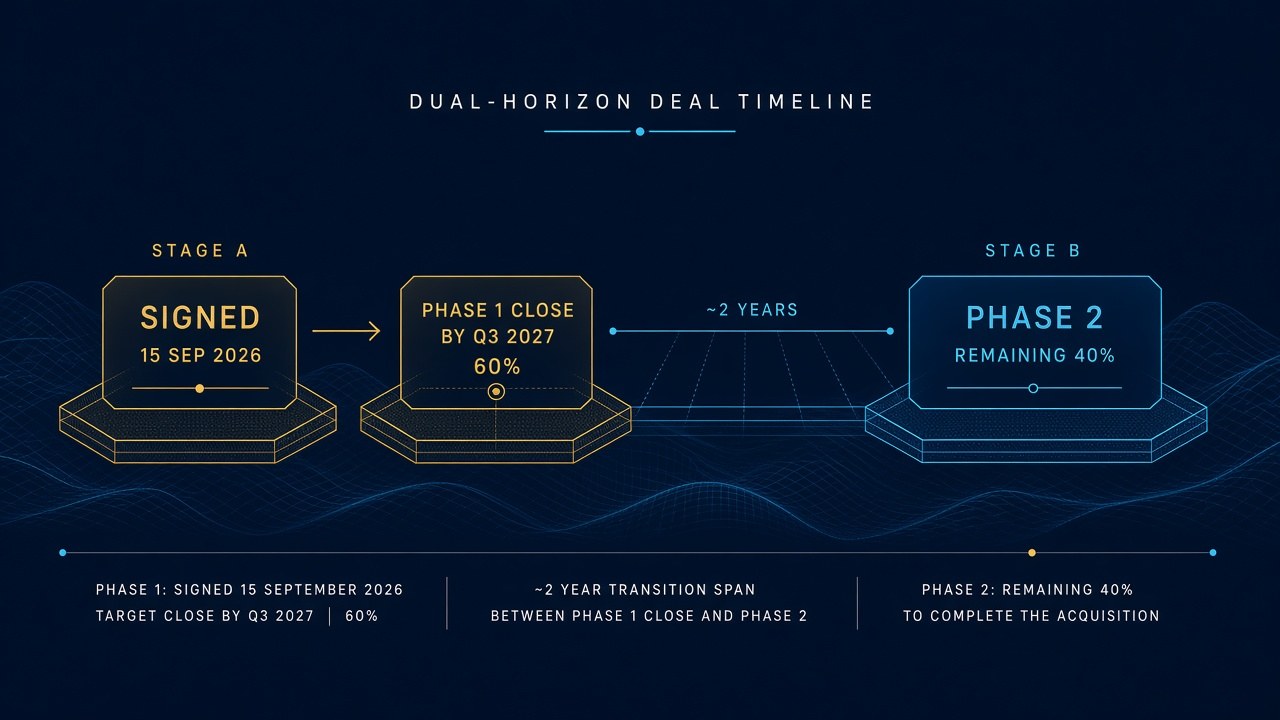
| Stage | Disclosed fact |
|---|---|
| Signed | 15 September 2026 |
| Phase 1 close | Targeted by Q3 2027, subject to approvals |
| Phase 1 stake | 60% |
| Phase 2 | Remaining 40%, approximately two years after Phase 1 close |
The announcement names the conditions in the usual way: regulatory approvals and other customary closing conditions, for both phases. It does not publish a list of named agencies, a reverse termination fee, or an outside date. Until those appear in a fuller filing, the live calendar is the one Grab did publish: Q3 2027 for Phase 1, then roughly 2029 for Phase 2 if Phase 1 lands on time. That 2029 year is an Acquiry illustration from “approximately two years after” a Q3 2027 close, not a stated year.[1][8]
Operating sequence is clearer than the regulatory list. Keep Atome’s management. Consolidate the financials into Financial Services. Pair Atome’s underwriting with Grab ecosystem data. Share collections, fraud and regulatory practice. Do not assume a single credit licence covers five markets. Thailand’s minority joint venture is a reminder that even the disclosed footprint is not a uniform 100% operating control in every country.[1]
- Phase 1 approvalsPending. Close by Q3 2027, subject to regulatory and customary conditions.
- ConsolidationTargeted at Phase 1 close. Atome reports inside Grab Financial Services; management stays.
- Primary capital deployed$0.26bn disclosed. Growth capital on Atome’s balance sheet, not a seller extra.
- Phase 2 formula windowSix months before that close. 13.0x adj. EBITDA and 2.5x revenue, 75/25, inside $2.0–4.5bn.
Acquiry view
Acquiry view. Grab is buying a consumer-lending operator it can distribute through a superapp it already owns, and it has refused to pay a single take-out multiple for the whole company. The $1.49 billion cash cheque buys control and puts $0.26 billion into the target. The second cheque is a collar. That is a disciplined way to buy a fast-growing private lender when the current EBITDA is not on the page.
The best companies are acquired, not sold. Advance Intelligence Group is still selling a 40% stub into a formula, which is not the same as walking away. Grab is identifying a specific capability, consumer BNPL and cash lending with a merchant network, and filling it inside five markets it already occupies. If the 2028 Financial Services targets need a $1 billion loan book that already exists, this is that purchase. If the formula later prints toward $4.5 billion, Grab will have paid for the growth it actually received.
Sources and methodology
Primary company and SEC disclosures rank above reporting. Calculations use disclosed inputs. Adjusted EBITDA remains Grab’s non-IFRS label. Atome user and loan-book figures are unaudited where the company says so.
- 01Grab announcement, 15 September 2026Primary
- 02Grab Form 6-K, filed 15 September 2026SEC
- 03Reuters, 15 September 2026Reported
- 04The Business Times, 15 September 2026Reported
- 05Bloomberg, 15 September 2026Reported
- 06Grab Form 6-K Exhibit 99.1SEC
- 07Temasek, Future of Southeast Asia Digital Financial Services (Grab citation)Industry
- 08Acquiry Deal Intelligence calculationsAcquiry
Method: Acquiry Deal Intelligence methodology. Acquiry was not engaged by any party. Nothing here is investment advice.