
What Databricks is buying
Databricks bought a scalable spreadsheet that connects to live governed data, and a team that will embed that grid inside Genie. The consideration stays private.
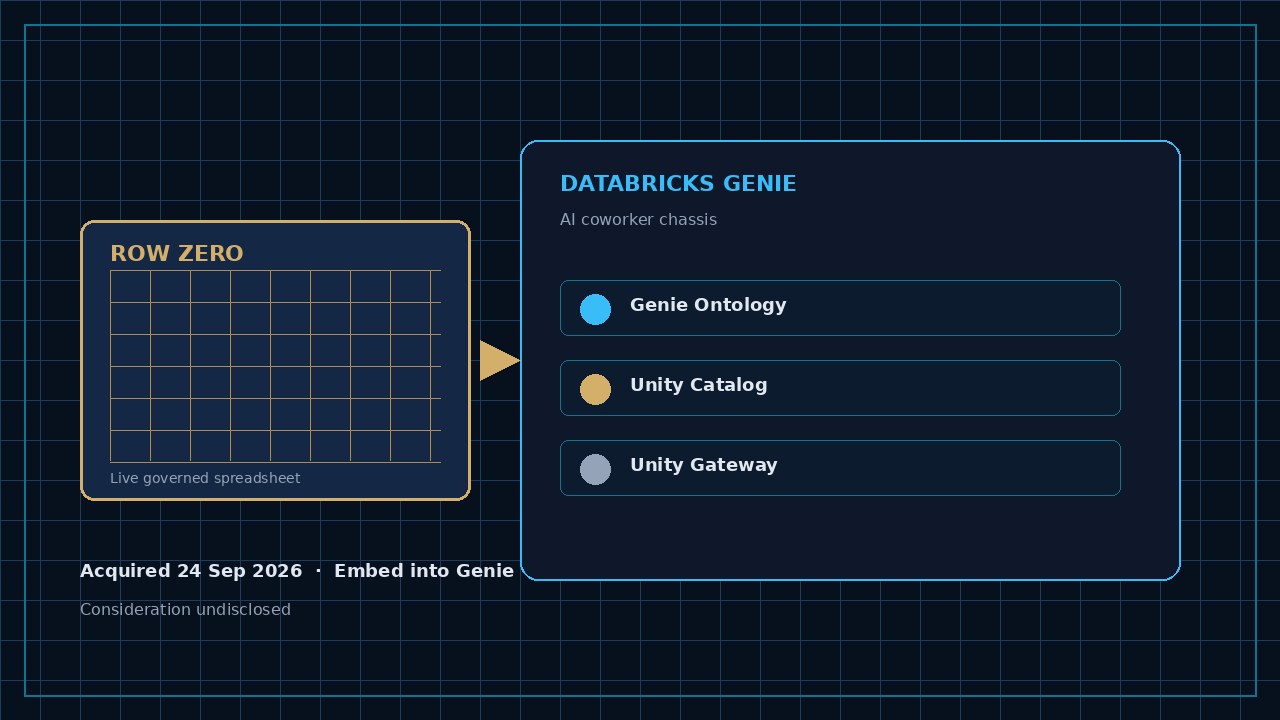
| Node | Disclosed fact |
|---|---|
| Buyer | Databricks |
| Target | Row Zero |
| Product home | Genie AI coworker |
| Governance stack | Genie Ontology, Unity Catalog, Unity Gateway |
| Announcement | 24 September 2026 |
| Consideration | Not disclosed |
The Databricks release is specific about the industrial object. Row Zero is "the spreadsheet built for humans and agents to work together with data." Genie already answers questions about margins or sales pipeline. With Row Zero, Genie adds a native spreadsheet surface where finance, operations, sales and marketing can explore, model, collaborate and act on the same business context.[1]
The company thesis is blunt. Spreadsheets remain the primary engine of business decision-making after four decades. Every data export into an ungoverned file, what Databricks calls a "spreadmart," adds to what it calls arguably the largest set of ungoverned data pipelines in the enterprise. As agents analyze and act, that pipeline becomes a liability. Row Zero's answer is a grid that connects directly to live, governed sources, with permission-aware queries, auto-refresh, locked-down exports, write-back and an auditable agent tool path that still speaks spreadsheet syntax.[1]
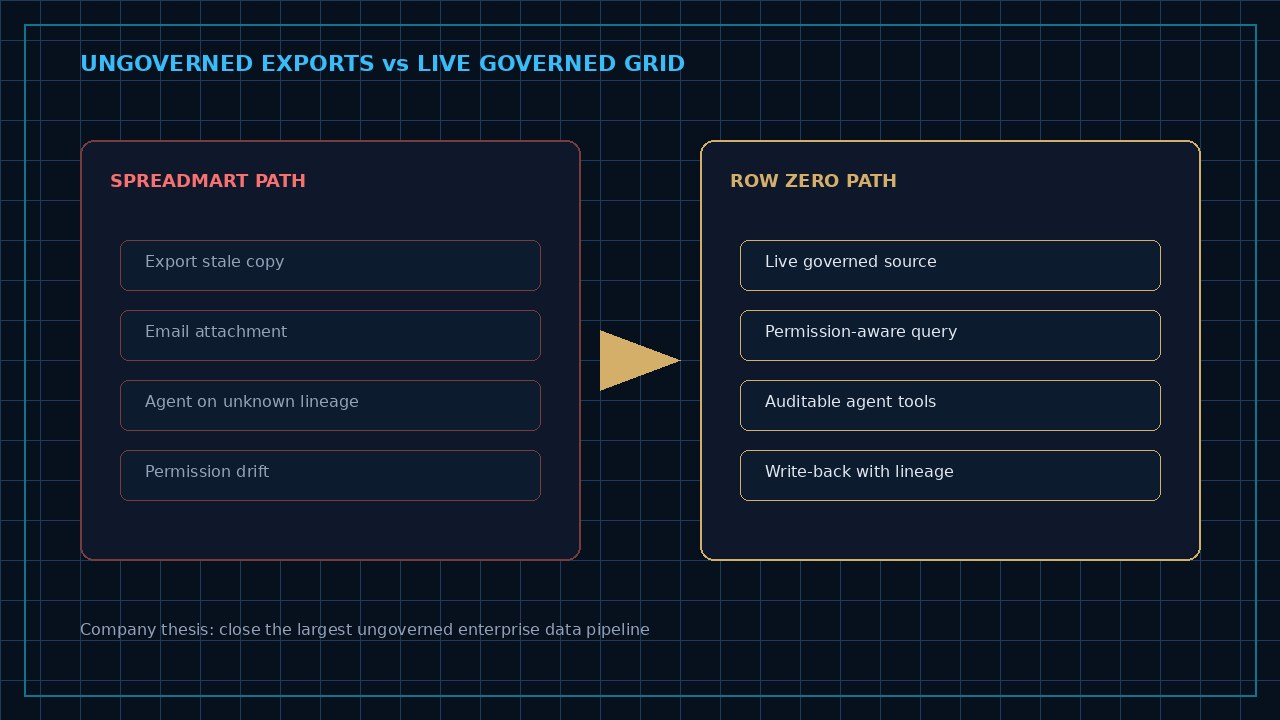
| Path | Disclosed claim |
|---|---|
| Spreadmart path | Stale exports, email attachments, unknown lineage |
| Row Zero path | Live governed sources, permission-aware queries, auditable agents |
Compatibility is deliberate. Row Zero is designed to complement Microsoft Excel and Google Sheets with familiar formulas, pivots and shortcuts, not to invent a third grammar for business users. Performance is the other half of the pitch: a processing engine that can work with billions of rows at interactive speeds. Those are product claims about what Databricks is putting under Genie. They are not a customer census.[1]
Who sat on the transaction
A private data-and-AI platform buyer, a Seattle spreadsheet startup founded by former AWS and Tableau engineers, and a product path into Genie rather than a named adviser roster.
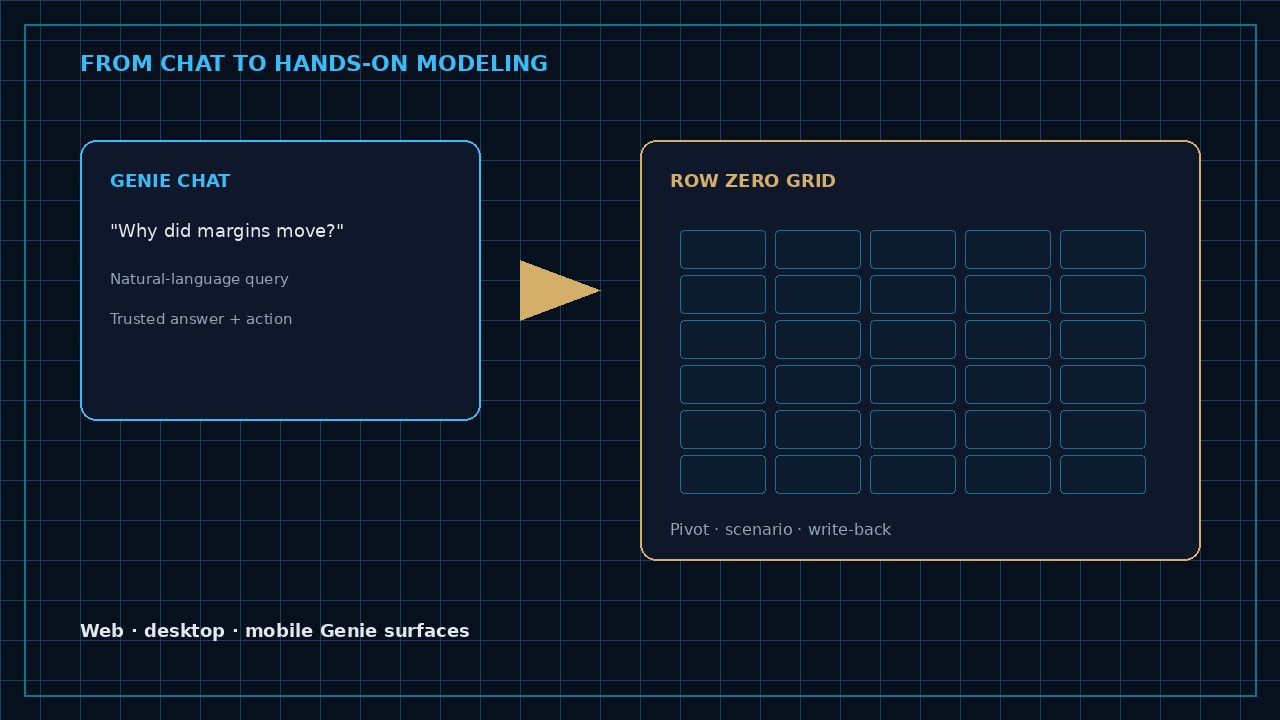
| Surface | Disclosed fact |
|---|---|
| Genie | AI coworker for trusted answers and actions |
| Row Zero | Native spreadsheet experience on Genie web, desktop and mobile |
On the buyer side, Patrick Wendell speaks for the engineering thesis. Ali Ghodsi, speaking to TechCrunch, supplies the corporate appetite: more acquisitions like this. TechCrunch also reports an origin story that is useful and should stay labelled as secondary color. Databricks' own finance team was already using Row Zero because it could scale beyond a million live spreadsheet rows while working with Genie. When executives asked what the tool was, the light bulb went on.[1][2]
On the target side, Breck Fresen is founder and CEO. Nick End is co-founder. GeekWire dates the company to 2021 and says both came out of Amazon Web Services; Databricks also lists Tableau engineering in the founding pedigree. Fresen, in a LinkedIn note covered by GeekWire, said the standalone Row Zero product remains available to existing users while the team focuses on embedding the technology across Databricks. End told GeekWire most of the team will work out of the Seattle Databricks office, and pointed to overlapping enterprise customers plus leadership continuity: all seven original Databricks founders still involved.[1][3]
No financial or legal advisers are named in the primary release. For a private-to-private tuck-in that is normal. The public record here is industrial: who built the product, where it sits, and what stays available after the close path Databricks describes.[1]
Why the businesses fit
Genie already speaks to business teams in natural language. Row Zero gives those same teams a spreadsheet they already know, on data Databricks already governs.
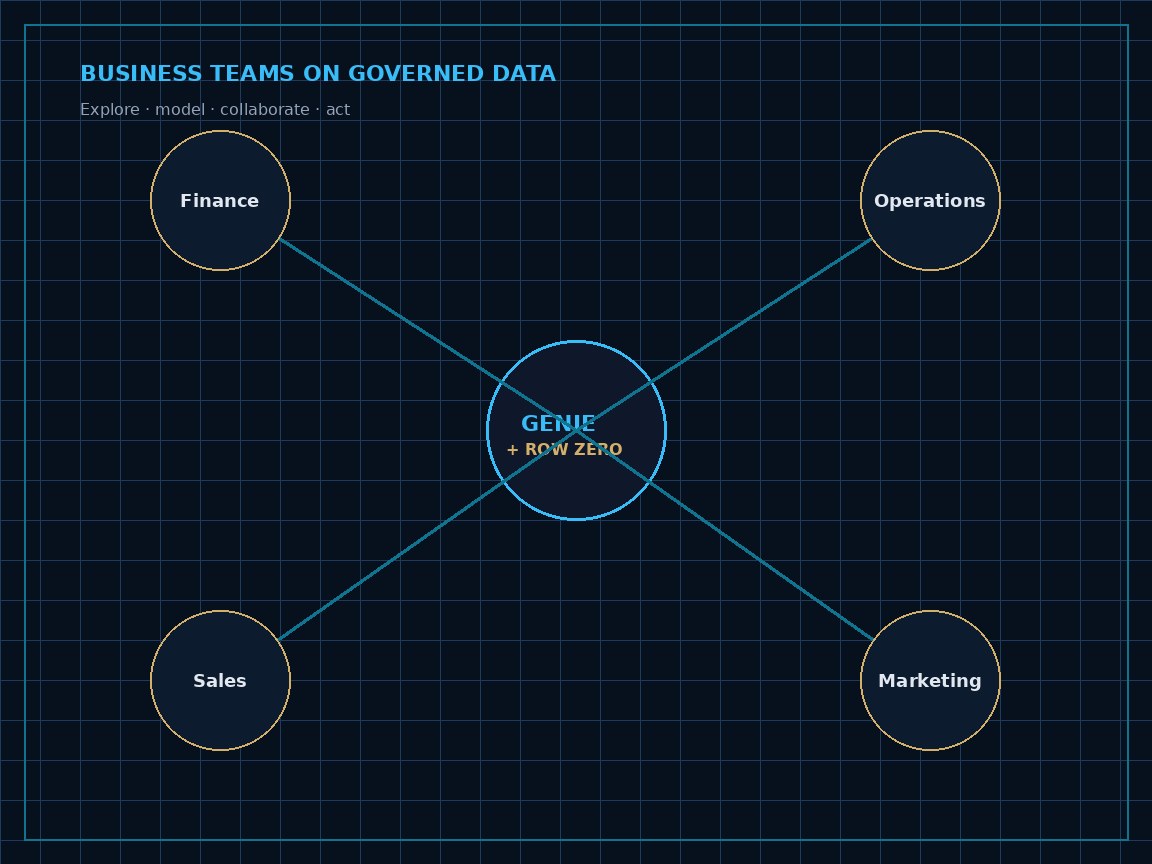
| Node | Disclosed fact |
|---|---|
| Named teams | Finance, operations, sales, marketing |
| Hub | Genie plus Row Zero on Databricks governance |
Ghodsi's public framing of the category is useful because it is short. Spreadsheets are the interface every business analyst loves. Intermarrying business intelligence, agents and spreadsheets is the point. The Fit is not "add another BI tool." It is keep the grid, move the data plane under governance, and let agents operate where humans can still audit the syntax.[2]
“Genie is helping make every knowledge worker dramatically more productive and impactful. As more finance, operations, and go-to-market teams adopt Genie, incorporating a seamless spreadsheet experience is a must-have.”
Patrick Wendell, Co-founder and VP of Engineering, Databricks[1]
Fresen's quote is the mirror image. Row Zero was built because the founders loved spreadsheets and wanted them connected to enterprise-scale data with governance at the core. Joining Databricks, he said, accelerates putting that spreadsheet "in the hands of customers." End's GeekWire email adds the verification angle: even as AI agents do more analysis, humans still need a familiar interface to check the work.[1][3]
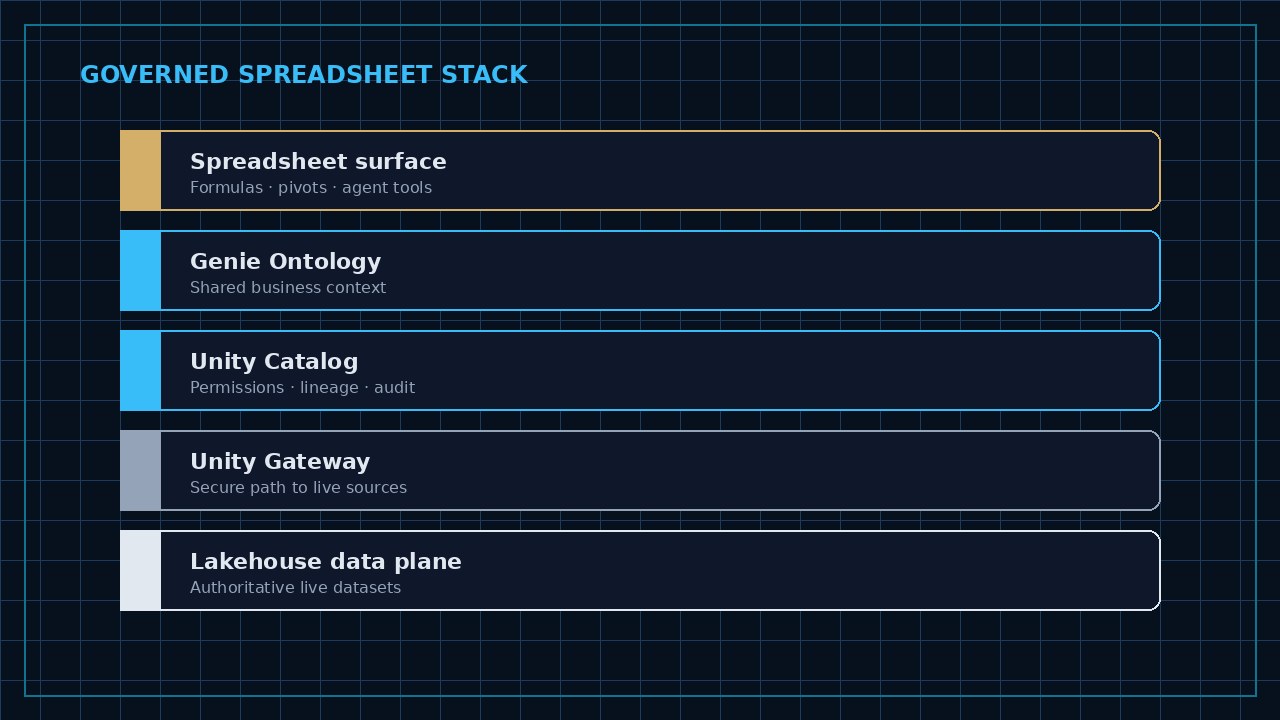
| Layer | Disclosed role |
|---|---|
| Spreadsheet surface | Row Zero formulas, pivots, agent tools |
| Genie Ontology | Shared business context |
| Unity Catalog | Permissions, lineage, audit |
| Unity Gateway | Secure path to live sources |
That is also why the acquisition is a platform motion rather than a point-solution bolt-on. Databricks already sells Lakebase, Genie, Unity Gateway, Agent Bricks, Lakeflow, Lakehouse and Unity Catalog to more than 20,000 organizations. Row Zero is the interface layer for the business user who will never open a notebook and should not be asked to.[1]
How the technology sits together
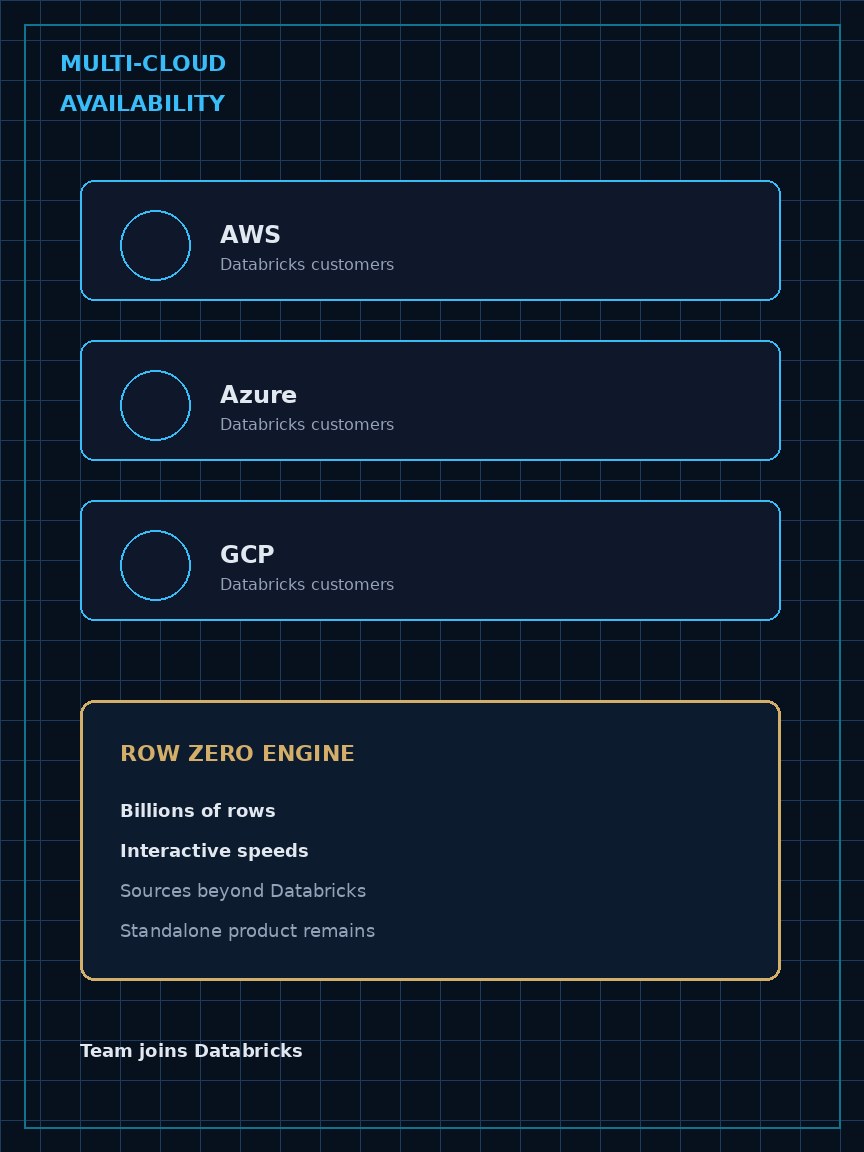
Row Zero becomes a native Genie experience on web, desktop and mobile, with multi-cloud delivery and continued support for data sources beyond Databricks.
| Layer | Disclosed fact |
|---|---|
| Clouds | Available across all major clouds to Databricks customers |
| Sources | Support for data sources beyond Databricks continues |
| Standalone | Row Zero product remains available to existing users |
Native integration means teams can move from Genie chat into hands-on pivoting, modeling and visualization without leaving the Databricks Data + AI Platform. The same Ontology, Catalog and Gateway context travels with the sheet. That is the difference between "export to Excel and hope" and "work in a grid that still knows who you are."[1]
Source breadth is a quiet but important line. Databricks says Row Zero will continue to feature support for data sources beyond Databricks. That keeps the product from becoming a closed lakehouse-only toy, and it matches End's point that the two companies already share many of the same enterprise customers who want cloud data in spreadsheet form.[1][3]
Standalone continuity is the commercial soft landing. Fresen said existing users keep the product; what changes is the speed at which Row Zero reaches Databricks' installed base of more than 20,000 organizations, including 70% of the Fortune 500. Low-friction path: Genie users get a governed grid; Row Zero users keep their worksheets and gain distribution. High-friction path: a forced cutover that turns a beloved interface into a migration project. The release points at the first path.[3][1]
| Capability | Databricks before | Row Zero adds | Together |
|---|---|---|---|
| Business interface | Genie chat and AI coworker actions | Familiar spreadsheet formulas, pivots, shortcuts | Chat-to-grid workflow on one context |
| Governance | Unity Catalog, Ontology, Gateway | Permission-aware live sheets, auditable agents | Governed analytics without spreadmarts |
| Scale | Lakehouse / large enterprise data plane | Interactive work on billions of rows | Business users on enterprise-scale data |
| Agents | Agent tools inside Genie and platform | Agent actions in spreadsheet syntax | Human-auditable agent work |
| Distribution | 20,000+ orgs; multi-cloud customers | Standalone book plus Seattle team | Grid shipped into existing accounts |
| Sources | Databricks platform sources | Integrations beyond Databricks retained | Open enough for shared enterprise stacks |
What the published numbers say
The acquisition cheque is private. The useful numbers are buyer scale, buyer capital context, and Row Zero's last disclosed raise, all labelled and kept separate from enterprise value.
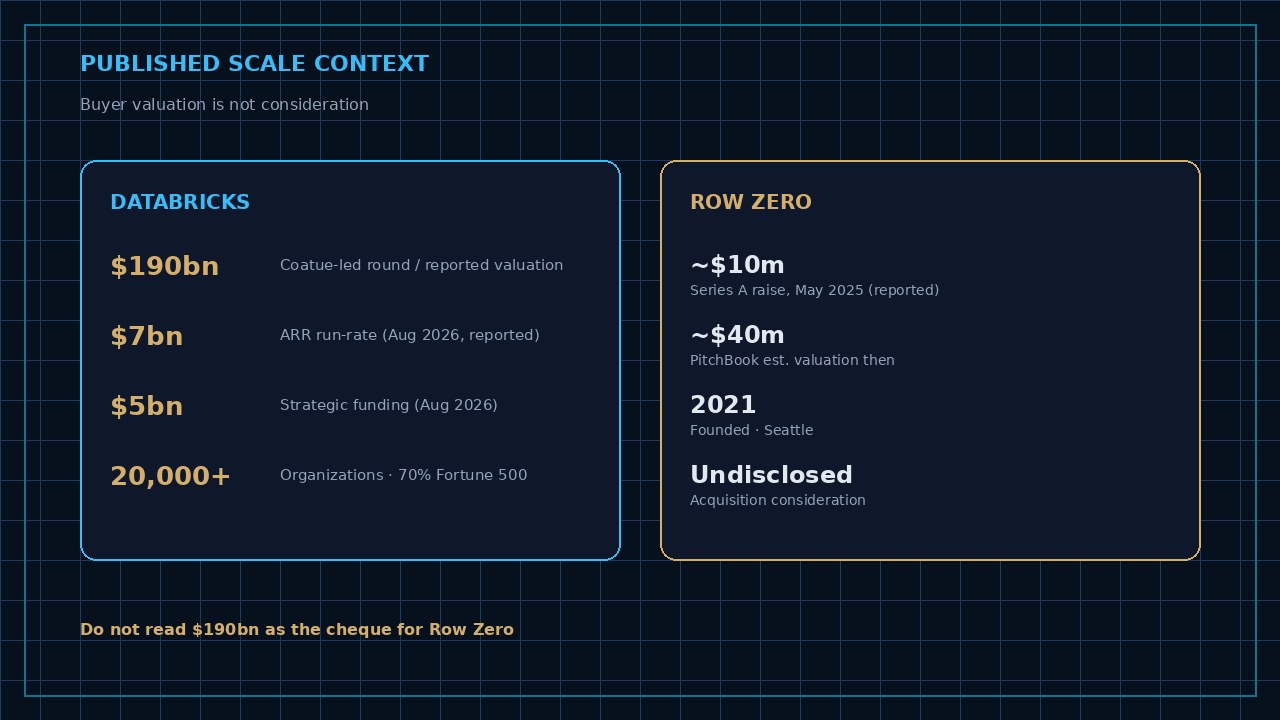
| Metric | Fact and label |
|---|---|
| Databricks valuation | $190bn reported context (Coatue-led round); not deal consideration |
| ARR run-rate | $7bn reported, August 2026 |
| Strategic funding | $5bn reported, August 2026 |
| Row Zero Series A | ~$10m, May 2025, reported |
| PitchBook estimate | ~$40m valuation at Series A time, reported |
| Acquisition price | Not disclosed |
Databricks publishes the installed-base facts that matter for distribution: more than 20,000 organizations worldwide, including adidas, AT&T, Bayer, Block, Mastercard, Rivian, Unilever and 70% of the Fortune 500. GeekWire and TechCrunch add the August capital and growth context: a $5 billion strategic funding round led by Coatue that brought the reported valuation to $190 billion, and a crossing of a $7 billion annualized revenue run-rate, up more than 80% year over year. Treat those as buyer-scale signals. Do not treat them as a multiple on Row Zero.[1][2][3]
| Marker | Figure | Label |
|---|---|---|
| Acquisition consideration | Not disclosed | Primary company release |
| Databricks reported valuation | $190bn | Secondary reporting on Coatue-led round; buyer context |
| Databricks ARR run-rate | $7bn | Reported, August 2026 |
| Databricks strategic funding | $5bn | Reported, August 2026 |
| Row Zero Series A | ~$10m | May 2025, TechCrunch / GeekWire via PitchBook and company history |
| Row Zero est. valuation at Series A | ~$40m | PitchBook estimate cited by TechCrunch; historical |
| Databricks organizations | 20,000+ | Company-published |
Row Zero's last public capital mark is the May 2025 raise of about $10 million, with a PitchBook estimate around $40 million valuation at the time, per TechCrunch. GeekWire names backers including IA Ventures, Trilogy Equity Partners, Founders' Co-op, Ludlow Ventures, K9 Ventures, Functional Capital and Wes McKinney. Those names describe who funded the product before this sale. They are not a post-money for the Databricks transaction.[2][3]
Recent Databricks M&A context, again from TechCrunch and labelled secondary, sketches appetite rather than a Row Zero multiple: Quotient AI and SiftD.ai in March, Panther in June, Electric (PGlite) last month. Ghodsi's line that Databricks intends to do many more acquisitions like this is the strategic signal. The economics of this particular cheque stay off the page.[2]
Where Databricks can put Row Zero
Distribution is the installed Genie and Databricks customer base across major clouds, plus the overlapping enterprises that already wanted cloud data in a spreadsheet.
Fresen's LinkedIn note, as reported by GeekWire, is the distribution sentence: Databricks can put Row Zero in front of customers faster than a standalone Series A company can. Twenty thousand-plus organizations and 70% of the Fortune 500 is a channel, not a press-release flourish, if Genie adoption among finance and go-to-market teams is real.[3][1]
The quieter half is reverse attach. Enterprises already using Row Zero against large live datasets gain a path into Genie, Ontology and Catalog without rebuilding their worksheets. Keeping non-Databricks sources supported is what makes that reverse path credible for mixed stacks.[1]
Geography is practical rather than theatrical. Row Zero is Seattle-born. Databricks already employs hundreds across Seattle and Bellevue, per GeekWire. End says most of the team will sit in the Seattle Databricks office. That is a continuity plan for a product team, not a greenfield market-entry story.[3]
How the combination could work
The announcement is done. The operating sequence is embed in Genie, keep the standalone product alive, ship across major clouds, and prove that agents stay auditable inside the sheet.
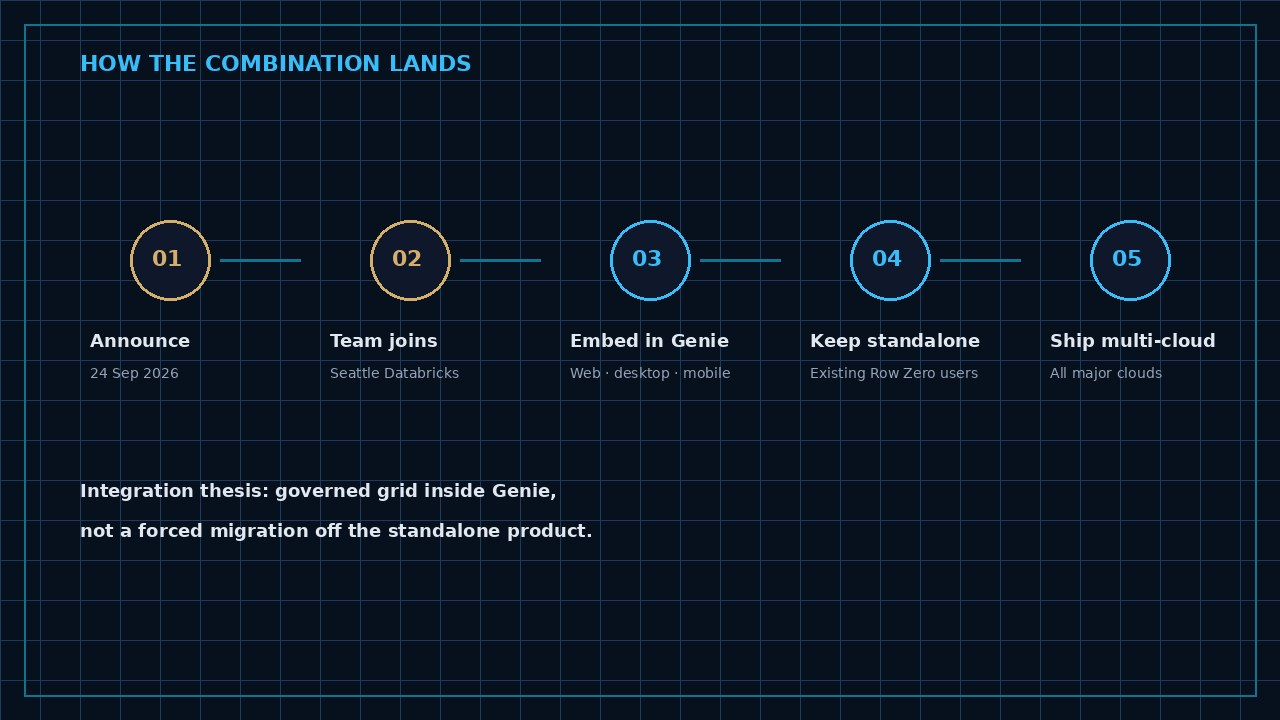
| Stage | Fact or label |
|---|---|
| Announce | 24 September 2026, company-disclosed |
| Team joins | Row Zero team joining Databricks; Seattle office, reported |
| Embed / standalone / multi-cloud | Company-disclosed product path |
Close mechanics, regulatory list and purchase-price escrow are not in the primary release. What is in the release is the product path: native Genie integration on web, desktop and mobile; availability to all Databricks customers across major clouds; continued support for external sources; standalone product still offered. That is enough to write an operating watchlist without inventing a filing calendar.[1]
- Genie embedFirst motion. Chat-to-grid on Ontology, Catalog and Gateway without a separate login island.
- Standalone continuityRetention. Existing Row Zero users keep the product while the Databricks channel ramps.
- Agent auditabilityTrust. Agent tools that remain interpretable in spreadsheet syntax, as the company claims.
- Multi-cloud shipParity. Same experience across major clouds for the 20,000-plus customer base.
- Further tuck-insContext. Ghodsi says more acquisitions like this are intended; treat as appetite, not a pipeline.
Acquiry view
Acquiry view. Databricks bought the interface business users already refuse to abandon, and put it on the governance stack it already sells. The $190 billion figure is the platform Databricks is building, not the price of Row Zero. The fit is mechanical: Genie needs a spreadsheet; Row Zero needs distribution and a governed data plane; both need agents that humans can still audit.
The best companies are acquired, not sold. Spreadsheets were never going to lose to a dashboard. The companies that win the next decade of analytics are the ones that stop pretending otherwise, and then refuse to let the grid become another ungoverned export. If Genie can make that true across 20,000 accounts without breaking standalone users, this is a small cheque with a large interface consequence. If the embed becomes a migration project, the same product reads as another BI surface the business team ignores.
Sources and methodology
The Databricks announcement is primary. TechCrunch and GeekWire supply labelled secondary color on capital history, origin story and founder quotes. Buyer valuation figures stay labelled buyer context.
- 01Databricks announcement: acquires Row Zero for live governed spreadsheets in Genie, 24 September 2026Primary
- 02TechCrunch: Databricks buys Row Zero and is scouting for more startups, 24 September 2026Reported
- 03GeekWire: Seattle startup Row Zero acquired by Databricks, 24 September 2026Reported
- 04Databricks corporate site and Data + AI Platform overviewPrimary
Method: Acquiry Deal Intelligence methodology. Acquiry was not engaged by any party. Nothing here is investment advice.