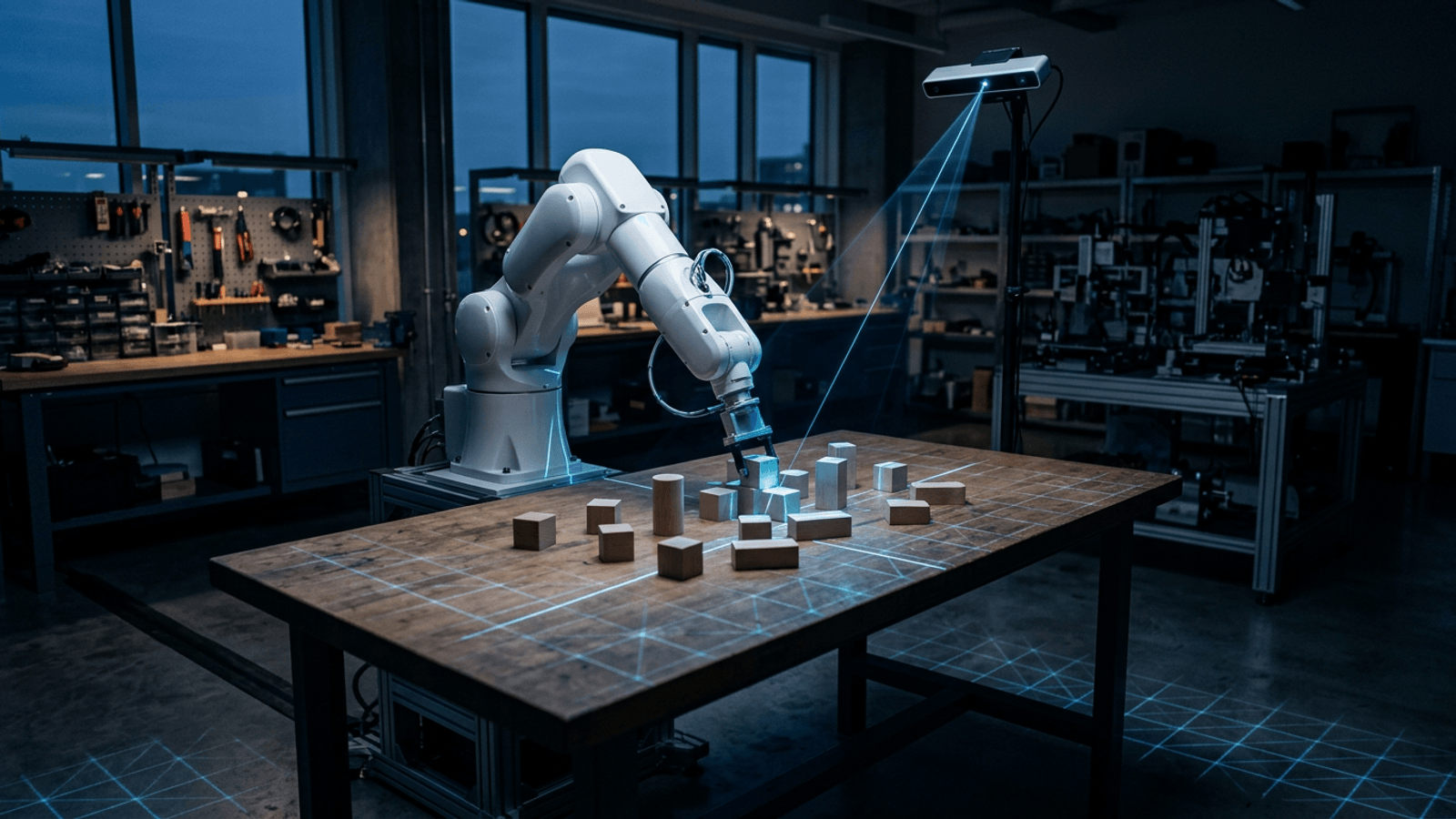
Summary
Summary
- Spatial intelligence is AI that understands and builds 3D space: it can perceive a room, generate a navigable world and let a person or a robot act inside it.
- It goes beyond chatbots. Text models predict words; world models predict how a physical scene looks, fits together and changes when something moves.
- Three digital industries need it most: robotics (safe training in simulation), games (worlds and physics at a fraction of the build cost) and VR (spaces generated on demand).
- Capital is concentrating fast. World Labs raised $1bn in February 2026 and AMD agreed to buy it for about $8.2bn seven months later, a clear signal that compute owners want the model layer.
01 · Research
Beyond text bots: what spatial intelligence actually is
World models understand space, not just words.
Most people met modern AI through chatbots. Those systems are trained to predict the next word, and they are very good at language. They are not built to understand where a chair is in a room, how far a robot arm must reach to pick up a cup, or what the back of a building looks like when you have only seen the front.
Spatial intelligence is the branch of AI that fills that gap. A spatially intelligent model can perceive a scene, rebuild it in 3D, generate new scenes that hold together from every angle, and let a person or an agent move and act inside them. The models that do this are usually called world models.
World Labs (opens in a new tab), the San Francisco lab founded by Dr. Fei-Fei Li, puts it simply: spatial intelligence is the next frontier in AI, and world models should reconstruct, generate and simulate 3D worlds that both humans and agents can interact with.
02 · Research
How world models work today
Two approaches, both maturing quickly.
The field has moved from research demos to products in about a year. Two approaches lead, and both are useful to buyers for different reasons.
- Explicit 3D worldsWorld Labs' Marble, generally available since 12 November 2025, turns text, images, video or a rough 3D layout into a full 3D world. Worlds can be edited, expanded and combined, then exported as Gaussian splats, triangle meshes (including low-fidelity collider meshes for physics) or video. That output drops straight into existing engines and pipelines.
- Real-time generated worldsGoogle DeepMind's Genie 3 (opens in a new tab) generates interactive environments frame by frame from a text prompt, at 24 frames per second and 720p, staying consistent for several minutes. Users can trigger 'promptable world events' such as a change in weather, and DeepMind has used Genie 3 worlds to train its SIMA agent.
- Physical-AI platformsNVIDIA's Cosmos (opens in a new tab) platform packages world foundation models and tooling for robotics and autonomous-vehicle developers, who use them to generate and test synthetic training data at scale.
The common thread is that each of these systems produces space, not sentences. That is what makes them commercially valuable in industries that have always paid heavily to build, capture or simulate the physical world.
03 · Research
The killer angle: three digital industries it unlocks
Robotics, games and VR all run on the same missing layer.
1. Autonomous robotics
Robots learn by trying things, and trying things in the real world is slow, expensive and occasionally dangerous. World models let developers generate unlimited training environments, from cluttered warehouses to volcanic terrain, and test 'what if' situations before a robot ever touches a real object. Genie 3's documentation explicitly frames this as a path to training and evaluating robots and autonomous systems.
2. Game worlds and physics
Building a high-quality 3D level can take a studio team months. Generative world models compress the first draft of that work dramatically: a designer can block out a scene with simple shapes, describe the style, and get a detailed, explorable world back. Marble's export of collider meshes alongside visual meshes is a direct bridge into the physics systems game engines already use. Studios, engine-tooling businesses and asset marketplaces all sit close to this shift. See our gaming M&A coverage for where consolidation is already heading.
3. Virtual and mixed reality
VR has always been constrained by content: headsets are only as compelling as the worlds available to step into. Spatial models that can lift a few photos or a short video into a navigable space make it possible to create environments for training, property, retail and entertainment on demand, rather than commissioning each one by hand.
| Market | What world models replace or accelerate | Who benefits |
|---|---|---|
| Robotics | Real-world data collection and physical testing | Robotics software, simulation and data businesses |
| Games | Manual level building and environment art | Studios, engine tooling, 3D asset platforms |
| VR / XR | Bespoke environment production | Immersive training, property tech, XR platforms |
04 · Research
Follow the money: the World Labs signal
From a $1bn round to an $8.2bn exit in seven months.
On 18 February 2026, World Labs announced $1 billion in new funding (opens in a new tab) from investors including AMD, Autodesk, Emerson Collective, Fidelity, NVIDIA and Sea. The investor list itself tells the story: chipmakers, a design-software leader and a games-and-internet group all wanted a seat at the table.
In July 2026 World Labs made its own acquisition, buying SceniX (opens in a new tab). Then on 28 September 2026, AMD announced an agreement to acquire World Labs in an all-stock transaction valued at approximately $8.2 billion, with closing expected by the end of 2026. On reported valuations for the February round, the price is roughly 1.5 to 1.6 times the value set seven months earlier.
- $1bn round closes
- 18 Feb 2026
- World Labs acquires SceniX
- 21 Jul 2026
- AMD deal announced
- 28 Sep 2026
- Step-up on reported round valuation
- ~1.5x
The logic for AMD is straightforward: owning a frontier world-model team gives it first-hand insight into what spatial and physical-AI workloads will demand of its silicon. Our full breakdown of the terms, the VWAP share mechanics and the road to close is in AMD to Acquire World Labs for $8.2 Billion.
05 · Research
What it means for buyers and sellers of digital businesses
Scarce inputs attract strategic premiums.
World models depend on three scarce inputs: rich 3D and spatial data, specialist research and engineering talent, and access to compute. When an input is scarce and strategic buyers are competing for it, the businesses that hold it gain leverage.
- Data ownersLibraries of 3D scans, game assets, mapped interiors, motion capture or robot interaction logs are training fuel. Clean rights and documented provenance turn them into a valuation driver.
- Tooling and pipelinesBusinesses that convert, render or deploy 3D content, such as splat renderers, mesh tooling and engine plug-ins, become the bridge between models and production use.
- Applied vertical playersSimulation, digital-twin, XR training and robotics software companies that can plug world models into a paying customer base are natural targets for both strategics and growth investors.
For acquirers, the opportunity is to secure spatial capability early, while many of the best teams and datasets still sit inside smaller, founder-led digital businesses. Acquiry runs buy-side mandates across AI, software, gaming and digital infrastructure. Discuss a mandate (opens in a new tab).
Reference
Frequently asked questions
What is spatial intelligence in AI?
Spatial intelligence is the ability of an AI system to perceive, reason about, generate and interact with three-dimensional space. Instead of producing text, a spatially intelligent model produces or understands scenes: where objects sit, how big they are, what they look like from another angle and how they behave when moved.
How is a world model different from ChatGPT?
A large language model predicts the next word in a sentence. A world model predicts the next state of an environment, such as the next frame of a scene or the 3D structure behind a photo. That makes world models useful wherever software has to deal with physical space: robots, game engines, simulation and virtual reality.
Who are the main companies building world models?
Leading names include World Labs (Marble), Google DeepMind (Genie 3) and NVIDIA (the Cosmos platform for physical AI). World Labs agreed to join AMD in an all-stock deal valued at about $8.2 billion, announced on 28 September 2026.
Why does spatial intelligence matter for M&A?
World models need large datasets of 3D scenes, specialist research teams and heavy compute. Those are scarce, so they attract strategic buyers. Digital businesses that hold 3D content, simulation tooling, engine expertise or robotics data can benefit from that demand when they raise capital or sell.
Keep reading
Related analysis

Research · AI
Artificial Intelligence and Strategic M&A in 2026
Capital Allocation, Valuation, and Market Structure: Evidence from 2022 to 2025 Transaction Data

Guides · AI
What AI Cannot Buy:The New Scarcity Map forDigital Business Acquisitions
When AI commoditises execution, five categories of digital business asset gain a scarcity premium. A 2026 framework for founders, operators, and acquirers navigating the new M&A landscape.

Market Report · Global M&A
Q3 2026: The Deals That Defined the Quarter
14 transactions, each told in full: who bought what, what they paid, what the filings actually say, and what it tells you about the market going into Q4.
Explore the sector:SaaS acquisitionsGaming acquisitions
About the analyst

Joash Boyton
Founder and Managing Director, Acquiry · Melbourne, Australia · Global coverage
Joash Boyton is the Founder and Managing Director of Acquiry, a specialist M&A advisory firm focused on the acquisition and sale of businesses. He executes buy-side and sell-side mandates from USD $1M to $500M across technology, SaaS, fintech, payments, gaming, blockchain and emerging verticals, and is not limited to them. Any sector, any market.