Summary
Summary
- AI data centre demand is growing faster than electricity grids can connect it. The scarce asset is no longer land or buildings. It is confirmed power.
- The AIP, MGX and BlackRock GIP consortium closed its $40bn acquisition of Aligned Data Centers on 21 July 2026 and committed another $5bn of growth capital.
- In Texas, data centres account for around 90% of potential demand in ERCOT’s large-load queue, and developers now pay $50,000 per megawatt and must prove land control before studies start.
- For acquirers, energised capacity, interconnection agreements, on-site generation and liquid-cooling readiness are now the core valuation drivers.
01 · Research
The constraint has moved to the grid
Power is now the long pole.
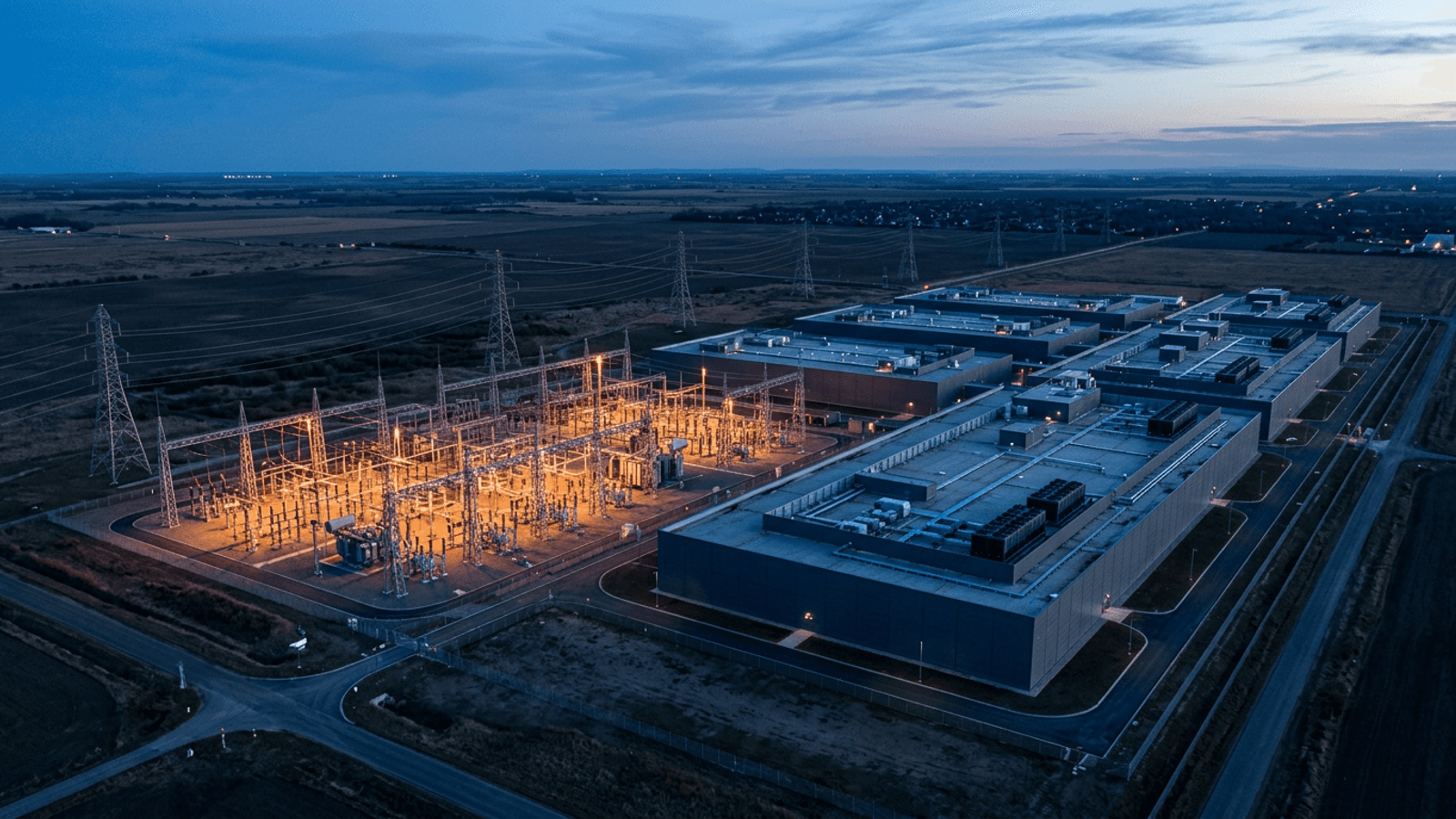
A modern AI training or inference campus can need hundreds of megawatts. Chips, servers and even buildings can be procured on timelines measured in months. A new high-voltage grid connection is measured in years: studies, upgrades, permits and construction.
Texas shows the pressure clearly. ERCOT (opens in a new tab) has received hundreds of requests for large-scale connections, and data centres account for around 90% of the potential demand. Regulators now require developers to pay $50,000 per megawatt and prove they control the land before grid studies even begin, a filter designed to clear speculative requests.
02 · Research
Follow the capital
Platform-scale money for power-secured platforms.
The AI Infrastructure Partnership, MGX and BlackRock’s Global Infrastructure Partners closed their $40bn acquisition of Aligned Data Centers on 21 July 2026, and committed a further $5bn of growth capital to expand Aligned’s AI-ready capacity. The size of the cheque reflects a platform with secured power and a pipeline of buildable sites, not just existing halls.
Brookfield has committed more than $25bn to data centre and power infrastructure, pairing capacity with generation. The pattern across the largest investors is the same: own the power alongside the building.
| Asset | Why it matters | Time it saves |
|---|---|---|
| Energised capacity | Revenue can start as soon as tenants fit out | Years of grid upgrades |
| Signed interconnection agreement | Contracted right to future capacity | Study and queue time |
| On-site or adjacent generation | Reduces reliance on grid upgrades | Transmission build-out |
| Liquid-cooling readiness | Supports dense AI racks without retrofit | Mechanical redesign |
| Local approvals and water rights | Lowers permitting and community risk | Planning cycles |
04 · Research
What it means for buyers and sellers
Power-first valuation.
- Value the megawatt, not the square metreBuyers increasingly benchmark platforms on energised and contracted MW, and on the certainty and timing of future capacity.
- Bolt-ons with power are prime targetsSmaller developers holding pre-approved grid access or generation rights are natural add-ons for the large platforms. Clear documentation of interconnection status is the single biggest value lever.
- The stack extends to softwareEnergy management, cooling control and capacity-planning software sit in the same buying pattern, as Schneider’s purchase of Shelly showed in September 2026.
Read alongside Inside the Agentic Stack: the software layers agents run on, and the power those layers consume, are both being bought by platforms with long-term capital.
Reference
Frequently asked questions
Why is power access so valuable in data centre M&A?
Because it is the slowest input to secure. Buildings and equipment can be procured in months, but a new grid connection can take years of studies, upgrades and approvals. A developer that already holds confirmed capacity can deliver revenue far sooner, and buyers pay for that time advantage.
What was the largest data centre acquisition of 2026?
The $40bn acquisition of Aligned Data Centers by the AI Infrastructure Partnership, MGX and BlackRock’s Global Infrastructure Partners, which closed on 21 July 2026 with a further $5bn committed for growth.
What is ERCOT’s large-load queue?
The list of requests to connect very large electricity users to the Texas grid. Data centres account for around 90% of the potential demand in it, and Texas regulators now require a $50,000 per megawatt payment and proof of land acquisition before grid studies begin.
What do buyers check in a data centre target?
Energised megawatts, signed interconnection agreements and their timelines, on-site or adjacent generation, cooling capability for high-density AI racks, water rights and local approvals, and the credit quality of contracted tenants.
Keep reading
Related analysis

News · Gaming
Sovereign Wealth Funds as Digital Acquirers: The Capital Shift Reshaping M&A in 2026
By Joash Boyton, Founder & Managing Director, Acquiry • February 2026

Research · AI
Inside the Agentic Stack: Why Supabase and Salesforce Are Buying AI Infrastructure, Not AI Features
AI agents create databases, call models and talk to customers at machine scale. The acquirers winning the infrastructure race are buying the layers underneath those agents, not another chatbot on top.

Research · AI
Artificial Intelligence and Strategic M&A in 2026
Capital Allocation, Valuation, and Market Structure: Evidence from 2022 to 2025 Transaction Data
Explore the sector:SaaS acquisitions
About the analyst

Joash Boyton
Founder and Managing Director, Acquiry · Melbourne, Australia · Global coverage
Joash Boyton is the Founder and Managing Director of Acquiry, a specialist M&A advisory firm focused on the acquisition and sale of businesses. He executes buy-side and sell-side mandates from USD $1M to $500M across technology, SaaS, fintech, payments, gaming, blockchain and emerging verticals, and is not limited to them. Any sector, any market.
03 · Research
Social licence is now part of the asset
Approval risk is priced in.
Regulators are adding expectations as well as fees. In March 2026 the Australian Government released expectations for data centre developers covering national interest, support for the energy transition and sustainable water use, framed explicitly as conditions for maintaining a social licence to operate.
For acquirers this turns community relations, water strategy and renewable sourcing into diligence items with real value attached. A site with approvals, local support and a credible energy plan is worth more than a cheaper site that still has to win them.