In this report
A compiler for the quantum era
SANTA CLARA, California — Intel (opens in a new tab) (Nasdaq: INTC) has entered into a definitive agreement (opens in a new tab) to acquire Classiq (opens in a new tab), a leading provider of quantum computing software based in Tel Aviv. Announced on 26 October 2026, the deal pairs Classiq’s automated quantum algorithm synthesis platform with Intel’s silicon spin-qubit technology, its existing quantum software and its semiconductor manufacturing expertise. Intel says the combination would create a user-friendly full-stack quantum computing platform, helping the technology mature into a mainstream computing business.
Intel frames the deal with a piece of chip history it knows well. More than forty years ago, Electronic Design Automation and Computer-Aided Design software transformed silicon chip design by giving engineers a common software platform that separated the design of a chip from the complexity of the hardware underneath. Intel says Classiq plays a similar role in quantum computing: a unifying software platform that is agnostic to the qubit modality and hardware, so that applications can scale beyond custom hand-crafted circuits.
That makes this a software acquisition by a hardware maker, and a clear statement of intent. Intel has been investing in quantum computing since 2015. Classiq, founded in 2020, has raised over US$200 million from investors including SoftBank Vision Fund 2, AMD Ventures, Qualcomm Ventures and IonQ. The transaction is expected to close in the first half of 2027, subject to regulatory approvals and other customary closing conditions.

Classiq lets developers describe quantum algorithms at a high level while its synthesis engine generates hardware-ready circuits.
The deal at a glance
Key facts
- Status Disclosed
- Agreed, 26 October 2026Definitive agreement. Expected to close in the first half of 2027.
- Classiq Series C Disclosed
- US$110 millionMay 2025, led by Entrée Capital. The largest ever for a quantum software company.
- Buyer Disclosed
- Intel CorporationInvesting in quantum computing since 2015.
- Target Disclosed
- Classiq, Tel AvivFounded in 2020. Used by dozens of global enterprises.
- Classiq funding Disclosed
- Over US$200 millionCumulative, as stated by Classiq in November 2025.
- After closing Disclosed
- Hardware-agnosticIntel intends to support Classiq’s multi-platform integrations.
- Disclosed
- Stated by a party to the transaction
The numbers behind the deal
Each figure has its own permanent link and a ready-made citation. Journalists, analysts and researchers are welcome to quote them with credit to Acquiry Deal Intelligence.
Every figure below comes from the announcements of Intel and Classiq, with the date and source shown for each. The dataset holds the same figures in machine-readable form, ready to download as JSON or CSV.
- H1 2027Disclosed
Expected closing window
Stated by Intel on 26 October 2026, subject to regulatory approvals.
- 2015Disclosed
Year Intel began investing in quantum computing
Stated by Intel on 26 October 2026.
- US$200M+Disclosed
Classiq cumulative funding
Stated by Classiq with its strategic up-round in November 2025.
- US$110MDisclosed
Classiq Series C, May 2025
Led by Entrée Capital. Classiq called it the largest ever for a quantum software company.
- Up to 97%Disclosed
Quantum circuit compression in a Deloitte Tohmatsu demonstration
Announced by Classiq on 11 December 2024 with Deloitte Tohmatsu and Mitsubishi Chemical.
Part I of III
Software meets silicon spin qubits
What Intel agreed, and the synthesis platform Classiq has built.
Intel signs to turn its quantum group into a full-stack business
A definitive agreement to combine Classiq’s synthesis platform with Intel’s spin qubits, software and manufacturing, expected to close in the first half of 2027.
Intel announced the agreement jointly from Santa Clara, California and Tel Aviv, Israel. Under it, Intel would acquire Classiq and combine its automated quantum algorithm synthesis platform with three things Intel already has: its quantum software platform, its scalable silicon spin-qubit technology and its advanced semiconductor manufacturing expertise. Intel says the result would make it a full-stack quantum solutions provider, covering everything from the qubit chip to the software developers use to program it.
The combination also widens Intel’s product range. Intel says the deal would allow it to add Quantum Processing Units, or QPUs, to a compute platform portfolio that already spans Central Processing Units, Graphical Processing Units and application-specific integrated circuits. In that framing, quantum becomes one more processor family Intel can offer its customers, with Classiq supplying the software layer that lets developers target it without hand-crafting circuits.
Joining forces with Classiq transforms Intel’s Quantum Computing Group into a full-stack quantum computing business.
Classiq’s co-founders join Intel’s Quantum Computing Group
Intel chief executive Lip-Bu Tan welcomed Classiq’s founding team by name. “I am delighted to have Nir, Yehuda, Amir and the entire Classiq team join Intel,” he said. Tan added that for more than a decade Intel has made “remarkable progress in quantum computing” by applying its semiconductor innovation, advanced manufacturing and systems engineering expertise to the development of scalable silicon spin-qubit technology. Classiq, in his account, is the piece that completes the stack.
Nir Minerbi, co-founder and chief executive of Classiq, described the deal as a continuation of the company’s founding mission. Since its founding, he said, Classiq has focused on making quantum computing practical and accessible, enabling developers, researchers and enterprises to create scalable quantum applications without requiring deep expertise in quantum circuit design. “Together, Intel and Classiq can help unlock the benefits of quantum computing and accelerate its adoption sooner,” he said.
The transaction is subject to regulatory approvals and other customary closing conditions. Until it closes, Intel and Classiq will continue to operate as separate, independent companies, so Classiq’s customers, academic users and hardware partners keep working with the same team and platform through the approval period.

Intel produces qubit chips using equipment and processes common to conventional silicon semiconductor manufacturing.
Classiq turns algorithm intent into hardware-ready circuits
A quantum software platform built on the Qmod language and automated synthesis, used by dozens of global enterprises and hundreds of academic institutions.
Classiq describes itself as a leading quantum computing software company providing enterprise-grade technology that makes it practical to develop scalable, efficient quantum applications. Its platform combines AI agents, a high-level quantum modelling language and design automation to accelerate the development of optimised, hardware-ready quantum software. It also supports hardware benchmarking, cost and performance optimisation, and execution across quantum hardware platforms. Intel says the platform is used by dozens of global enterprises.
At the centre of the product is Qmod (opens in a new tab), the Quantum Modeling Language, which Classiq made generally available in July 2024 and describes as the first high-level language for quantum coding. Qmod lets developers describe quantum algorithms at a high level of abstraction, mixing quantum-specific concepts with constructs familiar from classical programming languages. Developers state the functional intent of an algorithm, and Classiq’s compiler and synthesis engine work out the hardware-aware implementation details. Classiq says this is the step that moves quantum programming away from the hardware level, where only specialists could work.
Up to 97% shorter circuits in a Deloitte Tohmatsu demonstration
Synthesis matters because circuit length matters. To run on a quantum computer, an algorithm must be written as a quantum circuit, and the longer the circuit, the greater the risk of errors during calculation. In December 2024, Classiq, Deloitte Tohmatsu Group and Mitsubishi Chemical Corporation shared results (opens in a new tab) from a demonstration in materials development, including new organic electroluminescent materials. Deloitte Tohmatsu said one of the two quantum algorithms achieved circuit compression of up to 97 percent, and the other up to 54 percent, showing how efficient circuit design can improve calculation accuracy.
Classiq has also extended the platform toward the fault-tolerant machines the industry is building. On 30 September 2026 it announced its Fault Tolerance Engine (opens in a new tab), which translates optimised logical quantum programs into fault-tolerant execution plans. The engine decides how the protected qubits are laid out, how their interactions are routed and the schedule that runs them, and then measures the physical resources the application needs, including physical qubit requirements, error-correction cycles, code distance, runtime and accumulated error. Because those figures come from the plan the engine actually produced, Classiq says they describe the implementation a machine would run.

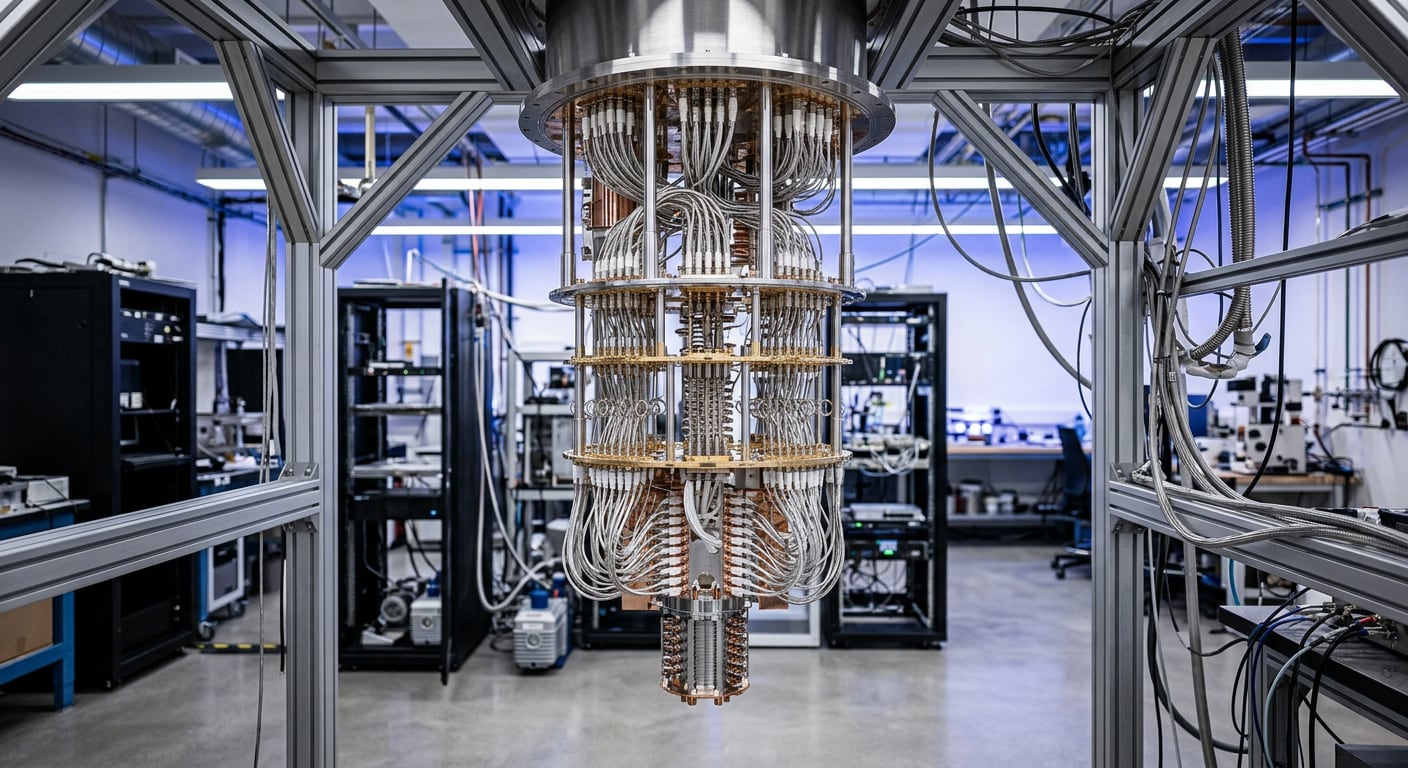
Quantum programs must ultimately run on physical qubits. Classiq’s software generates circuits sized for the hardware they target.
Figure 1
What Classiq adds to Intel’s quantum stack
- LanguageWhat it contributes: Qmod, a high-level quantum modelling languageEffect for Intel: Developers program by intent, not by gate
- SynthesisWhat it contributes: Automated quantum algorithm synthesis and AI agentsEffect for Intel: Optimised, hardware-ready circuits
- Fault toleranceWhat it contributes: Fault Tolerance Engine with measured physical resource plansEffect for Intel: A path to fault-tolerant machines
- IntegrationsWhat it contributes: Execution across multiple quantum hardware platformsEffect for Intel: An open, hardware-agnostic ecosystem
- HardwareWhat it contributes: Intel silicon spin qubits and cryogenic control electronicsEffect for Intel: Full stack from chip to application
Show method and sourcesHide method
Capabilities as described by Intel on 26 October 2026 and by Classiq in its product announcements. Effects are Acquiry analysis.
Enterprise customers from BMW to Toshiba
Classiq’s commercial footprint grew quickly. When it raised its Series C (opens in a new tab) in May 2025, the company said it had tripled its customer base and revenues year over year and was used by dozens of the top enterprise teams and hundreds of academic institutions worldwide. Named enterprise customers included BMW, Citi, Deloitte, Rolls-Royce, Mizuho and Toshiba, and the company listed collaborations with Microsoft, AWS and NVIDIA. Classiq also forms part of the official curriculum at many top-tier universities, giving it a steady pipeline of developers who learn quantum programming on its tools.
Part II of III
Quantum’s design-automation moment
Why a chipmaker wants a hardware-agnostic quantum compiler.
Design automation reshaped chips forty years ago; Intel wants it for qubits
Intel pairs its spin-qubit manufacturing with a software layer that abstracts quantum programs from the hardware, as chip design software did for classical computing.
Intel’s case rests on an analogy from its own industry. Chip design software abstracted the work of designing a chip from the complexity of the silicon underneath, and that abstraction let classical computing scale. Intel argues that quantum computing needs the same step: a high-level layer that lets quantum applications grow beyond custom hand-crafted circuits into a mainstream computing platform. Classiq’s synthesis platform is that layer, and Intel says it brings complementary assets to the quantum hardware and software capabilities Intel has developed over the last decade.
On the hardware side, Intel has been investing in quantum computing since 2015. It says it is the only company capable of producing qubit chips and complex cryogenic control electronics at scale using equipment and processes common to conventional silicon-based semiconductor manufacturing. Its approach uses silicon spin qubits, which build on the same manufacturing base as Intel’s conventional processors. Adding Classiq places a developer-facing software platform on top of that manufacturing base, so the people writing quantum applications have a direct route to the hardware Intel builds.

Electronic design automation let engineers describe chips at a higher level and leave the physical layout to software. Classiq applies the same idea to quantum circuits.
Intel can make qubits in a chip fab. Classiq gives developers a way to program them without hand-crafting circuits.
Lip-Bu Tan backed Classiq’s Series B in 2022
The deal also has a personal thread. In February 2022, Classiq announced (opens in a new tab) a US$33 million Series B that included personal investments from Lip-Bu Tan and Harvey Jones, whom it described as chip design titans. At the time, Classiq introduced Tan as the executive chairman and former president and CEO of Cadence Design Systems, a company at the heart of the chip design software Intel now cites as its model. Tan now leads Intel as chief executive and is bringing Classiq into the company he runs.
That background gives the analogy weight. The people steering the deal have watched design automation turn chip design from a specialist craft into an industry with common tools, and the agreement is a bet that quantum software follows the same path. Intel’s announcement makes the link explicit, describing Classiq as providing a unifying software platform that is agnostic to the underlying qubit modality and hardware.
Classiq stays modality- and hardware-agnostic after closing
Intel intends to support Classiq’s multi-platform integrations, keeping an open ecosystem for a company backed by AMD Ventures, Qualcomm Ventures, IonQ and SoftBank Vision Fund 2.
When a hardware maker buys a hardware-agnostic software platform, the commitment that matters most to users is openness, and Intel addressed it directly. Following the close of the transaction, Intel intends to continue to support Classiq’s existing multi-platform integrations and ensure a modality- and hardware-agnostic software solution that continues to enable an open and collaborative quantum software ecosystem. Developers who build on Classiq today keep the ability to run their programs across quantum hardware platforms.
That commitment fits a shareholder base that spans the computing industry. In November 2025, Classiq announced (opens in a new tab) a strategic up-round with participation from AMD Ventures, Qualcomm Ventures and IonQ, alongside financial institutions including Mirae Asset Capital, LeumiTech77 by Bank Leumi and Quantum Eretz. The round totalled tens of millions of dollars and brought Classiq’s cumulative funding to over US$200 million. Minerbi said at the time that as quantum hardware matures, the need for scalable, efficient software becomes even more critical.

Classiq’s platform targets many hardware modalities, and the companies say it will keep serving the wider quantum ecosystem after closing.
Earlier, in July 2025, SoftBank Vision Fund 2 (opens in a new tab) expanded the Series C with a strategic investment, joined by CDP Venture Capital, Italy’s largest venture capital operator. Classiq said SoftBank’s investment followed an in-depth evaluation by its R&D team, which validated Classiq’s ability to generate high-performance quantum circuits that reduce computational costs and deliver superior results on today’s hardware.
From US$48 million in 2022 to over US$200 million
Classiq’s funding history charts a fast rise. The Series B in February 2022 brought total funding to US$48 million in 20 months of existence, with Hewlett Packard Pathfinder, Phoenix, Spike Ventures and Samsung NEXT joining existing investors Wing VC, Team8, Entrée Capital, Sumitomo Corp. through IN Venture, and OurCrowd. In May 2025, a US$110 million Series C led by Entrée Capital, which Classiq called the largest ever for a quantum software company, brought total funding to US$173 million. Participants included Norwest, NightDragon, Hamilton Lane, HSBC and Samsung Next.
Minerbi set out the ambition plainly at the Series C. “We are building the Microsoft of quantum computing,” he said. Joining Intel pairs that software ambition with a partner that manufactures qubit chips and has a decade of quantum hardware work, while the commitment to stay hardware-agnostic keeps the broader ecosystem Classiq built around its platform.
Figure 2
From Tel Aviv start-up to Intel’s quantum stack
2015Intel
Intel begins quantum investment
Development of silicon spin-qubit technology.
2020Classiq
Classiq founded
Quantum algorithm design software, Tel Aviv.
Feb 2022Classiq
US$33M Series B
Total funding reaches US$48 million.
Jul 2024Classiq
Qmod generally available
A high-level language for quantum coding.
May 2025Classiq
US$110M Series C
Total funding reaches US$173 million.
Nov 2025Classiq
Strategic up-round
AMD Ventures, Qualcomm Ventures and IonQ join. Funding over US$200 million.
30 Sep 2026Classiq
Fault Tolerance Engine
Logical programs to fault-tolerant execution plans.
26 Oct 2026Intel and Classiq
Agreement announced
Definitive agreement for Intel to acquire Classiq.
H1 2027IntelExpected
Expected close
Subject to regulatory approvals and customary conditions.
Show method and sourcesHide method
Dates from Intel’s 26 October 2026 announcement and Classiq’s own announcements. Expected events reflect company guidance.
Part III of III
Closing in the first half of 2027
Approvals, integration and the milestones that follow.
Regulatory approvals ahead of a first-half 2027 close
The deal is expected to close in the first half of 2027. After that, Classiq joins Intel’s Quantum Computing Group as the software layer of a full stack.
The transaction is subject to regulatory approvals and other customary closing conditions, and Intel expects it to close in the first half of 2027. Until then, the two companies operate as separate, independent businesses. The approval period gives Classiq’s enterprise customers, academic users and hardware partners time to see how Intel plans to bring the platform into its quantum roadmap.
After closing, Classiq joins Intel’s Quantum Computing Group, which Tan says the deal transforms into a full-stack quantum computing business. The work ahead is to connect Classiq’s synthesis platform, Qmod language and Fault Tolerance Engine with Intel’s quantum software platform and silicon spin-qubit hardware, while keeping the multi-platform integrations Intel has committed to support. Done well, a developer writing in Qmod could target Intel spin qubits and other hardware from the same environment.

The transaction is expected to close in the first half of 2027, subject to regulatory approvals and customary closing conditions.
For Intel, the combined platform also gives its QPU ambitions a software story from day one. Customers already familiar with Intel CPUs, GPUs and ASICs gain a path to quantum processing through tools that hundreds of academic institutions and dozens of enterprises already use, and that Classiq has built to measure the physical resources an application needs before it runs on a real machine.
Five milestones after the first-half 2027 close
- Approvals. Regulatory clearance and the formal close, expected in the first half of 2027.
- Developer platform. How Classiq’s synthesis platform connects with Intel’s existing quantum software.
- Spin-qubit targets. Qmod and the Fault Tolerance Engine generating execution plans for Intel silicon spin qubits.
- Open integrations. Continued support for other hardware platforms, as Intel set out in its ecosystem commitment.
- Customers. Growth across the enterprise and academic base Classiq built before joining Intel.
Frequently asked questions
Is Intel buying Classiq?
Yes. Intel announced on 26 October 2026 that it has entered into a definitive agreement to acquire Classiq, a leading provider of quantum computing software.
What does Classiq do?
Classiq makes quantum computing software. Its platform combines AI agents, the Qmod high-level quantum modelling language and design automation to generate optimised, hardware-ready quantum programs, and supports execution across quantum hardware platforms.
When will the Intel Classiq deal close?
Intel expects the transaction to close in the first half of 2027, subject to regulatory approvals and other customary closing conditions.
Why is Intel acquiring Classiq?
Intel says combining Classiq’s synthesis platform with its silicon spin-qubit technology, quantum software and manufacturing makes it a full-stack quantum solutions provider and lets it add Quantum Processing Units to its CPU, GPU and ASIC portfolio.
Will Classiq still work with other quantum hardware?
Intel intends to continue supporting Classiq’s existing multi-platform integrations and keep the software modality- and hardware-agnostic after closing.
How much funding has Classiq raised?
Over US$200 million in total, according to Classiq in November 2025. That includes a US$110 million Series C in May 2025, which Classiq called the largest ever for a quantum software company.
Who founded Classiq?
Classiq was founded in 2020 in Tel Aviv. Nir Minerbi is co-founder and chief executive. Intel’s announcement names Nir, Yehuda and Amir as the team members joining Intel.
Methodology and limitations
This report draws on Intel’s 26 October 2026 announcement and Classiq’s own announcements on its funding rounds, the Qmod language, the Deloitte Tohmatsu demonstration and the Fault Tolerance Engine, retrieved on 27 October 2026.
All figures are disclosed by the companies. No valuation figures are calculated because the transaction value was not part of the announcement.
Statements about the benefits of the combination and closing timing are Intel forward-looking statements and have not been independently verified.
Independence. Acquiry was not engaged by any party. This is independent research from public sources and is not a solicitation, investment advice, or an offer to buy or sell any security. Acquiry holds no disclosed position in Intel Corporation or Classiq.
Sources
Numbered to match the superscript citations. Every source is a primary announcement from Intel or Classiq.
- 1Intel to Acquire Classiq to Create a Full-stack Quantum Computing Platform
Intel Corporation · · Press release
- 2Classiq Raises $110M in Largest-Ever Quantum Software Funding Round
Classiq · · Press release
- 3IonQ, AMD and Qualcomm Ventures Join Classiq Strategic Up-Round
Classiq · · Press release
- 4SoftBank Vision Fund 2 Makes Strategic Investment in Classiq, Expanding Series C
Classiq · · Press release
- 5Classiq Announces $33M in New Funding to Become the Leading Quantum Software Platform
Classiq · · Press release
- 6
- 7Classiq, Deloitte Tohmatsu, and Mitsubishi Chemical Compress Quantum Circuits by Up to 97%
Classiq · · Press release
- 8Classiq Introduces Fault Tolerance Engine to Bridge Quantum Applications and Fault-Tolerant Hardware
Classiq · · Press release
Cite this report
Boyton, J. (2026, October 27). Intel to Acquire Classiq: A Full-Stack Quantum Computing Platform. Acquiry Deal Intelligence. https://www.acquiry.com/deal-intelligence/intel-to-acquire-classiq/
@online{boyton2026intelclassiq, author = {Boyton, Joash}, title = {Intel to Acquire Classiq: A Full-Stack Quantum Computing Platform}, organization = {Acquiry Deal Intelligence}, year = {2026}, month = {oct}, url = {https://www.acquiry.com/deal-intelligence/intel-to-acquire-classiq/}}
Joash Boyton is a technology sector analyst, publisher, and the founder of Acquiry, where he executes buy-side and sell-side M&A mandates across digital assets, software, and gaming technologies. He is the author of peer-reviewed corporate finance literature indexed across institutional repositories including Google Scholar and the ORCID Registry. Joash publishes Acquiry Deal Intelligence to deliver independent, forensic strategic reviews and valuation benchmarks of global technology acquisitions, compiling primary data directly from corporate disclosures, SEC filings, and regulatory ledgers.
Research support: Acquiry Deal Intelligence.